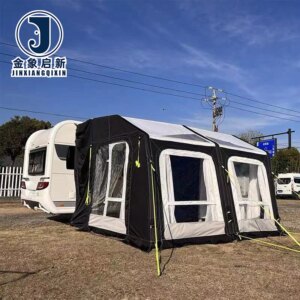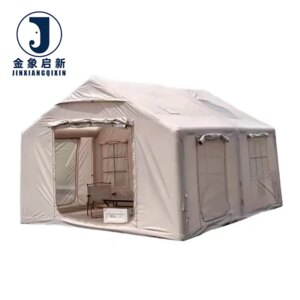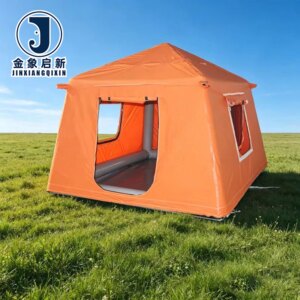
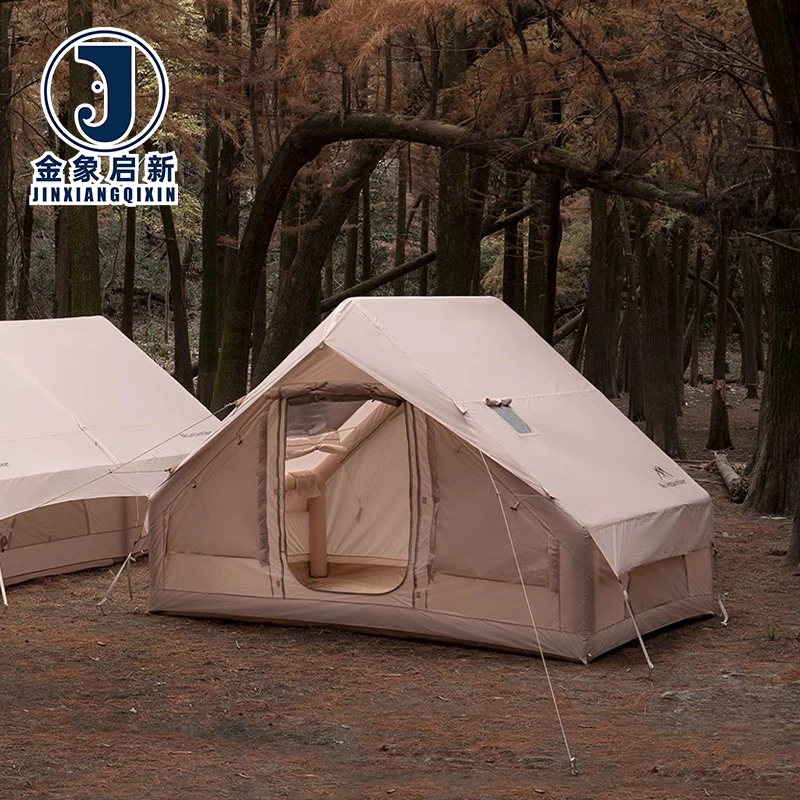
Coating Chemistry Control — Every roll of inflatable tent fabric PVC coated manufacturer output starts with base fabric denier matched to coating weight, ensuring seam adhesion holds under continuous pneumatic load rather than relying on generic stock.
Technical Specifications
| Parameter | Value |
|---|---|
| Product Type | Inflatable Tent |
| Core Material | PVC tarpaulin |
| Capacity | 1-12 Person |
| Season Rating | Four-Season |
| Opening Mechanism | Quick Automatic Opening (Inflatable) |
| Key Features | Waterproof, UV-resistant, tear-resistant, fire-retardant, anti-static |
| Fire-Retardant Treatment | Available — confirm grade required for your market |
| UV-Resistant Treatment | Available — confirm test basis for your deployment environment |
| Anti-Static Treatment | Available — confirm surface resistance standard required |
| Customization | OEM & ODM (size, material thickness, pattern printing, design) |
| Production Lines | 3 full production lines |
| Processing Equipment | 36 sets |
| R&D Team | 10 technicians |
| Quality Control | Full-process inspection, dedicated QA & QC staff |
| Standards | ISO9001, ISO14001, ISO45001, CE |
Application Suitability
| Application | Exposure & Requirement |
|---|---|
| Outdoor event facilities | Repeated inflation cycles, wind loading, UV exposure, crowd proximity requiring fire-retardant compliance |
| Mobile field stations | Extended seasonal deployment, temperature swings, structural rigidity under internal air pressure |
| Temporary workforce accommodations | Continuous occupancy, weather sealing, ventilation compatibility, abrasion from setup and breakdown |
| Emergency response shelters | Rapid deployment, transport abrasion, all-weather waterproof integrity, regulatory acceptance |
| Commercial outdoor operations | High-frequency use, UV degradation resistance, weld seam reliability under pneumatic stress |
Why Stating "Fire Retardant" Without a Grade Fails Your Inflatable Tent Fabric Project
A fire-retardant claim without a cited standard leaves your inflatable tent structure uncertifiable in most regulated markets.
Inflatable tent fabric PVC coated manufacturer specifications often list flame resistance as a feature, yet the test method, classification grade, and certification body remain absent from the documentation. When your local fire marshal or site safety officer asks for the test report, a generic claim provides no basis for approval. [NEED_CITE: fire classification standards for temporary structures and tents vary by jurisdiction]
The consequence is predictable: the structure arrives on site, installation proceeds, and then the inspection fails because the fabric certificate does not reference the standard your jurisdiction requires. This happens regularly when buyers accept marketing language in place of documented test grades tied to batch references.
Coating Adhesion Determines Whether Your Inflatable Beams Hold Pressure
The structural integrity of an inflatable tent depends entirely on whether the PVC coating bonds to the base fabric strongly enough to resist delamination under continuous internal pressure. When coating adhesion is insufficient, air beams develop soft spots at stress concentrations — typically near valve ports and beam junctions — long before the fabric itself shows wear. Material-level control over the coating process ensures the bond strength matches the tensile demands of pneumatic inflation.
Weld Compatibility Defines Production Yield for Tent Manufacturers
Commercial inflatable tent manufacturers heat-seal or RF-weld seams to create airtight beam structures and canopy joints. If the PVC coating formulation does not match your welding equipment’s temperature and dwell-time parameters, seams either fail to fuse or scorch through the coating layer. Sourcing inflatable tent fabric PVC coated manufacturer output with verified weld compatibility data reduces trial-and-error on your production floor and keeps rejection rates within acceptable limits. [NEED_CITE: heat-sealing parameter compatibility for PVC coated fabrics]
How Base Fabric Denier and Coating Weight Interact Under Inflation Load
The relationship between base fabric denier, weave density, and PVC coating weight determines how the material behaves when pressurized. A high-denier base fabric with insufficient coating weight may show adequate tensile strength on a test machine but fail at the weld line because the coating cannot transfer load across the seam. Conversely, excessive coating weight on a low-denier base creates a stiff panel that cracks at fold lines during packing and transport. The correct pairing depends on whether the fabric is used for inflatable air beams — which require flexibility and airtightness — or canopy panels, where dimensional stability and UV resistance dominate. Selecting the right GSM range for each component of the tent structure prevents over-engineering some areas while leaving others vulnerable to premature failure. Coating method also matters: knife-coated fabrics typically deliver higher adhesion strength than laminated alternatives, making them the preferred choice for welded inflatable structures where seam integrity is non-negotiable.
What Happens When Colour and Coating Weight Vary Between Rolls
Batch inconsistency in PVC coating weight or colour creates visible defects once multiple rolls are cut and assembled into a single inflatable tent structure. Panels welded side by side from different rolls may show shade variation that becomes obvious under daylight, forcing the manufacturer to reject entire sections or accept a product that looks mismatched to the end client. Coating weight variation between rolls also means that weld parameters optimized for the first roll may produce weak seams on the second, generating hidden failures that only surface during pressure testing or field deployment. [NEED_CITE: batch consistency requirements for coated fabric in commercial tent production] These problems compound when order volumes span multiple production batches, making pre-shipment verification of both colour reference and GSM essential before material leaves the factory.
Procurement Backed by Process Control, Not Marketing Claims
Each roll ships with a material specification sheet stating base fabric denier, coating type, and GSM, so you verify what you received against what was quoted. Fire-retardant and anti-static treatments are documented with the applicable test grade on request, tied to the specific batch reference rather than a generic product family claim. Pre-shipment inspection includes visual review, weight verification, and weld compatibility confirmation before dispatch, reducing surprises on your production floor. The R&D team of 10 technicians develops custom samples within days when your application requires non-standard thickness, colour, or printing. Production across 3 full lines and 36 sets of equipment supports volume orders while maintaining batch-to-batch consistency in coating weight and colour.
Documentation & Verification
- Material spec sheet stating GSM, base fabric denier, coating type, and treatment options per roll
- UV and fire-retardant test reports referencing batch number and applicable standard
- Pre-shipment inspection record covering weight verification, colour check, and surface quality
- ISO9001, ISO14001, ISO45001, and CE certificates covering production facility scope
- Roll packing list with individual roll weights, dimensions, and batch traceability codes
- Certificate of origin and customs documentation for international shipment
Fabrication, Handling & Storage
- Heat-seal test samples recommended before full production to confirm weld parameters match PVC coating formulation
- Store rolls upright on pallets to prevent flat-spot deformation that affects coating surface tension during welding
- Allow cold-transported rolls to acclimate to workshop temperature before unrolling to avoid coating micro-cracking
- Use compatible PVC adhesive for field repairs on inflatable beam seams, matching coating chemistry to the base material
- Plan cutting layout to minimize transverse welds on air beam sections where pneumatic stress concentrates
- Avoid dragging rolls on unprotected floors to prevent surface abrasion that compromises waterproof coating integrity
Requesting a Specification That Matches Your Deployment
Provide your target market’s fire safety classification requirements so we match the correct retardant grade and test documentation to your compliance framework. Specify whether you need fabric rolls for your own welding production or finished cut-and-sewn inflatable tent components, along with annual volume estimates and colour or printing requirements. Include the inflation pressure range and operating temperature envelope your structures encounter in the field, enabling a material recommendation that balances flexibility, coating weight, and seam strength for your specific application.
Frequently Asked Questions
Q: What GSM and denier are recommended for inflatable tent air beams versus canopy panels?
A: Air beams require higher denier base fabric with coating weight calibrated for airtightness and flexibility under pneumatic cycling. Canopy panels prioritize dimensional stability and UV resistance, often at a different GSM range. The optimal pairing depends on your inflation pressure and structural span — request a sample set covering both component types to test on your equipment.
Q: Are fire-retardant and anti-static treatments certified or just claimed?
A: Treatments are available in specific grades with test documentation referencing the applicable standard and batch number. Generic claims without cited grades do not satisfy regulatory inspections. Confirm the fire classification standard required in your deployment market so we supply the correct test report with your shipment.
Q: Can I get samples to test weld strength on my production equipment before bulk ordering?
A: Sample rolls are developed within days for custom thickness or coating formulations. We recommend welding test panels under your production parameters to verify seam strength and coating adhesion before committing to volume. This step eliminates parameter mismatch that causes seam failures during full-scale production.
Q: How is colour consistency maintained across multiple rolls in the same order?
A: Coating colour is controlled against a reference standard with inspection at each production stage. Pre-shipment records document colour verification per roll within your order batch. For large orders spanning multiple production runs, we schedule batch consolidation to minimize shade variation across the complete delivery.