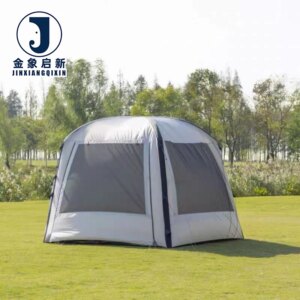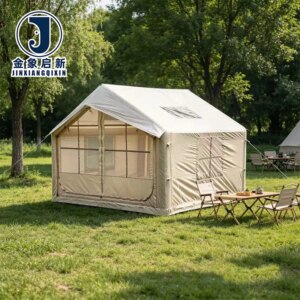
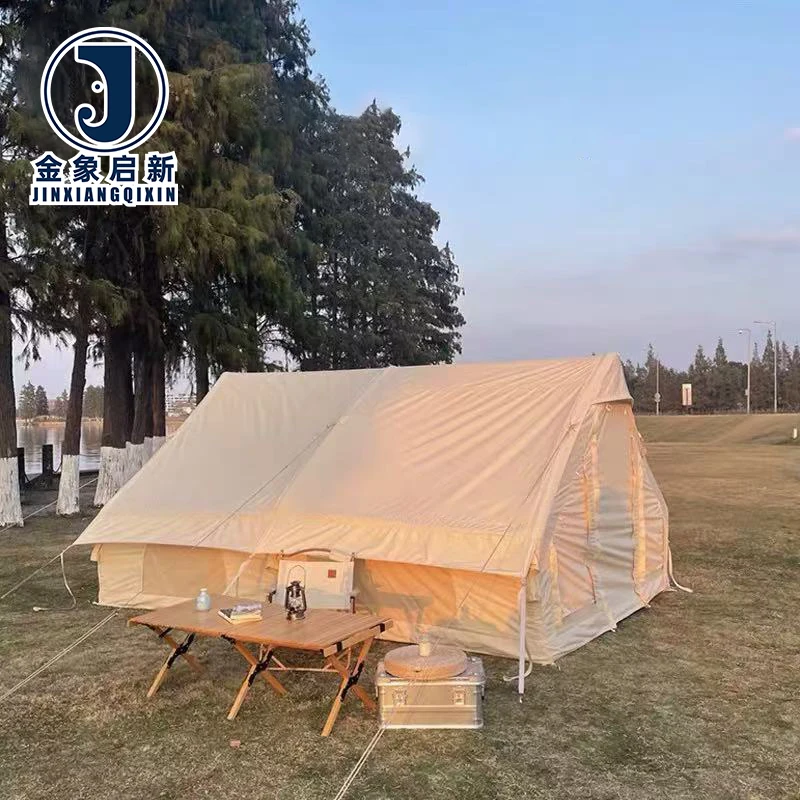
Deep process control over coating — verified through material specification sheets stating exact GSM, base fabric denier, and coating weight for every roll of inflatable tent fabric produced.
Technical Specifications
| Parameter | Value |
|---|---|
| Product Type | Inflatable Tent Fabric / PVC Tent |
| Core Material | PVC Tarpaulin |
| Waterproof | Fully coated waterproof construction |
| UV-resistant | Available in UV-resistant grades — confirm the grade required for your market |
| Tear-resistant | Tear-resistant construction — test basis available on request |
| Fire-retardant | Available in flame retardant grades — confirm the grade required for your market |
| Anti-static | Available in anti-static grades — confirm the treatment required for your site |
| Product Forms | Single Layer Construction, Extended Type |
| Customization Service | OEM & ODM, sample customization, pattern printing |
| Standards | ISO 9001, ISO 14001, ISO 45001, CE |
Application Suitability
| Application | Exposure & Requirement |
|---|---|
| Commercial glamping sites (four-season) | Year-round UV and weather exposure, repeated inflation cycles, guest safety compliance for fire-retardant fabric |
| Large-scale event accommodations | Rapid deployment and breakdown, high foot traffic abrasion, temporary structure fire codes |
| Industrial temporary shelters | Dust and chemical exposure, wind loading on inflated membranes, possible anti-static requirements in sensitive environments |
| Inflatable membrane structures | Continuous internal air pressure, seam integrity under flex, coating adhesion under thermal cycling |
Why Coating Weight Alone Fails Technical Buyers Specifying PVC Tarpaulin Material for Inflatable Tents
Coating weight without base fabric specification tells you nothing about how the material will behave under inflation pressure.
Technical buyers evaluating PVC inflatable tent aftermarket supplier options routinely receive quotations stating a single GSM figure. That number blends base fabric and coating into one value, making it impossible to judge whether tensile strength comes from a dense polyester weave or simply from a thick layer of plastisol. When an inflatable membrane is pressurised, the base fabric carries the structural load while the coating provides environmental protection — two entirely different functions that a single GSM figure obscures. [NEED_CITE: tensile and tear test methods for coated fabrics per ISO 1421]
Base Fabric Denier, Weave Density and Inflation Load
The structural backbone of any PVC inflatable tent aftermarket supplier fabric is the polyester base cloth. Higher denier yarns and tighter weave densities resist tearing when the membrane flexes under wind gusts or when internal pressure fluctuates during temperature changes. A loosely woven base fabric with heavy coating may register a high GSM on paper, yet the coating simply fills gaps in the weave rather than contributing meaningful tensile capacity. Buyers specifying material for four-season commercial glamping tents should request both base fabric denier and coating weight separately, not just a combined GSM total.
Coating Method and Its Effect on Seam Integrity
Knife-coated PVC tarpaulin builds the coating layer by layer directly onto the base fabric, creating a mechanical bond that resists delamination during high-frequency welding. Laminated constructions, by contrast, bond a pre-formed PVC film to the base cloth with an adhesive interlayer — adequate for static covers but vulnerable to peeling at welded seams when the inflatable structure cycles through pressurisation and deflation. For commercial inflatable tent applications where welded seams carry structural loads, knife-coated material provides superior peel strength and longer weld-line life. [NEED_CITE: peel strength testing for knife coated versus laminated PVC tarpaulin]
Specification Decisions That Determine Field Performance
Coating weight and base fabric density together define how this PVC inflatable tent aftermarket supplier material behaves in service. The coating method — knife coated versus laminated — determines whether welded seams hold through repeated inflation cycles or begin to peel after a season of thermal expansion and contraction. Available fire-retardant grades must be matched to the fire code enforced at the installation site, whether that is a European classification, an NFPA standard, or a local building authority requirement. Anti-static treatment becomes relevant when the tent is deployed near fuel handling, grain storage, or other environments where static discharge poses an ignition risk, and the treatment level should be confirmed against the applicable safety standard.
What Happens When Material Specifications Are Not Verified Before Production
A tent manufacturer orders fabric quoted at a specific GSM and receives rolls that measure lighter on arrival because the supplier blended base fabric weight and coating weight into one unverified figure. The inflatable membrane then under-performs under wind load, with seams pulling apart at the points of highest stress. Fire-retardant treatment is claimed on the purchase order but no test report accompanies shipment, leaving the commercial glamping operator unable to pass the local fire marshal inspection. Colour variation between production rolls becomes visible only after the tent panels are welded together side by side on site. [NEED_CITE: DIN 4102 fire classification for building materials]
Why Technical Buyers Source This Fabric Here
Nearly 30 years of focused production on coated fabric provides process control over coating adhesion and weight consistency that newer producers cannot match on their first production run. Three full production lines and 36 sets of professional processing equipment support the volume requirements of commercial tent fabricators ordering multiple container loads of roll stock. A dedicated 10-technician R&D team handles material selection, sample development, and pattern printing proofs before bulk production begins. Every roll undergoes dedicated QA and QC inspection at each production stage, with 100 percent pre-shipment verification of GSM and visual consistency. Material samples for custom formulations are developed within days, allowing technical buyers to test weld parameters and confirm coating weight before committing to a production order.
Documentation & Verification
- Material specification sheet stating GSM, base fabric denier and weave, and coating weight separately per roll
- Test reports for UV resistance and flame-retardant grades citing the specific standard applicable to your market
- ISO 9001, ISO 14001, ISO 45001 and CE certification documentation provided with each shipment
- Pre-shipment inspection record confirming weight verification and visual consistency against the approved sample
- Roll packing list with batch numbers for traceability across your production inventory
- Certificate of origin and customs documentation prepared for your destination country
Fabrication, Handling & Storage
- Set high-frequency welder dwell time to match the knife-coated PVC layer thickness for consistent seam peel strength
- Reinforce eyelet and tie-down zones with additional PVC patches bonded to the base fabric weave
- Store rolls horizontally on racks to prevent permanent creasing of the coated surface across the full width
- Allow material to acclimatise before unrolling in cold weather to avoid cracking the PVC coating at low temperature
- Use only PVC-compatible cleaners to avoid dissolving the surface coating treatment layer
- Match cutting layout to available roll widths to minimise welded seam count on the inflated membrane panels
Before You Request a Quote
Provide the operating environment and climate zone for your inflatable tent project so that the correct UV and fire-retardant grades can be specified from the start. Confirm the fire classification required by your local building authority or event licensing body, and whether anti-static treatment is mandated at the installation site. Indicate whether you need roll stock for your own fabrication facility or finished cut-and-welded panels, along with annual volume estimates to align production scheduling.
Frequently Asked Questions
Q: What base fabric and coating details are included in the material specification sheet?
A: The specification sheet states the base fabric denier, weave density, coating method, and coating weight separately rather than as a single blended GSM figure. This allows technical buyers to evaluate tensile and tear capacity independently from environmental protection properties, which is essential when specifying material for pressurised inflatable membrane structures.
Q: Which fire-retardant standards can this PVC tarpaulin comply with?
A: The material is available in multiple flame retardant grades. The specific standard — whether a European classification such as B1 per DIN 4102, NFPA 701, or another local requirement — must be confirmed at the inquiry stage so that the correct formulation is produced and the matching third-party test report is supplied with the shipment.
Q: How is UV resistance verified for long-term outdoor deployment?
A: UV-resistant formulations are available and the test basis can be provided upon request. Buyers operating commercial glamping sites in high-irradiance regions should confirm the required exposure duration and testing standard at the quotation stage so that the appropriate treatment level is applied and documented.
Q: How does knife coating versus lamination affect weld seam performance?
A: Knife coating builds the PVC layer directly onto the base fabric, creating a bond that withstands high-frequency welding without delamination. Laminated constructions rely on an adhesive interlayer that can peel under the cyclic stress of inflation and deflation, making knife-coated material the preferred choice for structural inflatable tent seams.
Q: Can coating weight and material thickness be adjusted for a specific project?
A: Yes. Coating weight, base fabric specification, and surface finish can all be adjusted through OEM and ODM customisation. A pre-production sample is developed within days so that buyers can verify weld parameters, confirm colour consistency, and measure coating weight before authorising bulk production.