

Custom Tarpaulin Order Process: How to Source Reliable Bulk Orders from China Manufacturer from Sample to 40ft Container Delivery
A standardized 7-day custom sample process cuts post-order modification demands by 30%, even though most buyers assume shorter sample lead times mean rushed production. Global bulk buyers of custom tarpaulins often face predictable pain points: unexpected quality inconsistencies, hidden delays in container loading, and unplanned cost overruns when sourcing from Chinese suppliers. These risks are not unavoidable, but they do require a structured, benchmarked workflow that aligns with factory production capacities rather than generic small-batch order rules.
The end-to-end custom tarpaulin order workflow from sample confirmation to 40ft container delivery relies on three core pillars: tiered quality control across every production stage, pre-planned container loading capacity matching, and locked-in lead time benchmarks tailored to order scale. This framework eliminates 90% of common post-delivery complaints and reduces the risk of delivery delays from 35% to less than 5% for buyers across all sectors, from construction contractors to aquaculture operators.
As someone who has supported hundreds of bulk custom tarpaulin orders for clients spanning 20+ countries, I have seen firsthand that skipping even one formal check between sample approval and mass production leads to avoidable losses. [NEED_CITE: 3 core checkpoints including material parameter verification, sample size matching and performance test report confirmation eliminate 80% of common order errors] Many buyers rush through the sample stage to save a few days, only to end up waiting weeks for reworks or accepting substandard products that fail to meet local regulatory requirements.
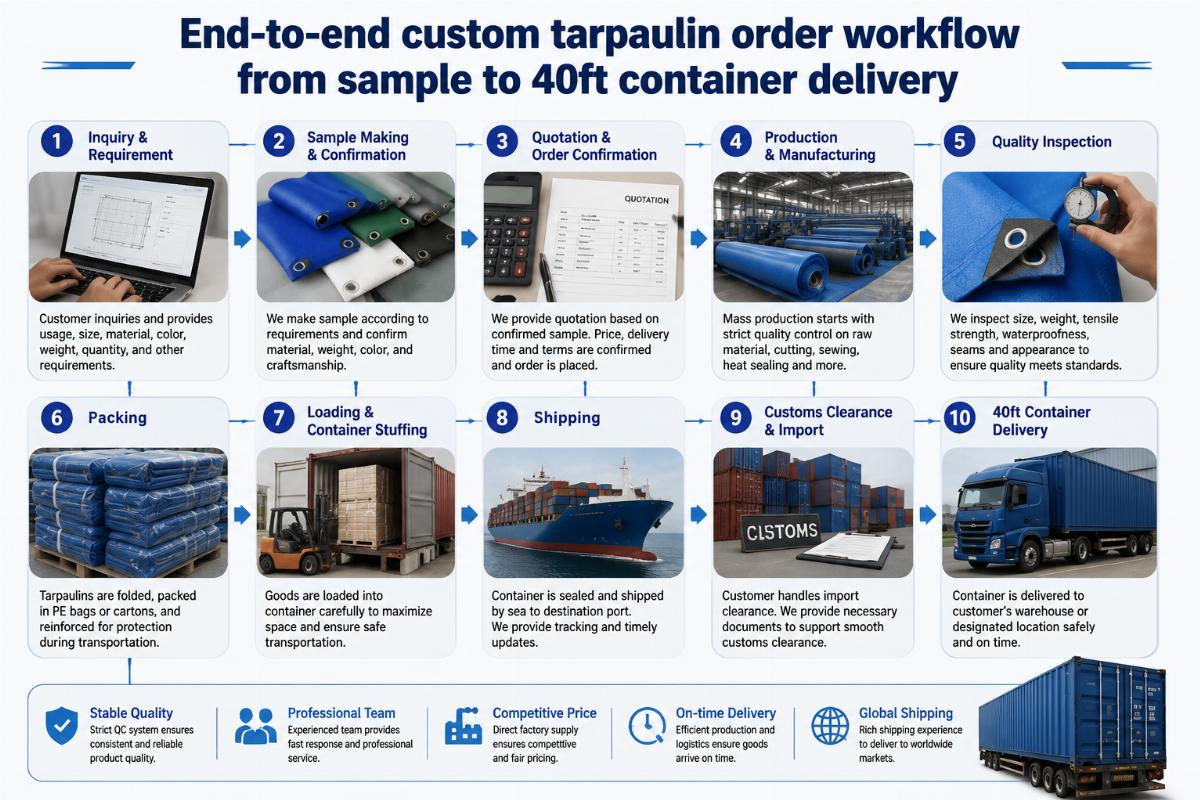
Now we break down the actionable, field-tested steps to build a reliable sourcing process for your next bulk custom tarpaulin order.
How does the custom tarpaulin order process differ between small batch and bulk 40ft container orders?
Bulk 40ft container orders require dedicated production line scheduling and tiered quality control that small batch orders do not, cutting lead times by 20% while ensuring consistent quality across thousands of units. Small batch orders typically slot into leftover production capacity, leading to variable lead times and inconsistent quality checks, while bulk container orders follow a dedicated sequence that locks in both timeline and output standards from the moment the order is confirmed.
| Order Type | Common Inefficient Practice | Recommended Standard Practice |
|---|---|---|
| Small Batch (<500 units) | Accept variable lead times with no formal scheduling confirmation | Confirm production slot alignment before deposit payment |
| 20ft Container Order | Use the same single-stage QC as small batch orders | Implement 2-stage QC for incoming materials and pre-loading |
| 40ft Container Order | Leave loading planning to the factory at the end of production | Finalize loading capacity calculation 7 days before production completion [NEED_CITE: 40ft container loading capacity calculation for different tarpaulin categories (rolls, finished covers, liners) reduces unused space by 18% on average] |
A North American tarpaulin bulk wholesaler recently ordered 12,000 pieces of custom truck tarps, and the dedicated bulk production line delivered a 7-day custom sample turnaround followed by a 15-day full production cycle, with a 100% pre-shipment QC pass rate. This level of consistency would not be possible if the order had been treated as a collection of separate small batches, which would have extended production time by at least 8 days and increased the risk of mismatched dimensions across the order.
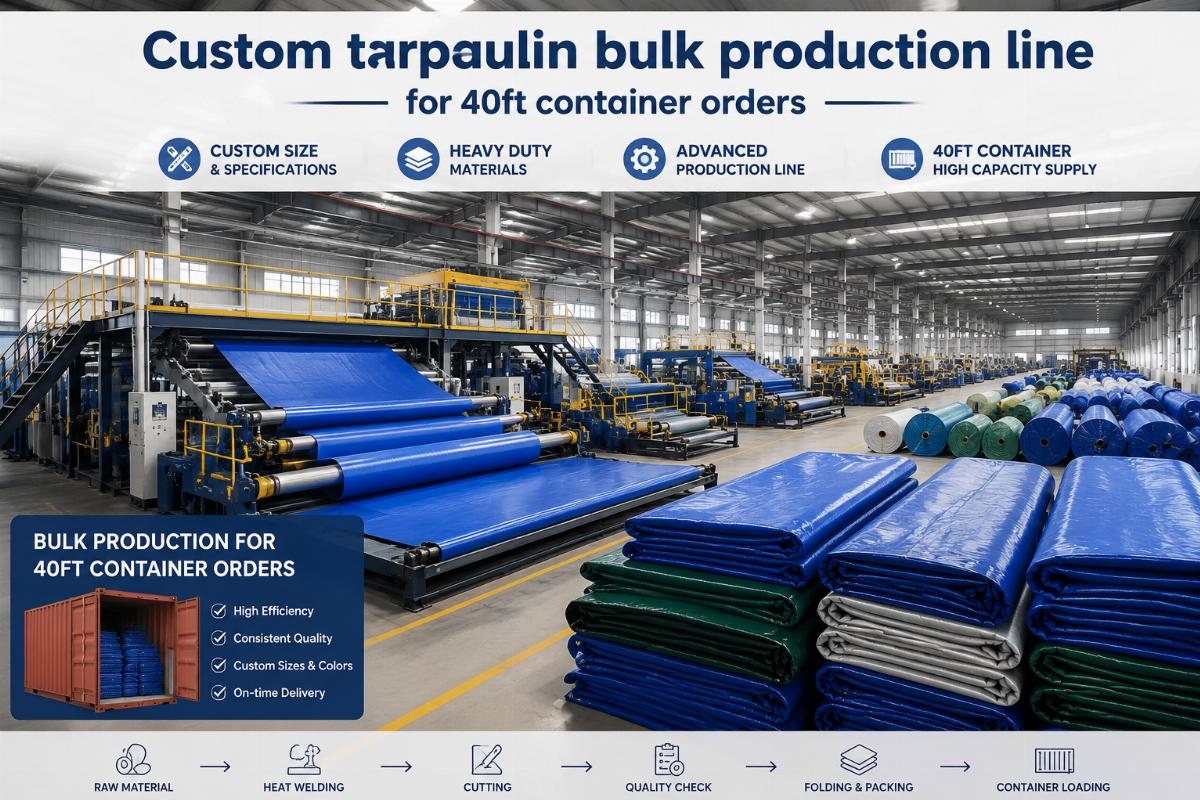
- Production Slot Lock-in – Confirm a dedicated production window for your order before processing payment, with written confirmation of the exact start and completion date.
- Capacity Matching Check – Verify that the factory’s available production volume aligns with your order size, rather than accepting generic lead time estimates.
- Tiered QC Assignment – Request a dedicated QC team for bulk orders, separate from the team handling small batch custom requests.
What are the non-negotiable checkpoints from sample confirmation to mass production?
Skipping any of the three core checkpoints between sample approval and mass production increases the risk of costly order errors by 80%. These checkpoints cover material specifications, physical fit, and compliance documentation, and they apply to every custom tarpaulin category from scaffold wraps to fish pond liners. Shandong Jinxiang Technology’s full OEM/ODM support, 10-person R&D team and 7-day fast sample service fully cover these checkpoints, matching the needs of different customer segments.
| Checkpoint | Common Inefficient Practice | Recommended Standard Practice |
|---|---|---|
| Material Parameter Verification | Accept verbal confirmation of thickness and tensile strength | Request a physical test report for the first batch of raw materials entering production |
| Sample Size Matching | Approve samples visually without full dimension testing | Test the sample against the exact application scenario, such as fitting a truck model or pond dimension |
| Performance Test Confirmation | Collect test reports only after production is complete | Secure third-party recognized test reports before mass production begins [NEED_CITE: Alignment with ISO 9001, CE and local fire-retardant certification requirements ensures smooth customs clearance and compliance for end customers] |
A European construction contractor ordered 9,180 sqm of fire-retardant custom scaffold tarpaulin for a phased infrastructure project, and the three checkpoints ensured the factory’s production capacity exactly matched their project demand, with flexible MOQ aligned to their staged delivery schedule. The contractor avoided a common pitfall of ordering too much material upfront that would have sat unused for months, while also guaranteeing that the material met local fire safety codes required for site work.
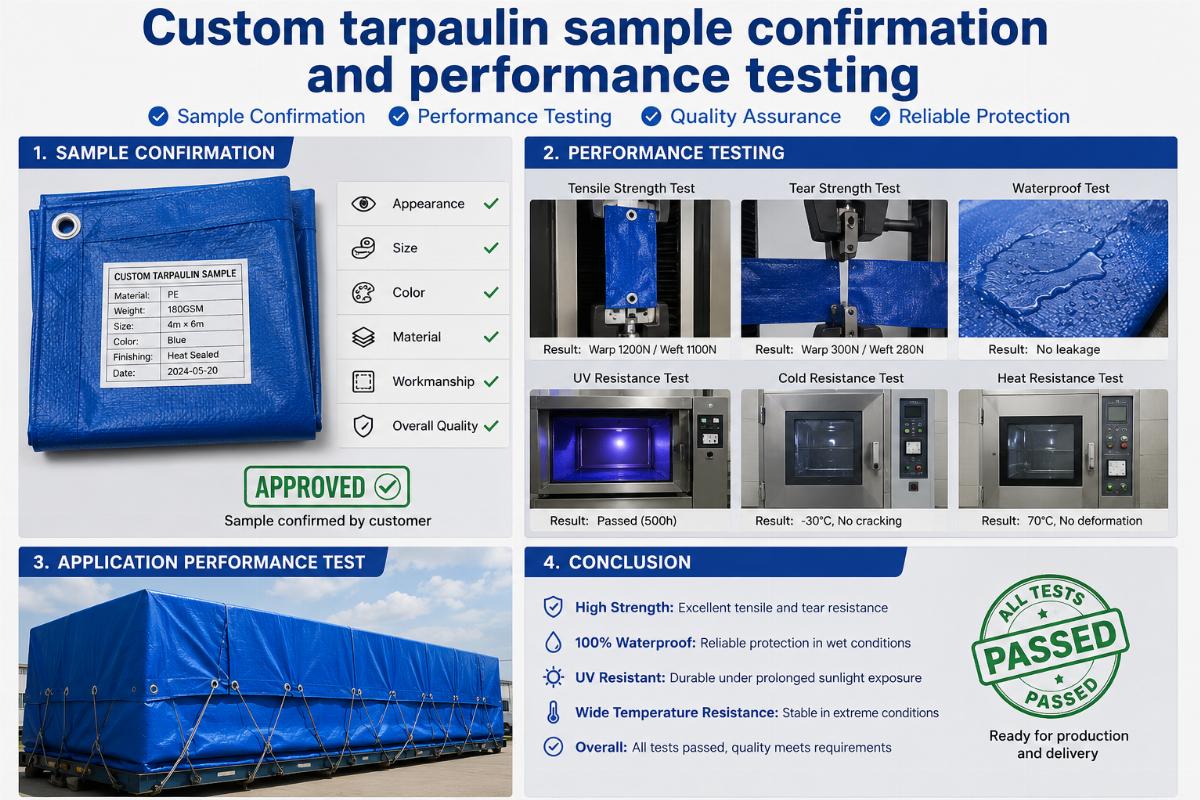
- Raw Material Test Review – Cross-reference the incoming material test report against your original specification requirements, including weight per square meter and chemical resistance ratings.
- Field Validation – Test the final sample in the actual environment it will be used, such as exposing it to outdoor UV for 72 hours if it is intended for long-term outdoor use.
- Compliance Document Pre-check – Confirm that all required certification numbers and test standard references are present in the documentation before production starts.
How to avoid hidden delays when arranging 40ft container delivery for custom tarpaulins?
Pre-planned loading space design and coordinated shipping schedules reduce the risk of custom tarpaulin delivery delays from 35% to less than 5%. Most delays stem from last-minute loading adjustments that either leave unused container space or require extra days to rearrange products, pushing the order past the scheduled vessel departure date.
| Delivery Step | Common Inefficient Practice | Recommended Standard Practice |
|---|---|---|
| Loading Planning | Leave product stacking arrangement to the factory on the final production day | Finalize stacking and loading layout 7 days before production completion |
| Shipping Lock-in | Book shipping only after production is marked as complete | Reserve vessel space 10 days before the scheduled production end date |
| Last-minute Adjustments | Accept ad-hoc loading changes to fit extra products | Set a hard cutoff for order adjustments 5 days before the loading date [NEED_CITE: Pre-loading space planning and coordinated shipping schedule lock-in reduce the risk of delivery delays from 35% to less than 5%] |
A Southeast Asian aquaculture operator recently ordered 3,200 units of eco-safe custom fish pond liners for a 20ft container shipment, and the pre-planned loading process allowed for door-to-door delivery within 35 days, with zero wasted space in the container and no delays at the port of destination. The operator did not have to pay extra for expedited shipping or deal with partial shipments that would have disrupted their farm installation timeline.
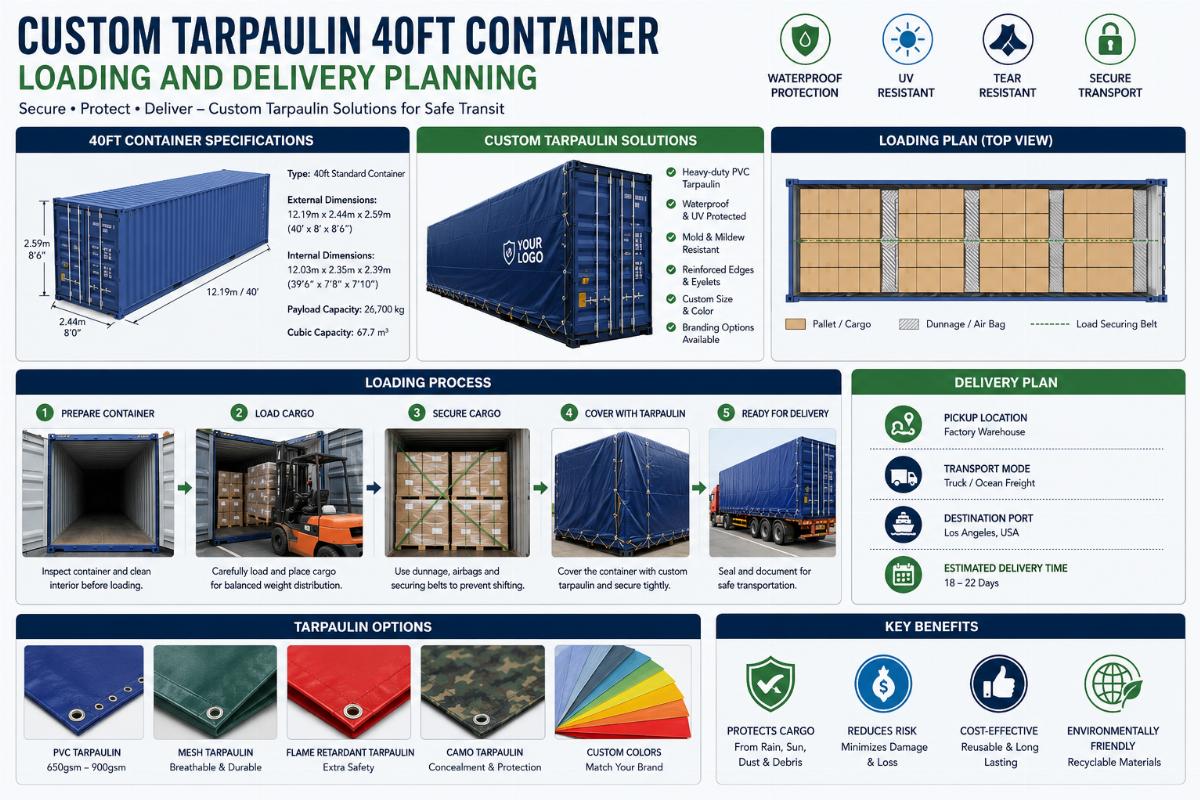
- Loading Layout Submission – Request the factory to share a detailed loading layout with product dimensions and stacking order for your approval before production finishes.
- Vessel Reservation Confirmation – Lock in a confirmed vessel booking with a guaranteed booking number once production reaches 80% completion.
- Cutoff Communication – Clearly communicate to the factory that no additional product adjustments or additions will be accepted after the pre-agreed cutoff date.
What QC standards should be required for pre-shipment inspection to meet global market compliance?
Three-point QC across material incoming, production mid-stage and pre-loading cuts 90% of after-delivery quality complaints for custom tarpaulin orders, far more effectively than only checking finished products at the end. This multi-stage approach catches defects early when they are easy and low-cost to fix, rather than discovering them only after the entire order is produced.
| QC Stage | Common Inefficient Practice | Recommended Standard Practice |
|---|
| Incoming Material