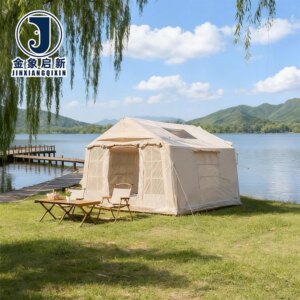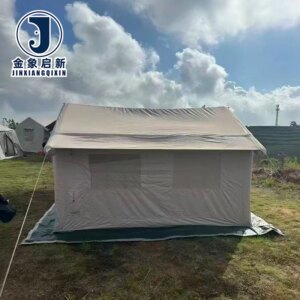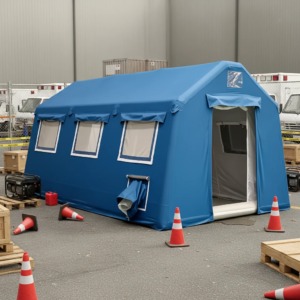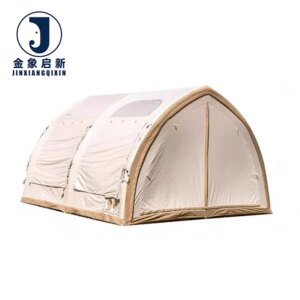
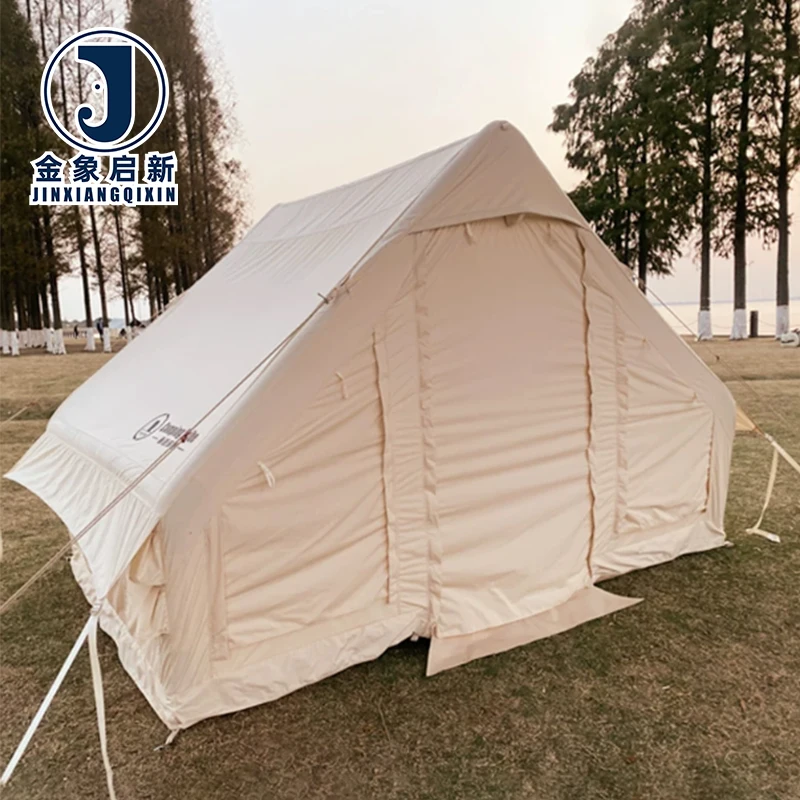
Coated Fabric Process Control — Nearly three decades of PVC coating expertise applied to inflatable tent fabric, with QA verification at every production stage to ensure batch consistency across your order.
Technical Specifications
| Parameter | Value |
|---|---|
| Product Type | Inflatable Tent Fabric |
| Core Material | UV Water-resistant PVC Fabric |
| Key Performance Features | Waterproof, UV-resistant, Tear-resistant |
| Product Form | Inflatable structure with single layer design |
| UV Protection Retention | 90% after 500 hours of accelerated weathering |
| Tear Resistance | Exceeds 300N in warp and weft directions (test basis not stated) |
| Wind Load Rating | Up to 12m/s (verify against final structure engineering) |
| Airtightness Test | Maintains pressure for 72 hours |
| Fabric Thickness Option | 0.3mm to 0.8mm (confirm the grade for your project) |
| Color | Khaki (custom Pantone matches available) |
| Customization Service | OEM & ODM, sample customization, pattern printing |
| Production Facility | 9,180 m² with 3 full production lines and 36 sets of equipment |
| R&D Team | 10 technicians supporting material selection and pattern development |
| Standards | ISO9001, ISO14001, ISO45001, CE |
Application Suitability
| Application | Exposure & Requirement |
|---|---|
| Commercial outdoor event management | High foot traffic, rapid deployment, sustained UV and rain exposure, branded visual appeal |
| Industrial site accommodations | Continuous occupancy, wind load on walls, temperature fluctuation, compliance documentation |
| Mobile exhibition spaces | Frequent packing and unpacking, crease resistance, custom print surface for branding |
| Construction site temporary shelters | Dust and debris abrasion, multi-season weathering, structural airtightness under load |
| Outdoor marketing activations | High-visibility print clarity, quick inflation and deflation, transport weight reduction |
Why Stated UV Performance Matters More Than a Label
Accelerated weathering data is the only way to verify that an inflatable tent fabric will hold up through a full commercial season.
Many suppliers label PVC material as UV-resistant without providing the test methodology or retention percentage behind that claim. For commercial operators deploying inflatable structures across multiple seasons, this gap means the fabric could degrade, lose tensile integrity, or fade visibly before the project timeline ends. When sourcing custom inflatable tent fabric, buyers need documented proof — not marketing language — to plan replacement cycles and justify material cost to project stakeholders. [NEED_CITE: ISO 4892 accelerated weathering methods for plastics and coated fabrics]
Material Formulation for Sustained Outdoor Deployment
The PVC coating on this inflatable tent fabric incorporates stabilized additives designed to maintain protective properties through prolonged sun exposure. Rather than relying on a surface treatment that wears away, the UV resistance is integrated into the coating matrix. This approach supports consistent performance across the entire fabric surface, including welded seams and cut edges where topical treatments often fail first. Buyers specifying material for four-season commercial structures can request the accelerated weathering report to confirm suitability for their regional climate conditions.
Single Layer Construction and Deployment Efficiency
A single layer design reduces overall material weight compared to multi-layer alternatives, making transport and field deployment more manageable for event crews and site installation teams. The weight reduction does not compromise structural airtightness — the fabric is tested to maintain inflation pressure over extended periods. This balance between portability and pressure retention is critical for applications where the structure must be erected and dismantled frequently. [NEED_CITE: airtightness testing standards for inflatable membrane structures]
Reading the Specs That Actually Define Performance
Tear resistance exceeding 300N in both warp and weft directions indicates the base fabric can resist propagation of a puncture or cut under load. This value matters more than tensile strength for inflatable structures, because the air pressure creates multi-directional stress that tests tear behavior rather than pure pull. Fabric thickness ranging from 0.3mm to 0.8mm gives buyers a selection band — lighter grades for temporary event structures, heavier grades for semi-permanent industrial shelters. The 72-hour airtightness test confirms that heat-welded seams hold pressure without leakage, which is the most common failure point in inflatable membrane construction. UV retention measured at 90% after 500 hours of accelerated weathering provides a benchmark for comparing this material against alternative suppliers.
What Happens When Specification Gaps Reach the Field
When tear resistance is not verified per roll, a puncture from site debris can propagate across an entire wall panel, forcing an unplanned structure replacement mid-project. If airtightness is not tested at the factory, slow leaks at welded seams may not appear until the structure is inflated on site — costing installation crews hours of troubleshooting. Batch color variation between rolls becomes visible once panels are joined side by side, undermining the professional appearance of branded exhibition spaces. [NEED_CITE: common failure modes in inflatable and membrane structure fabric]
Why This Production Setup Supports Your Specification
A 10-person R&D team handles material selection, Pantone color matching, and sample development specifically for inflatable applications — not generic tarpaulin conversion. Three full production lines with 36 sets of professional equipment mean your order runs on dedicated coating and finishing machinery, not shared lines where changeover contamination affects surface quality. Full-process QA and QC inspection covers coating weight, color consistency, and seam integrity before any roll ships. OEM and ODM capability extends from initial sample through pattern printing and finished panel cutting. ISO and CE certification accompanies documentation packages for customs and site compliance in regulated markets.
Documentation & Verification
- Material specification sheet confirming GSM, base fabric denier, and coating type per roll
- Accelerated weathering test report showing UV protection retention metrics
- Pre-shipment inspection record with 100% QA/QC verification per batch
- ISO9001, ISO14001, ISO45001, and CE certificates included with shipment
- Certificate of origin and customs documentation for international dispatch
Fabrication, Handling & Storage
- Heat-weld at manufacturer-recommended temperature to match the PVC coating formulation and avoid seam delamination
- Store rolls upright on pallets to prevent flat-spot creasing across the 0.3mm to 0.8mm thickness range
- Use compatible PVC adhesive for field repairs on punctures to maintain airtightness at the patch boundary
- Clean surfaces with mild detergent only — solvent-based cleaners can degrade the UV stabilizer package in the coating
- Allow fabric to reach ambient temperature before unrolling in cold conditions to prevent coating micro-cracking
How to Structure Your Inquiry
Provide your intended application, deployment duration, and regional climate conditions so the R&D team can recommend the appropriate fabric thickness grade. Specify whether you need rolls for your own fabrication line or finished panels cut to your structure dimensions. Include Pantone references or print artwork if custom color and branding are required, and state the compliance standards your end market demands.
Frequently Asked Questions
Q: What UV testing standard is used and how does it translate to outdoor service life?
A: The fabric undergoes accelerated weathering with UV protection retention measured at 90% after 500 hours. This data allows comparison against alternative materials, but actual outdoor service duration depends on regional solar intensity, deployment season, and whether the structure is permanently inflated or cycled. Request the full test report for your project engineer’s review.
Q: What customization is available for dimensions, color, and branding?
A: Fabric thickness from 0.3mm to 0.8mm is available depending on your structural requirements. Custom Pantone color matching and pattern printing are supported through the OEM/ODM service. Structural dimensions are cut to your specifications, and samples are developed for approval before bulk production begins.
Q: How is batch-to-batch color consistency maintained across multiple rolls?
A: Dedicated QA/QC staff verify color against the approved Pantone reference at every production stage. Rolls from the same production run are inspected side by side before packing. If your order spans multiple production runs, specify this requirement during inquiry so batch matching protocols are applied.
Q: What documentation accompanies each shipment for compliance?
A: Every shipment includes a material specification sheet, UV test report, ISO and CE certificates, pre-shipment inspection record, certificate of origin, and packing list. Additional documentation for specific market compliance can be arranged during the quotation stage.
Q: What are the heat-welding parameters for fabricating this inflatable tent fabric?
A: Welding temperature and dwell time depend on the specific thickness grade selected. The technical team provides recommended parameters with your sample approval package. Seam airtightness is validated during production, and the same parameters should be followed in your fabrication facility for consistent results.