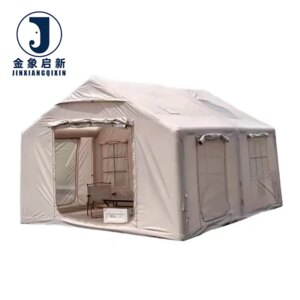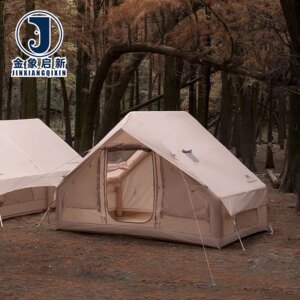
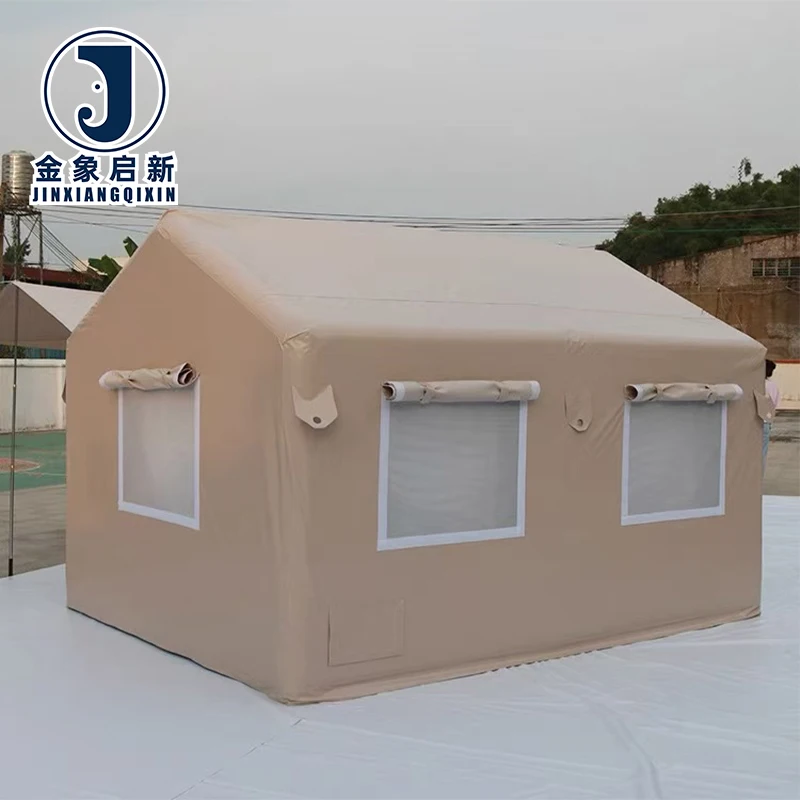
Precision coating control — Every roll of PVC inflatable tent fabric is backed by material specification sheets and test documentation, with dedicated QA at each production stage to verify coating weight and base fabric adhesion against your quotation.
Technical Specifications
| Parameter | Value |
|---|---|
| Product Type | Inflatable tent |
| Core Material | PVC tarpaulin |
| Material Thickness | 0.4mm–1.2mm |
| Size Range | 2–8 persons (customizable) |
| Construction | Single layer |
| Setup Mechanism | Quick automatic opening (inflatable) |
| Waterproof | Yes (test basis not stated in source) |
| UV-Resistant | Yes (test basis not stated in source) |
| Tear-Resistant | Yes (test basis not stated in source) |
| Flame Retardant | Yes (grade not stated in source) |
| Anti-Static | Yes (surface resistance or standard not stated in source) |
| Printing Option | Pattern printing available |
| Color Customization | Available |
| Reinforcement Options | Reinforced stress points, extended awnings (customizable) |
| Standards | ISO 9001, ISO 14001, ISO 45001, CE |
Application Suitability
| Application | Exposure & Requirement |
|---|---|
| Emergency response shelters | Rapid inflation cycles, harsh weather exposure, immediate deployment reliability |
| Construction site temporary enclosures | Wind loading, site debris abrasion, fire-retardant compliance for enclosed work areas |
| Logistics field operations | Frequent packing and unpacking, ground contact abrasion, variable climate storage |
| Disaster relief operations | Mass deployment, transport damage resistance, multi-environment weather protection |
| Outdoor equipment storage | Sustained UV exposure, moisture ingress prevention, theft deterrence through structural integrity |
| Agricultural field operations | Chemical contact from fertilizers, livestock proximity, seasonal re-deployment |
What "Flame Retardant" Means Without a Grade Behind It
A flame-retardant claim without a cited standard leaves your inflatable structure vulnerable at the inspection stage.
When sourcing PVC inflatable tent fabric, buyers frequently encounter quotations that state flame retardancy as a feature without referencing a specific test method or classification. On a construction site or at a public event, the fire marshal does not accept a general claim — they require documentation showing compliance with the local standard, whether that is DIN 4102, NFPA 701, or another regional framework. Material that arrives without this traceability may pass visual inspection but fail the compliance audit, forcing costly replacement mid-project. [NEED_CITE: fire classification standards for temporary inflatable structures vary by jurisdiction]
Coating Chemistry and Base Fabric Bonding
The performance of PVC inflatable tent fabric depends fundamentally on how the coating bonds to the base fabric. Coating weight and adhesion are controlled through the production process, where the PVC compound is applied to the polyester or nylon scrim under controlled temperature and pressure. A strong bond prevents delamination during repeated inflation and deflation cycles — a failure mode that compromises the airtight integrity of the inflatable beams. Our three full production lines and 36 sets of professional equipment maintain consistent coating application across batch runs, which matters when you are sourcing multiple rolls for a production run of inflatable structures.
Thickness, Tensile Behaviour and Structural Integrity
Material thickness in the 0.4mm–1.2mm range directly influences how the inflatable tent fabric responds to internal air pressure and external mechanical loads. Thinner gauges reduce packed weight and improve portability for emergency deployment scenarios, while heavier gauges provide greater resistance to puncture and abrasion at ground contact points. The tensile and tear behaviour of the coated fabric is a function of both the base fabric denier and the coating compound formulation — not thickness alone. When specifying PVC inflatable tent fabric for industrial applications, the relationship between these variables determines whether the structure holds pressure under wind loading or develops stress fractures at the weld lines. [NEED_CITE: tensile and tear test methods for coated fabrics per ISO 1421]
How Coating Weight, Base Fabric Density and Treatment Interact
Coating weight and base fabric density work together to define the mechanical performance envelope of the material. A heavier coating does not automatically produce higher tear strength if the underlying scrim has low denier or loose weave construction. The base fabric provides the structural skeleton, while the PVC coating delivers environmental protection, airtight sealing and surface durability. For inflatable tent applications, the coating must remain flexible enough to fold repeatedly without cracking, yet rigid enough to maintain beam geometry under pressure. Available in flame-retardant grades — confirm the grade required for your market — and with anti-static treatment options, the material can be configured to meet specific regulatory environments. Surface finish options affect cleanability and print receptivity; pattern printing is available for branding or visibility requirements. The single-layer construction balances durability with the portability needed for rapid inflatable deployment across field operations.
The Hidden Cost of Misaligned Material Specification
Selecting material based on a single parameter — coating weight or thickness alone — creates failure points that surface only after the inflatable structure enters service. A fabric that meets the quoted GSM but lacks adequate base fabric density will show premature tearing at the weld seams, where stress concentrates during inflation. Flame-retardant treatment claimed without a test result to support it becomes a liability when the site safety officer requests documentation. Colour varying between rolls in the same order becomes visible once multiple inflatable units are deployed side by side at a single site. Welded seams failing before the fabric does represents a specification imbalance between coating adhesion and base fabric strength. These failures do not appear in sample evaluation — they emerge under operational cycling. [NEED_CITE: welded seam integrity relative to coating adhesion in inflatable fabric structures]
Why Source Inflatable Tent Fabric Here
Nearly 30 years of focused production on coated fabric has produced deep process control over coating weight and adhesion — the two variables that determine whether your inflatable tent fabric performs through repeated deployment cycles. Three full production lines with 36 sets of professional equipment support bulk capacity while maintaining roll-to-roll consistency across your order. A 10-person R&D team handles material selection, thickness configuration and sample development, returning samples within days for custom requirements. Dedicated QA and QC personnel conduct inspection at every production stage, with 100% pre-shipment inspection before dispatch. Customization capability extends across the 0.4mm–1.2mm thickness range, colour matching, pattern printing and reinforcement specification — all supported by ISO 9001, ISO 14001, ISO 45001 and CE documentation.
Documentation & Verification
- Material specification sheet stating GSM, base fabric composition and coating compound for each roll
- Test reports for UV resistance and flame-retardant grades where applicable to your market requirements
- ISO and CE certificates provided with shipment documentation package
- Pre-shipment inspection record with dimensional and visual verification against your order specification
- Certificate of origin and customs documentation supporting international shipment clearance
Fabrication, Handling & Storage
- Heat-weld parameters must be matched to the specific coating thickness within the 0.4mm–1.2mm range to avoid seam failure at inflation stress points
- Reinforce stress points and beam junctions with additional fabric patches bonded using compatible PVC adhesive and heat activation
- Store rolls upright on pallets in a dry, shaded environment to prevent compression marks and surface adhesion between layers
- Avoid deploying material below the rated temperature flexibility threshold to prevent coating cracking at fold lines
- Clean surfaces with mild detergent compatible with PVC coating chemistry; avoid solvent-based cleaners that degrade the coating bond
- Field repairs to punctures require PVC-compatible patch material and heat-activated bonding for airtight integrity restoration
Request a Specification Proposal
Provide your target application environment, required thickness range within the 0.4mm–1.2mm spectrum, and any specific regulatory standards your end market mandates for flame retardancy or anti-static performance. Indicate whether you require raw fabric rolls for your own fabrication line or finished inflatable tent units with custom sizing for 2–8 person capacity. Colour requirements, pattern printing specifications and reinforcement preferences should be included in your initial inquiry to accelerate sample development and quotation turnaround.
Frequently Asked Questions
Q: How is the coating weight and GSM verified on arrival against the quotation?
A: Each shipment is accompanied by a pre-shipment inspection record documenting actual measurements taken during the 100% inspection process. The material specification sheet included with your documentation states the verified GSM, base fabric composition and coating weight per roll. Our dedicated QA team conducts verification at every production stage before release for dispatch.
Q: What test basis supports the UV-resistant and flame-retardant claims?
A: UV-resistant and flame-retardant treatments are available with test documentation — confirm the specific grade and standard required for your target market. Test reports are provided where applicable, citing the relevant testing methodology. We recommend specifying your regulatory framework at the inquiry stage so the appropriate treatment level and documentation package can be prepared.
Q: How does the PVC coating adhesion perform under repeated inflation and deflation cycles?
A: The coating-to-base-fabric bond is controlled through our production process with consistent application across all three production lines. Adhesion performance is verified during pre-shipment inspection. For applications involving high-frequency deployment cycles, we recommend discussing your specific usage pattern so the appropriate coating formulation and thickness within the 0.4mm–1.2mm range can be specified.
Q: What custom thickness, colour and printing options are available for inflatable tent fabric?
A: Material thickness is customizable across the 0.4mm–1.2mm range to balance portability against durability requirements. Colour customization and pattern printing are available, with batch consistency maintained across your order quantity. Reinforcement options including stress point reinforcement and extended awnings can be integrated during fabrication. Samples are developed within days for approval before bulk production.
Q: How are welded seams tested to ensure they outlast the fabric at flex and stress points?
A: Welded seam integrity is inspected as part of our full-process quality control system, with dedicated QA staff verifying bond strength at critical junction points. The relationship between coating adhesion and base fabric strength is managed through our production parameters to prevent premature seam failure. Pre-shipment inspection records document the verification results for each production batch.