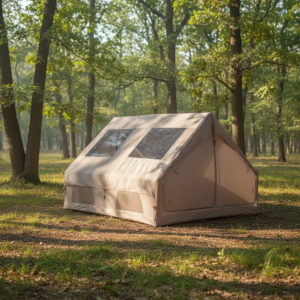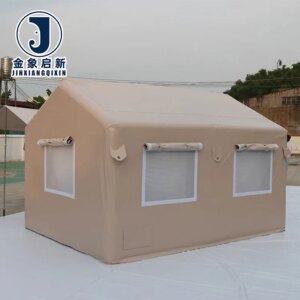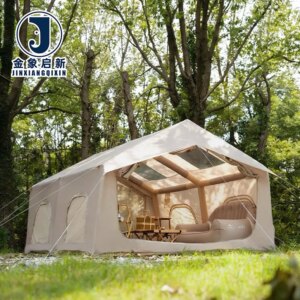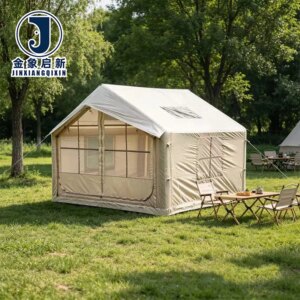
Material and Coating Technology Focus — Deep process control over coating weight, base fabric adhesion, and surface treatment for inflatable structure fabric, validated at every production stage before dispatch.
Technical Specifications
| Parameter | Value |
|---|---|
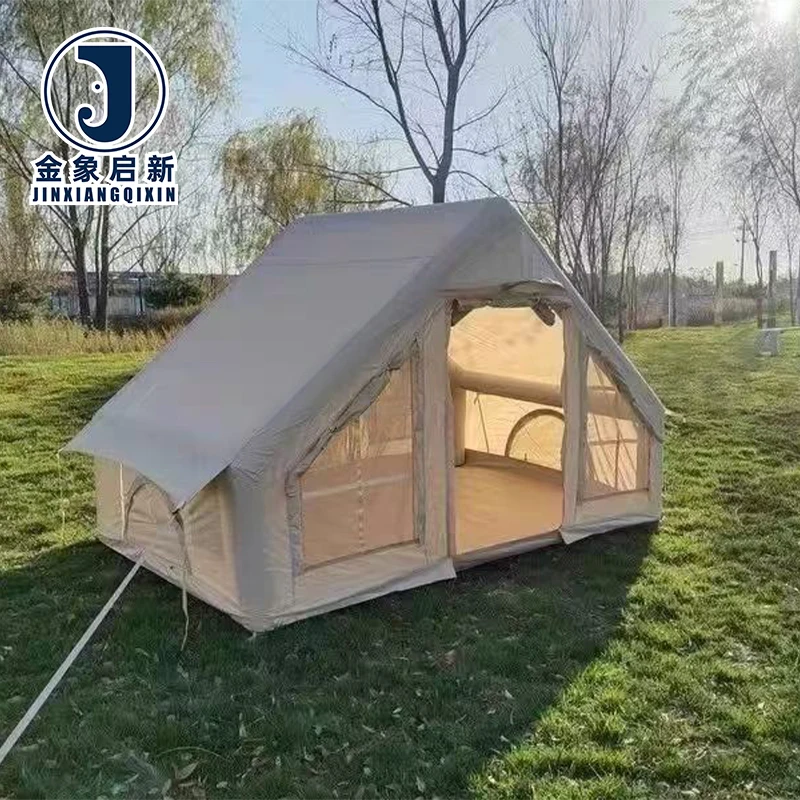
| Product Type | Inflatable Tent |
| Core Material | PVC Tarpaulin |
| Waterproof Rating | Waterproof (grade not stated in source) |
| UV Treatment | UV-resistant (test basis not stated in source) |
| Flame Retardant Grade | Fire-retardant (grade not stated in source) |
| Anti-Static | Anti-static (standard not stated in source) |
| Tear Resistance | Tear-resistant (standard not stated in source) |
| Product Forms | Inflatable structure with quick automatic opening mechanism |
| Structure Type | Single-layer |
| Customization Service | OEM & ODM — sample customization, pattern printing, material selection, product design |
| Standards | ISO 9001, ISO 14001, ISO 45001, CE |
Application Suitability
| Application | Exposure & Requirement |
|---|---|
| Temporary site command centers during infrastructure projects | Prolonged UV radiation, wind loading, frequent inflation and deflation cycles, rapid setup under project deadlines |
| Equipment storage shelters in remote construction zones | Dust ingress, moisture exposure, temperature fluctuation, abrasion from equipment movement |
| Mobile workshop facilities for field operations | Welding spark proximity, chemical contact from maintenance fluids, repeated structural stress at inflation points |
| Emergency response stations for disaster recovery logistics | All-season weather exposure, rapid deployment urgency, transport abrasion during repeated relocation |
| Extended outdoor exposure in harsh weather conditions | Continuous moisture contact, UV degradation risk, thermal expansion and contraction of the PVC membrane |
What "Fire-Retardant" Means Without a Verified Grade for Inflatable Tent Fabric
Compliance on paper is not compliance on site — the grade must match the jurisdiction where the inflatable shelter will be inflated.
Procurement teams sourcing PVC inflatable tent fabric for emergency shelters and industrial field operations frequently discover that a generic "fire-retardant" label does not satisfy the local fire marshal, the mine safety inspector, or the project HSE officer. The fabric may have been treated, but without a test report referencing a recognized standard — whether DIN 4102, NFPA 701, or a regional equivalent — the inflatable tent fails the compliance gate before it is ever inflated. [NEED_CITE: fire classification standards for temporary structures and membrane fabrics] This is not a paperwork inconvenience; it halts project mobilisation, delays disaster response deployment, and exposes the buyer to contractual penalties. We supply material test data and certifications to match the specification you require, so you confirm the grade needed for your market before production begins.
Coating Adhesion and the Weld Line on Inflatable Structures
Inflatable tent fabric demands reliable coating adhesion because the structural integrity of the entire shelter depends on heat-welded seams holding air pressure continuously. PVC tarpaulin used for inflatable applications must maintain a consistent coating bond across the full roll surface so that high-frequency or hot-air welding produces uniform seam strength. Any variation in coating weight or plasticiser migration at the weld interface creates a failure point that will reveal itself the first time the structure flexes under wind load or internal pressure changes. Our coating process is controlled to maintain adhesion consistency, and every batch undergoes inspection before it reaches the fabrication stage.
Anti-Static Treatment and Its Role in Industrial Safety Compliance
For inflatable shelters deployed in mining, tunnelling, or fuel-handling environments, anti-static performance is not an optional specification — it is a site-access requirement. Static charge accumulation on the PVC membrane surface can attract combustible dust or create discharge events in volatile atmospheres. Available in anti-static grades, the PVC inflatable tent fabric we produce can be formulated to address these risks, but the specific standard your site enforces must be confirmed before we finalise the treatment. [NEED_CITE: anti-static requirements for temporary structures in hazardous zones] This confirmation step prevents the costly scenario where a shelter arrives on site and is rejected during the safety audit.
Reading the Specification Sheet Beyond the Surface Claims
Base fabric denier and weave density interact with coating weight to determine how the inflatable tent material behaves under tension and at stress concentration points. A heavier coating does not automatically mean higher tear resistance if the base fabric has a loose weave; conversely, a tightly woven base with insufficient coating will resist tearing but may allow water penetration at flex points. The single-layer inflatable structure relies on the membrane carrying all structural and environmental loads simultaneously, so the balance between tensile strength from the base yarn and waterproof integrity from the PVC coating must be specified as a system. Surface finish — whether glossy or matte — affects not only appearance but also cleanability in the field and the adhesion of printed patterns for branding or safety markings. Fire-retardant grades vary significantly between markets, and selecting the correct chemistry during compounding avoids the need for post-production topical treatments that can compromise the hand feel and weldability of the PVC inflatable tent fabric.
The Hidden Cost of Specifying Without Test Data
Buyers who accept a quotation based on stated treatment claims — without requesting the corresponding test report — often discover the gap only when the inflatable shelter is inspected on site. A fire-retardant treatment that lacks a recognised grade reference means the HSE officer cannot sign off, the emergency response agency cannot deploy the shelter, and the entire procurement cycle restarts. Colour variation between rolls in the same order becomes visible when multiple inflatable units are erected side by side at a disaster relief staging area, undermining the professional appearance of the response operation. Welded seams that fail before the fabric itself tears indicate a process mismatch between the coating formulation and the welding parameters used by the fabricator. [NEED_CITE: common failure modes in coated fabric seams for inflatable structures] These are not theoretical risks; they are the documented complaints that arrive after the material has already been shipped and paid for.
Why Procurement Teams Source Inflatable Tent Material Here
Deep process control over coating weight and adhesion means the PVC tarpaulin we supply behaves predictably when your fabrication team sets welding parameters — no trial-and-error on the shop floor. Three full production lines and 36 sets of professional equipment support bulk roll output with consistent coating application across the entire production run. A 10-person R&D team handles material selection, sample development, and structural design adaptation, so custom thickness or formulation requests move from inquiry to approved sample without delay. Dedicated QA/QC staff conduct 100 percent inspection at every production stage, catching coating weight deviations and surface defects before the roll is packed. Pre-production samples are developed within days, giving you physical confirmation of colour, finish, and weld behaviour before mass manufacturing begins.
Documentation & Verification
- Material specification sheet detailing PVC coating weight, base fabric denier, and weave density for your inflatable structure design
- Test report for fire-retardant and anti-static grades supplied per batch — confirm the standard required for your market before ordering
- Pre-shipment inspection record confirming coating adhesion, colour consistency, and surface quality across all rolls
- ISO 9001, ISO 14001, ISO 45001, and CE certificates included for import compliance and project audit trails
- Certificate of origin and customs documentation prepared to match the destination country’s import requirements
- Roll packing list specifying net weight, roll dimensions, and batch traceability codes for warehouse receipt
Fabrication, Handling & Storage
- Heat-weld PVC inflatable tent fabric at temperatures matched to the specific coating formulation — request our recommended parameter sheet
- Store rolls horizontally on padded racks to prevent permanent creasing in the PVC coating layer
- Allow cold-stored rolls to reach ambient temperature before unrolling to avoid coating micro-cracking
- Use compatible PVC adhesive for field repairs on single-layer inflatable structures — solvent-based contact cement recommended
- Clean the membrane surface with mild detergent; avoid abrasive pads that damage the coating finish
- Plan cutting layouts to minimise transverse welds on the inflatable panels, as each seam is a potential pressure-loss point
Inquiry Guidance for Inflatable Shelter Material
Provide the intended deployment environment — including temperature range, UV exposure duration, and any fire or anti-static compliance standards enforced at the site. Specify the required roll width, colour reference, and whether you need finished cut sizes or full rolls for in-house fabrication. If pattern printing or branding is required, share the artwork and confirm the surface finish preference to ensure ink adhesion. Indicate your annual volume estimate so we align production scheduling and batch consistency controls to your delivery windows.
Frequently Asked Questions
Q: What fire-retardant and anti-static test standards can be supplied for site inspections?
A: We supply test reports referencing the specific standard your site requires. Fire-retardant grades and anti-static treatment are available, but the exact classification — such as DIN 4102, NFPA 701, or a regional equivalent — must be confirmed by your HSE team before we finalise the formulation. Share your site’s compliance documentation so we match the correct grade to your inflatable shelter order.
Q: How do I select the right material thickness for different inflatable structure pressure requirements?
A: Material thickness and base fabric denier together determine how the PVC membrane withstands internal inflation pressure and external wind loading. Higher-pressure structures typically require a denser base fabric with sufficient coating weight to maintain air retention. Our R&D team reviews your structural design and recommends a specification, then produces a sample for your engineering validation before mass production.
Q: What is the sample approval process and lead time for custom inflatable tent orders?
A: Once you confirm the specification — including colour, coating treatment, and dimensions — our R&D team develops a pre-production sample within days. You evaluate the sample for weld behaviour, colour accuracy, and surface finish. After your written approval, mass manufacturing begins. This step prevents batch-level discrepancies from reaching your fabrication floor.
Q: How is batch consistency controlled for colour and coating weight across large-volume orders?
A: Every production run is monitored by dedicated QA/QC staff at each stage, with coating weight verified against the stated specification. Colour consistency is checked across rolls within the same batch using controlled lighting conditions. Pre-shipment inspection records document these checks, so you receive traceable quality data with your inflatable tent fabric delivery.
Q: What customisation options are available for sizing, printing, and structural design?
A: Full OEM and ODM capability covers roll width, cut size, pattern printing, and material formulation adjustments. We adapt the PVC tarpaulin specification to your inflatable structure design — including surface finish for print adhesion and coating formulation for specific welding methods. Share your design drawings and branding artwork, and our team will confirm feasibility and produce a sample.