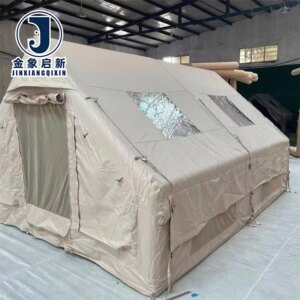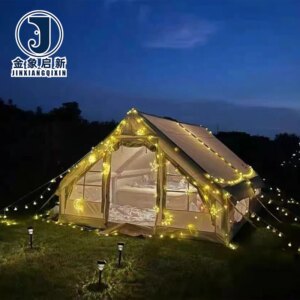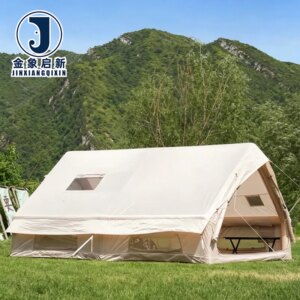
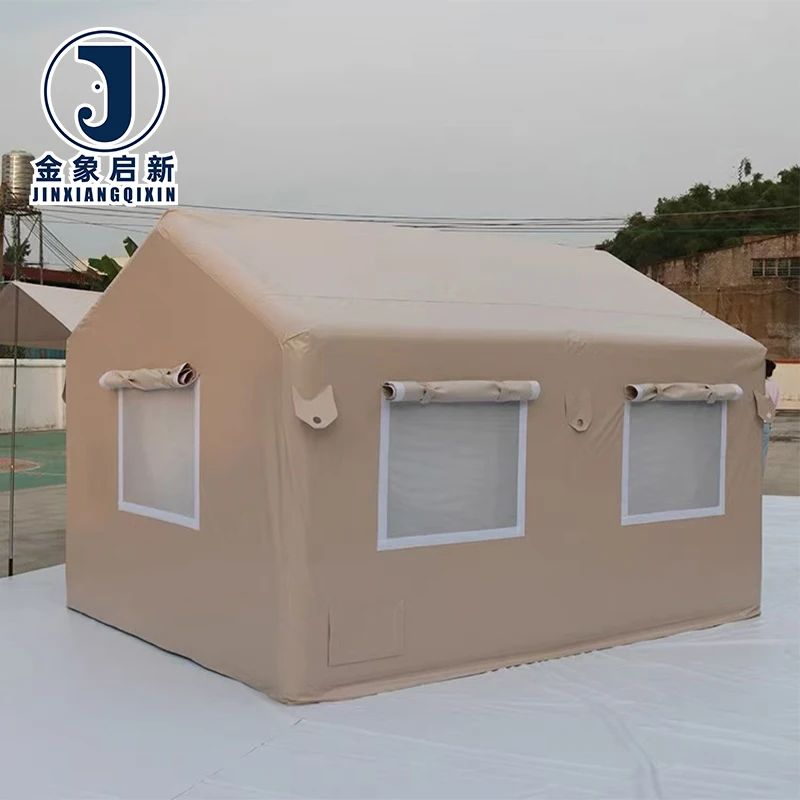
Coated Fabric Process Control — Batch-level GSM and coating weight verification applied to every roll of inflatable tent fabric before dispatch.
Technical Specifications
| Parameter | Value |
|---|---|
| Product Type | Inflatable Tent |
| Core Material | PVC tarpaulin |
| Waterproof | Yes — fully coated construction |
| UV Treatment | Anti-UV treatment applied (test basis available on request) |
| Flame Retardant | Available in flame retardant grades — confirm the grade required for your market |
| Anti-Static | Available with anti-static treatment — confirm the standard required for your environment |
| Tear Resistance | Tear-resistant PVC construction (test standard available on request) |
| Capacity | 8–10 Person |
| Opening Mechanism | Quick Automatic Opening |
| Season Rating | Four-Season |
| Customization | OEM & ODM — sample customization, pattern printing, custom sizing |
| Certifications | ISO 9001, ISO 14001, ISO 45001, CE |
Application Suitability
| Application | Exposure & Requirement |
|---|---|
| Temporary site offices at construction projects | Continuous outdoor weather exposure, wind loading on inflated structure, UV degradation risk |
| Equipment storage shelters on industrial sites | Moisture ingress prevention, puncture resistance from handling, temperature fluctuation |
| Emergency response command centers | Rapid deployment requirement, reliable inflation seal integrity, all-weather protection |
| Temporary event venues and commercial outdoor operations | High foot traffic abrasion at entry points, repeated inflation/deflation cycles, visual consistency |
What "Flame Retardant" Means Without a Grade Behind It
Specify the test standard your jurisdiction requires before ordering — a generic claim does not pass a site inspection.
When a PVC inflatable tent fabric is labelled flame retardant without a named grade, procurement teams discover the gap at the worst possible moment: the fire safety officer on site asks for the certificate, and the document does not match the local building code. Industrial shelters used as temporary offices or command centers must meet the fire classification enforced in the project’s jurisdiction, whether that is DIN 4102, NFPA 701, or a regional equivalent. An Inflatable Tent Fabric manufacturer that supplies material without batch-level test documentation leaves the buyer carrying the compliance risk. [NEED_CITE: fire classification standards for temporary structures in construction and events]
Coating Integrity Across Inflation Cycles
An inflatable tent relies on air pressure to maintain structural form, which means the PVC tarpaulin must hold a consistent seal at every welded seam through repeated pressurization and deflation. The coating adhesion to the base fabric determines whether micro-cracks develop along stress lines after multiple setup cycles. Our PVC Inflatable Tent aftermarket supplier process controls coating weight and base fabric bonding at each production stage, with in-process QA checks before the material moves to finishing. This is what separates a shelter that holds pressure on its fiftieth deployment from one that begins leaking at the seams.
Four-Season Material Behaviour
A four-season inflatable shelter must perform when temperatures drop and the PVC compound stiffens, as well as when summer UV exposure accelerates surface degradation. The anti-UV treatment applied to this fabric slows the loss of tensile strength and surface chalking that untreated PVC exhibits after sustained sun exposure. Buyers operating in regions with wide seasonal temperature swings should request the UV test basis documentation to confirm the treatment level matches their expected deployment duration. [NEED_CITE: UV degradation mechanisms in plasticized PVC compounds]
Reading the Specification Sheet Beyond GSM
GSM tells you the total weight per square metre, but it does not reveal how that weight is distributed between the base fabric and the coating layers. A PVC tarpaulin with a high GSM achieved mostly through heavy coating but a low-denier base fabric will show adequate stiffness yet underperform in tear propagation resistance. The weave density and yarn denier of the base cloth govern how well the material resists a puncture from spreading into a structural failure. For inflatable tents, where a single tear can compromise the entire air beam, understanding the relationship between base fabric construction and coating weight is essential — a specification sheet that lists only GSM leaves critical gaps in the buyer’s evaluation. The coating method also affects weldability: knife-coated PVC typically delivers higher peel strength at welded seams compared to laminated alternatives, which matters when an inflated structure places continuous tension on every joined edge.
The Hidden Cost of Specifying on Price Alone
When inflatable tent fabric is selected primarily on quoted GSM and unit cost, the failure pattern tends to appear in the field rather than in the sample approval stage. A coating that is thinner than specified will allow the base fabric to absorb moisture at cut edges, leading to delamination that starts at welded seams and propagates under inflation pressure. Flame retardant grades that lack supporting test reports create a different risk: the material passes a visual inspection but fails when the site safety audit demands documentation. Buyers who have received inconsistent rolls within a single shipment report visible colour variation once the shelters are erected side by side at an event or site. [NEED_CITE: coating adhesion failure modes in welded PVC structures]
Why Source Inflatable Tent Fabric Here
Nearly 30 years of focused PVC coated fabric production means the coating formulation and base fabric selection for inflatable applications are refined from long production history, not adapted from unrelated product lines. Three full production lines and 36 sets of professional processing equipment give the capacity to deliver consistent output across container-volume orders without splitting batches across different machines. A 10-person R&D team handles material selection, pattern printing, and sample development for OEM and ODM requirements, producing working samples within days rather than weeks. Dedicated QA and QC staff inspect at every production stage, with 100% pre-shipment inspection ensuring the rolls leaving the facility match the specification sheet the buyer approved. The documentation package accompanying each shipment includes material specification sheets and batch inspection records, so arrival verification is straightforward rather than disputed.
Documentation & Verification
- Batch-level quality inspection report matching the GSM and coating weight stated on your order
- Material specification sheet listing base fabric denier, coating type, and colour reference
- UV and flame retardant test reports provided where applicable to the grade ordered
- ISO 9001, ISO 14001, ISO 45001, and CE certificates supporting procurement compliance
- Pre-shipment inspection record confirming roll count, dimensions, and surface quality
- Certificate of origin and customs documentation for international shipments
Fabrication, Handling & Storage
- Heat-weld seams using temperature and speed settings matched to the PVC coating thickness — request the recommended weld parameters with your sample
- Store rolls horizontally on pallets in a dry environment to prevent permanent creasing in the PVC tarpaulin coating
- Avoid dragging cut panels across abrasive surfaces during shelter assembly to protect the coated face
- Use PVC-compatible cleaners only; solvent-based products can soften the coating and compromise weld integrity
- Inflate test panels before final assembly to verify seam strength under operating air pressure
- Allow cold-stored fabric to reach ambient temperature before unrolling to prevent coating crack at low flexibility
Planning Your Inflatable Tent Fabric Order
Provide your target deployment environment, including expected temperature range and UV exposure duration, so the correct treatment level can be specified. Confirm the fire safety standard enforced in your market or project jurisdiction — this determines which flame retardant grade and test report you need with the shipment. Share your required dimensions, annual volume, and whether you need rolls for your own fabrication or finished custom-sized shelters with pattern printing. If colour matching or branding is part of the specification, a pre-production sample is the most reliable way to approve the result before the full order runs.
Frequently Asked Questions
Q: What flame retardant grade is available and which test standard does it meet?
A: Flame retardant treatment is available in multiple grades. The specific grade and corresponding test standard — such as DIN 4102 or NFPA 701 — must be confirmed against your local fire safety requirements before production. We supply the matching test report with your shipment once the grade is agreed during sample approval.
Q: What is the UV treatment test basis and expected outdoor service life?
A: Anti-UV treatment is applied during coating, and the test basis documentation is available per batch upon request. Expected service life depends on deployment conditions including sun intensity, temperature range, and inflation frequency. Share your operating environment so we can recommend the appropriate treatment level.
Q: How is the PVC tarpaulin GSM verified and what documentation supports arrival inspection?
A: Every roll undergoes GSM verification during our pre-shipment inspection, and the batch quality report is included with your documentation package. This allows your receiving team to cross-check the stated GSM against physical weight measurements at arrival without dispute.
Q: What customization options are available and what is the MOQ?
A: OEM and ODM customization covers size, pattern printing, material specification, and colour. The minimum order quantity depends on whether you are ordering roll stock or finished inflatable tent units. Provide your dimensions and annual volume for a specific MOQ and lead time quotation.
Q: Does the inflatable tent fabric meet anti-static requirements for industrial or mining environments?
A: Anti-static treatment is available for environments where static discharge poses a risk. The applicable standard must be specified at the inquiry stage so the correct treatment is applied and documented. Confirm your site’s anti-static compliance requirement when requesting a sample.