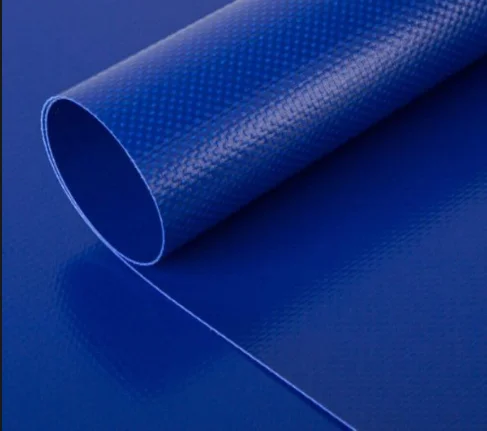
Deep Process Control Over Coating Weight and Adhesion — Nearly three decades of focused coated fabric production ensures that every roll of PVC Knife Coated Tarpaulin leaves the line with verified coating weight, consistent adhesion, and full traceability from base yarn to finished surface.
Technical Specifications
| Parameter | Value |
|---|---|
| Product Type | PVC Knife Coated Tarpaulin Roll |
| Coating Method | Knife Coated |
| Coating Material | PVC |
| Welding Compatibility | HF Welding, Hot Air Welding, Sewing |
| UV Treatment | Available with UV resistance — confirm grade required for your market |
| Flame Retardant | Available in fire retardant grades — confirm the standard required for your project |
| Antibacterial & Mildew Proof | Claimed — verify applicable test standard with supplier |
| Oil and Stain Resistance | Claimed surface resistance |
| Acid and Alkali Resistance | Claimed chemical resistance |
| Temperature Resistance | High temperature and cold resistance — confirm operating range for your application |
| Anti-Oxidation & Weather Resistance | Claimed outdoor durability |
| Flexibility | Highly flexible yet resistant to cracking |
| Self-Cleaning | Claimed self-cleaning surface |
| Tensile Strength | Claimed excellent tensile resistance — test standard available on request |
| Tear Strength | Claimed excellent tearing resistance — test standard available on request |
| Adhesion Strength | Claimed excellent peeling resistance — test standard available on request |
| Finish | Available in glossy or matte finish |
| Color | Custom colors available — confirm reference with supplier |
Application Suitability
| Application | Exposure & Requirement |
|---|---|
| Tensile Structures | Continuous tension loading, wind uplift, UV exposure, long-term dimensional stability required |
| Stadium Architectural Structures | Large-span membrane stress, public fire safety compliance, weather cycling |
| Airport Hangars | Wide coverage, wind load, fire retardant requirements for aviation environments |
| Portable Storage Structures | Repeated assembly and disassembly, abrasion at frame contact points, weather exposure |
| Shade Systems and Shadings | Direct solar radiation, thermal expansion, color fastness over extended outdoor service |
| Large Format Technical Textiles | Custom fabrication, welding integrity across long seams, surface printability |
Why "Flame Retardant" on a Quotation Means Nothing Without a Test Report
A fire retardant claim only protects your project when it is backed by a grade matched to your local building code.
I have reviewed quotations where PVC knife coated tarpaulin rolls were listed as fire retardant with no grade stated and no test report attached. When the fabric arrives on site, the building inspector asks for a certificate referencing DIN 4102, NFPA 701, or M2 — and the supplier cannot produce one. The membrane fails inspection, the structure cannot open, and the contractor absorbs the delay. [NEED_CITE: fire classification standards for architectural membrane materials per DIN 4102 and NFPA 701]
This is not a documentation oversight. It is a specification gap that originates when the buyer does not state the target market standard at the inquiry stage, and the supplier defaults to a generic claim. The fix is straightforward: confirm the fire classification your jurisdiction requires before the order is placed, and require the matching test report as a dispatch document.
Knife Coating Process and Adhesion Control
The knife coated method applies PVC paste directly onto the base fabric under controlled blade pressure, forcing the coating into the yarn interstices before curing. This penetration creates a mechanical bond between coating and substrate that delivers high peel strength — a critical property when welded seams are placed under structural tension. For tensile structures and stadium membranes, where panel edges carry sustained load, the bond between coating and base fabric must resist delamination over the service life of the installation. PVC Knife Coated Tarpaulin produced on this basis supports HF welding, hot air welding, and sewing, giving fabricators flexibility in seam construction depending on panel geometry and load distribution.
Functional Treatments and Their Verification
Beyond the base coating, functional additives are introduced at the compounding stage. UV stabilisers protect against polymer degradation under direct solar radiation — a non-negotiable requirement for shade systems and architectural membranes in high-irradiance climates. Antibacterial and mildew-resistant formulations address humid or marine environments where biological growth compromises surface appearance and coating integrity. Acid and alkali resistance extends the material’s suitability to industrial settings where chemical aerosols or runoff contact the fabric surface. [NEED_CITE: ISO 1421 tensile and tear test methods for coated fabrics and their relevance to structural membrane specification]
The critical point is that each treatment must be verifiable. If UV resistance is specified, request the test method and exposure duration. If fire retardancy is required, name the standard before production begins.
Reading the Specification Sheet Beyond GSM
GSM alone tells you what the fabric weighs, not how it will perform under load. Two PVC coated fabrics at the same GSM can differ substantially in tensile and tear strength depending on base fabric denier, yarn count, and weave density. A heavier base yarn with an open weave may weigh the same as a finer yarn with a tight weave, yet behave very differently when a tear initiates at a cut edge or a welded seam.
The knife coated process adds coating weight to the base fabric weight, and the ratio between them determines both flexibility and surface durability. A higher proportion of coating relative to base fabric produces a smoother, more self-cleaning surface but can reduce drape and increase stiffness at low temperatures. Conversely, a lighter coating on a dense base fabric preserves flexibility but may sacrifice surface abrasion resistance. Understanding this balance is essential when selecting PVC Knife Coated Tarpaulin for applications ranging from tensioned architectural membranes to portable storage structures that are repeatedly folded and deployed.
Temperature response also varies with formulation. PVC becomes stiffer in cold conditions and softer at elevated temperatures. The claimed high temperature and cold resistance should be matched against the actual operating range at the installation site to avoid brittle cracking in winter or tackiness in peak summer heat.
The Hidden Cost of Specifying on Price Per Kilogram Alone
When procurement decisions reduce PVC coated fabric to a cost-per-kilogram comparison, the first casualty is coating weight consistency. A supplier absorbing cost pressure may reduce coating thickness while maintaining the stated base fabric specification, delivering a roll that technically meets the GSM target on a small swatch but falls short across the full roll width and length. [NEED_CITE: batch-to-batch coating weight variation and its effect on long-term membrane performance]
The consequences surface after installation. Thinner coating at weld seams leads to premature delamination under wind load. Reduced UV stabiliser concentration causes surface chalking and embrittlement within seasons rather than years. A fire retardant additive diluted below effective concentration fails the on-site burn test that the building inspector conducts before issuing occupancy approval. Each of these outcomes costs far more than the marginal saving on the original material purchase.
Fabric Sourcing Backed by Process Expertise
Nearly 30 years of focused coated fabric manufacturing means the production team understands how coating viscosity, blade gap, and line speed interact to control final GSM and adhesion — this is not outsourced knowledge, it is controlled in-house on three full production lines.
A 10-person R&D team handles material selection, custom formulation, and sample development, supporting technical buyers who need to match specific membrane properties to structural engineering requirements. Samples for custom colors, widths, and functional treatments are developed within days, allowing specification validation before bulk commitment.
Dedicated QA/QC at every production stage with 100% pre-shipment inspection means each roll of PVC knife coated tarpaulin is checked against the specification sheet before packing — not sampled, but inspected in full.
ISO and CE certified production supports documentation requirements for export markets across North America, Europe, and Asia, with certificates available as part of the dispatch package.
Documentation & Verification
- Material specification sheet stating GSM, base fabric construction, coating method, and color reference for every roll shipped
- Fire retardant test report issued against the specific grade confirmed at order stage — not a generic certificate
- UV resistance test data referencing the method and exposure conditions applicable to your project climate
- Pre-shipment inspection record covering coating weight, surface quality, and dimensional accuracy before dispatch
- ISO and CE certificates included in the documentation package for customs clearance and site compliance
- Certificate of origin and customs support documents prepared for the destination market
Fabrication, Handling & Storage
- HF welding suits this knife coated PVC fabric for clean, high-strength seams on architectural membrane panels
- Hot air welding is recommended for long continuous seams on shade systems and tensile structure field joints
- Sewn seams should use UV-stable thread and sealed needle holes to maintain waterproof integrity on the coated surface
- Store rolls upright on a flat surface in a dry warehouse to prevent edge deformation and surface creasing
- Allow cold-stored rolls to reach ambient temperature before unrolling to avoid coating stiffness and surface cracking
- Clean the self-cleaning surface with mild detergent and soft brush — avoid abrasive pads or solvent-based cleaners that damage the coating
What We Need to Move Your Inquiry Forward
Provide the application type and the environmental conditions the membrane will face — sustained tension, wind load category, and UV exposure level at the installation site. State the fire classification standard your local authority requires, so the correct grade is matched and the matching test report is prepared with the shipment.
Confirm the roll width and color reference you need, along with whether you require full rolls or cut panels with welded edges. If this is a new specification, request a sample for your own weld testing and tensile verification before committing to production volume.
Frequently Asked Questions
Q: What is the difference between knife coated and laminated PVC in terms of peel strength?
A: Knife coated PVC forces the coating paste into the base fabric weave under blade pressure before curing, creating a mechanical bond through yarn penetration. Laminated PVC bonds a pre-formed film to the fabric surface with adhesive, which can delaminate under sustained peel stress. For structural membranes where welded seams carry tension, knife coated construction provides the higher adhesion strength that structural engineers typically specify.
Q: How do I confirm the GSM on arrival matches what was quoted?
A: Cut a measured sample from the roll edge using a standard template, weigh it on a calibrated scale, and calculate the weight per square metre. Compare the result against the GSM stated on the material specification sheet that accompanies the shipment. Any significant deviation should be flagged before the material is cut or fabricated, as most suppliers will not accept weight claims after fabrication has begun.
Q: Which fire retardant test standards can be provided with this fabric?
A: Common standards include DIN 4102 classifications such as B1, NFPA 701 for textile flame propagation, and French M2 rating. The specific standard must be confirmed at the inquiry stage so the correct additive formulation is used and the matching test report is prepared. Do not assume a generic fire retardant claim covers your local building code requirement — always verify before ordering.
Q: How does HF welding compare to hot air welding for different fabric weights?
A: HF welding uses high-frequency energy to fuse the PVC coating at the seam and is effective across most coated fabric weights, producing a clean bond line with consistent strength. Hot air welding uses heated air and pressure, suited to thicker materials and field repairs where HF equipment is unavailable. The choice depends on seam geometry, production environment, and the structural load the joint must carry.
Q: How is color consistency controlled between rolls in a single order?
A: Production batches are matched against a confirmed color reference using standard light-source comparison under controlled lighting conditions. Rolls from the same production run are grouped together for dispatch to minimize any visible variation when panels are installed side by side. For large projects requiring multiple production runs, request a roll plan that groups panels by batch to manage installation sequencing.