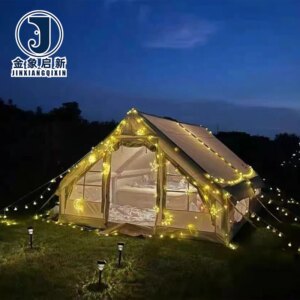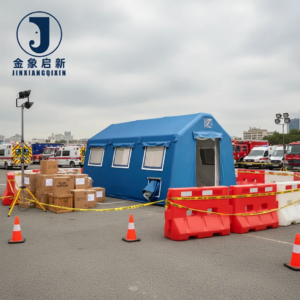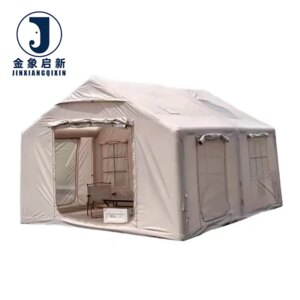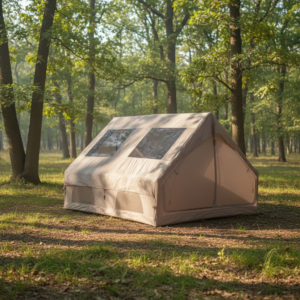
Certified Production Lines — Every roll of PVC inflatable tent fabric is produced under ISO9001, ISO14001, ISO45001, and CE certified processes with full QA/QC tracking from coating to dispatch.
Technical Specifications
| Parameter | Value |
|---|---|
| Product Type | Inflatable Tent |
| Core Material | PVC tarpaulin |
| Product Form | Inflatable structure with single layer construction |
| Waterproof | Fully waterproof coated construction |
| UV Treatment | UV-resistant (test basis not stated in source — confirm UV rating for your deployment environment) |
| Tear Resistance | Tear-resistant (test standard not stated — request test data per batch) |
| Flame Retardant | Fire-retardant available (grade not stated — confirm the grade required for your market) |
| Anti-Static | Anti-static treatment available (surface resistance or standard not stated — verify compliance for your site) |
| Customization | OEM & ODM with sample customization and pattern printing |
| Certifications | ISO9001, ISO14001, ISO45001, CE |
Application Suitability
| Application | Exposure & Requirement |
|---|---|
| Emergency response command centers | Rapid deployment demand, continuous occupancy, fire safety compliance on site |
| Mining and tunnelling temporary shelters | Underground particulate exposure, anti-static requirements, fire-retardant regulatory mandates |
| Construction site temporary shelters | Four-season weather cycles, wind loading on inflated walls, UV exposure during extended use |
| Disaster relief rapid deployment shelters | Immediate setup under pressure, variable ground conditions, multi-climate transit and storage |
| Mobile field operations bases | Repeated inflation and deflation cycles, transport abrasion, equipment housing inside structure |
Why PVC Inflatable Tent Fabric Fire Retardant Certified Matters Beyond the Label
A fire-retardant claim without a verified grade is a compliance gap waiting to be found at your site inspection.
When procurement teams specify PVC inflatable tent fabric for disaster relief or mining shelters, the fire-retardant requirement is rarely optional — it is written into the site safety plan and enforced by the safety officer on arrival. Yet fabrics routinely arrive on site with a data sheet that says "fire retardant" and nothing more. No DIN classification, no NFPA reference, no local building code alignment. The tent passes the visual check but fails the documentation audit, and the entire shelter deployment is held up while the supplier scrambles for a test report that matches the batch delivered. [NEED_CITE: fire classification standards for temporary structures and inflatable shelters]
This is not a paperwork problem. It is a production problem. Flame-retardant additives must be compounded into the PVC coating at a specific loading to achieve a given classification, and that loading affects the coating weight, the hand feel, and the weld behaviour of the fabric. A supplier who treats fire retardancy as a checkbox rather than a process variable cannot produce consistent results across batches.
Coating Chemistry and Fire-Retardant Integration
The PVC inflatable tent fabric fire retardant certified for industrial use requires the flame-retardant additive system to be fully integrated during the coating stage, not applied as a topical finish after the fabric leaves the line. Topical treatments can wash out or migrate over time, reducing the effective protection level after repeated inflation cycles and outdoor exposure. When the additive is compounded into the plastisol before coating, the fire-retardant performance is locked into the coating matrix and survives the handling, folding, and re-deployment that disaster relief shelters undergo.
Anti-Static Treatment for Sensitive Environments
In mining and tunnelling applications, inflatable shelters often house electronic monitoring equipment, communication relays, and gas detection instruments. Anti-static treatment on the PVC inflatable tent fabric prevents surface charge buildup that could interfere with sensitive electronics or, in extreme cases, contribute to ignition risk in particulate-laden air. The anti-static performance must be verified with surface resistance data for each production batch, not assumed from a general product description. [NEED_CITE: anti-static surface resistance testing for industrial fabrics in hazardous environments]
Single-Layer Inflatable Construction and Rapid Deployment
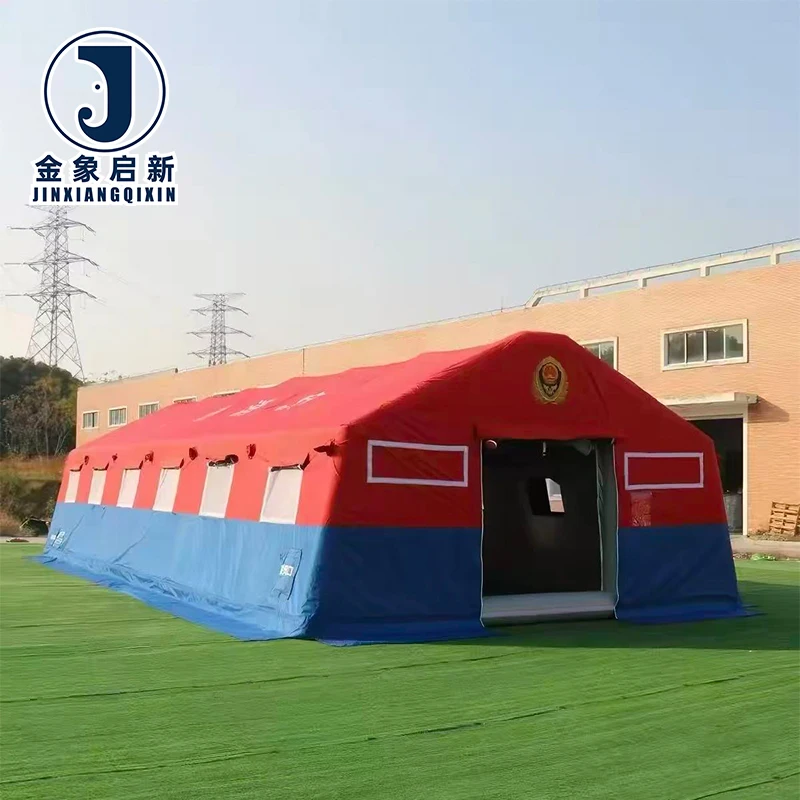
The single-layer inflatable construction allows these shelters to be erected by a small team in minutes using a standard air pump, with no poles, no frame assembly, and no rigging hardware. For disaster relief scenarios where the first hours determine the effectiveness of the response, this deployment speed is the primary reason inflatable structures are specified over conventional frame tents. The PVC tarpaulin must hold air pressure consistently across the entire envelope, which places direct demand on the weld integrity of every seam in the structure.
Understanding the Specification Sheet for Inflatable Tent Fabric
When you review a material specification sheet for PVC inflatable tent fabric, the GSM value tells you the total coated weight per square metre but does not by itself define the tensile or tear performance. A 650 GSM fabric with a high-density polyester base will outperform a 650 GSM fabric with a loose weave and heavy coating, because the base fabric carries the structural load while the coating provides the environmental barrier. The relationship between base fabric denier, weave density, and coating weight determines how the material behaves under the sustained internal pressure of an inflated structure and under wind loading on the exterior walls.
The coating method also matters. Knife-over-roll coating produces a tighter bond between the PVC and the base fabric, which translates to better peel strength at the weld seams — the exact point where inflatable structures concentrate stress during inflation and deflation cycles. Calendered coatings tend to be more cost-effective but may show lower adhesion values, which becomes visible when the shelter is repeatedly packed and redeployed. [NEED_CITE: peel strength and weld adhesion test methods for coated fabrics per ISO 1421]
The Cost of Specification Gaps in Inflatable Shelter Projects
When the fire-retardant grade on the data sheet does not match the grade required by the local authority having jurisdiction, the shelter cannot be occupied regardless of how well it performs in every other respect. Site safety officers in mining, construction, and disaster relief zones check documentation before they check the fabric, and a missing or mismatched test report stops the project until it is resolved.
Batch-to-batch colour variation is a secondary but costly problem. When inflatable shelters are deployed in groups — for a refugee camp, a construction village, or a disaster relief staging area — visible colour differences between adjacent units signal inconsistent production control and raise immediate questions about whether the material properties also vary between batches. [NEED_CITE: colour consistency standards and measurement methods for coated fabrics]
Weld seam failure is the third specification gap that surfaces in the field. The seams on an inflatable structure carry the internal pressure load continuously, and if the welding temperature or dwell time was set for a different coating formulation, the seam peels open under pressure long before the fabric itself reaches its limit.
Why Source PVC Inflatable Tent Fabric Here
Three full production lines and 36 sets of professional equipment give this facility the capacity to run bulk inflatable tent fabric orders without the scheduling conflicts that delay smaller operations. When disaster relief procurement windows are measured in days, not months, having dedicated line time matters.
A 10-person R&D team handles material selection, pattern printing layout, and custom sizing for OEM and ODM projects, developing samples within days rather than weeks. For inflatable structures where the pattern affects both the visual identity and the structural geometry, having in-house design capability shortens the approval cycle.
Dedicated QA/QC runs at every production stage, with 100 percent inspection before shipment. For fire-retardant and anti-static grades, this means every batch is checked against the specification before it leaves the facility, not after a complaint arrives from the field.
Nearly 30 years of focused coated fabric production provides the process knowledge to adjust coating weight, additive loading, and weld parameters as a coordinated system rather than as isolated variables.
Documentation & Verification
- Material specification sheet stating base fabric denier, coating type, GSM, and treatment parameters for your inflatable tent batch
- Fire-retardant test report matching the grade specified in your site safety plan and target market regulation
- Anti-static surface resistance data sheet verifying compliance for mining and tunnelling deployment environments
- Pre-shipment inspection record covering airtightness test and structural load verification on finished inflatable units
- ISO9001, ISO14001, ISO45001, and CE certificate copies included with every dispatch for customs and site compliance
Fabrication, Handling & Storage
- Set heat welder temperature and dwell time to match the specific PVC coating formulation on your inflatable tent fabric batch
- Inflate test each completed unit after welding to verify seam integrity before folding for shipment
- Store rolled PVC inflatable tent fabric upright on pallets to prevent flat-spot creasing that weakens the coating at fold lines
- Avoid dragging single-layer inflatable fabric across abrasive ground during deployment to protect the coated surface
- Use PVC-compatible cleaning agents only, as solvent-based cleaners can extract fire-retardant additives from the coating matrix
- Repair minor punctures with matching PVC patches and solvent cement compatible with the coating weight of the tent material
Request a Material Proposal for Your Inflatable Shelter Project
Provide the deployment environment, the fire-retardant classification required by your local authority, and the anti-static compliance level your site safety plan mandates. Include the shelter dimensions, expected inflation cycle frequency, and whether you need finished units or roll stock for your own fabrication line. Specify any pattern printing or colour requirements and the annual volume you anticipate so the quotation reflects your actual procurement pattern.
Frequently Asked Questions
Q: How do you verify fire-retardant performance for each batch of inflatable tent fabric?
A: Each production batch is tested and a fire-retardant test report is issued matching the grade specified in your purchase order. The report references the test standard and classification achieved. We recommend you confirm the exact grade your target market requires before production begins so the additive loading is set correctly from the start.
Q: What anti-static certification data accompanies the fabric for mining deployments?
A: Anti-static treated batches ship with a surface resistance data sheet showing the measured values for that specific production run. Mining and tunnelling sites typically require this documentation for safety audits. Confirm the surface resistance range your site safety plan mandates so we can match the treatment formulation to your compliance target.
Q: How does the sample process work before committing to a bulk order?
A: We develop samples within days based on your specified dimensions, coating parameters, and treatment requirements. The sample undergoes the same coating and welding process as production material, so you can validate weld settings, inflation behaviour, and surface finish before authorizing bulk production. Sample approval locks the specification for the order.
Q: What documentation is included with each shipment for compliance purposes?
A: Every dispatch includes a material specification sheet, relevant test reports for fire-retardant and anti-static performance, a pre-shipment inspection record, packing list, certificate of origin, and copies of ISO9001, ISO14001, ISO45001, and CE certifications. This documentation package supports customs clearance and on-site safety audits without requiring follow-up requests.
Q: Can you maintain batch-to-batch consistency across large-volume inflatable tent orders?
A: Our three production lines operate with process-controlled coating parameters, and our QA team verifies GSM, colour, and treatment levels at every stage. For repeat orders, we reference the locked specification from your approved sample to ensure each batch matches the previous delivery. This prevents the colour variation and performance drift that causes field complaints on multi-batch projects.