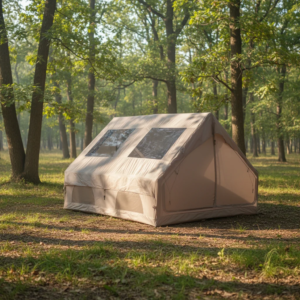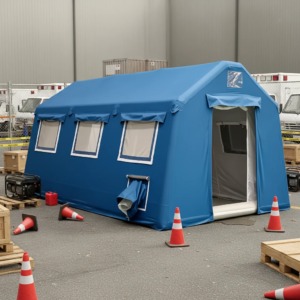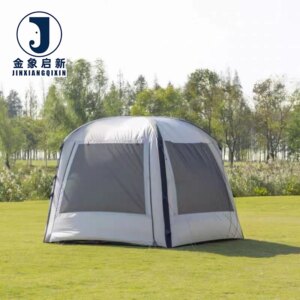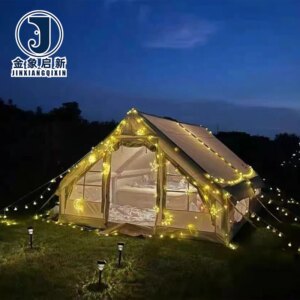
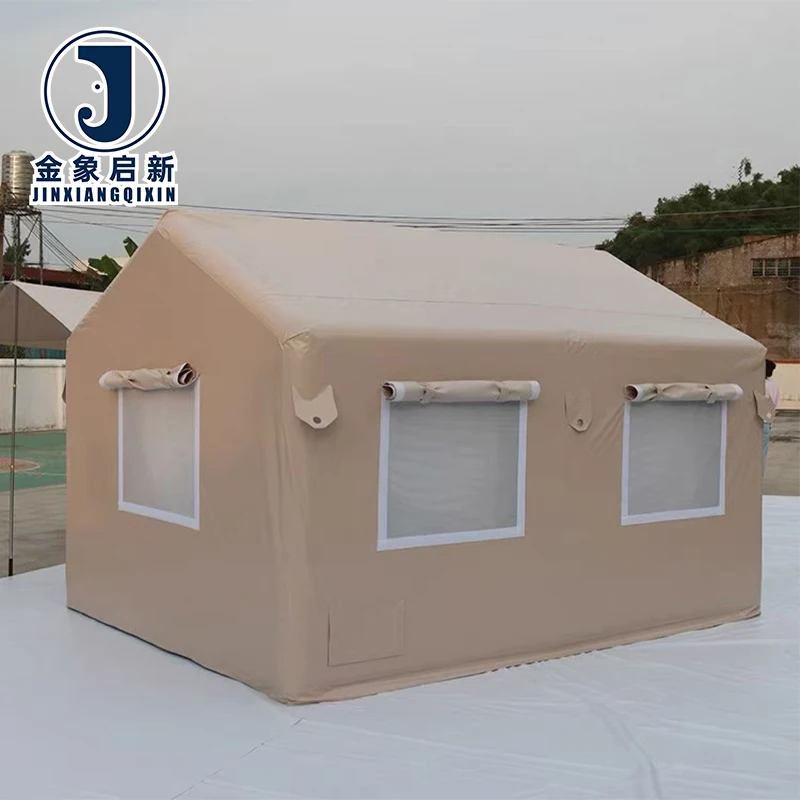
Deep Coating Process Control — consistent coating weight and adhesion across every roll, verified at each production stage for airtight inflatable chamber integrity.
Technical Specifications
| Parameter | Value |
|---|---|
| Product Type | Inflatable Fabric / Inflatable Shelter |
| Core Material | PVC Tarpaulin |
| Capacity | 6–8 persons |
| Deployment Feature | Quick Automatic Opening |
| Design Configuration | Four-Season, Single Layer Construction, Extended Type |
| Waterproof | Yes (test basis not stated in source) |
| UV Treatment | UV-resistant (test basis not stated in source) |
| Tear Resistance | Tear-resistant (test standard not stated in source) |
| Flame Retardant | Available in flame retardant grades — confirm the grade required for your market |
| Customization | OEM & ODM: material selection, design, pattern printing |
| Production Facility | 9,180 m² with 3 full production lines |
| Processing Equipment | 36 sets of professional equipment |
| R&D Team | 10 technicians |
| Quality Control | Full-process inspection, pressure testing, dimensional verification before shipment |
| Certifications | ISO 9001, ISO 14001, ISO 45001, CE |
Application Suitability
| Application | Exposure & Requirement |
|---|---|
| Emergency disaster relief command centers | Rapid deployment under time pressure, exposure to rain and wind, need for airtight inflatable chambers |
| Temporary site offices on infrastructure projects | Continuous UV exposure, dust and debris abrasion, repeated inflation cycles |
| Remote equipment storage in construction zones | Ground moisture contact, temperature fluctuation, puncture risk from sharp tools and materials |
| Temporary warehousing at logistics hubs | High-volume foot traffic, forklift proximity, weather shielding for sensitive cargo |
| Outdoor industrial and commercial deployment | Multi-season weather variation, wind load on membrane surfaces, long-term UV exposure |
Why "Waterproof" Means Little Without a Test Basis Behind the Claim
A waterproof declaration without a hydrostatic head rating or standardized test reference leaves buyers guessing about real-world performance.
Inflatable shelters deployed for emergency relief face sustained rainfall, pooling water at base seams, and internal condensation cycles. When the PVC inflatable tent fabric manufacturer does not disclose which standard underpins the waterproof claim, procurement teams cannot compare materials on equal footing. I have reviewed specifications from multiple suppliers where "waterproof" covered anything from a light shower resistance to full submersion tolerance — a gap that only surfaces after the shelter is inflated in the field and water starts penetrating at the weld lines [NEED_CITE: hydrostatic head test methods for coated fabrics per ISO 1421]. Requesting the specific test basis before placing a bulk order avoids costly field failures and emergency re-procurement.
Coating Adhesion and Airtight Chamber Performance
The core function of PVC inflatable tent fabric is maintaining internal air pressure across sealed chambers. Coating adhesion to the base fabric determines whether the laminate holds under repeated inflation and deflation cycles. When adhesion is weak, micro-delamination begins at stress points — typically around valve cutouts and welded seams — and the chamber slowly loses pressure. A PVC inflatable tent fabric manufacturer with controlled coating process parameters can deliver consistent peel strength across the entire roll width, reducing the reject rate during fabrication.
Batch-to-Batch Colour Consistency in Multi-Unit Deployments
Disaster relief operations and large construction sites often deploy multiple inflatable shelters side by side. If rolls from the same order vary in colour or gloss level, the visual mismatch becomes obvious once the units are inflated and positioned adjacent to one another. This is a coating formulation and pigment dispersion issue, not a base fabric problem. Confirming colour reference standards with your custom inflatable shelter material supplier before production starts prevents visible variation across the delivered batch [NEED_CITE: colour fastness and batch consistency standards for PVC coated textiles].
Reading the Specification Sheet Beyond Surface Claims
Tear resistance in PVC tarpaulin depends on both the base fabric denier and the coating’s ability to distribute load across yarn intersections. A higher GSM reading alone does not guarantee better tear performance if the base weave is loose or the coating penetrates unevenly. Similarly, UV-resistant treatment must be specified with the test basis — without it, the claim cannot be verified against the exposure duration your inflatable shelters will face. Buyers evaluating custom inflatable shelter material should cross-reference the base fabric construction, coating weight, and treatment documentation rather than relying on headline numbers.
The Hidden Cost of Specifying on Price per Kilogram Alone
When buyers focus solely on unit cost, suppliers may reduce coating weight to hit the target price while maintaining the stated base fabric specification. The roll arrives at the correct width and length, but the inflatable chambers fail pressure testing during fabrication because the coating is too thin to seal properly at welded seams. This failure mode does not appear on a certificate of analysis — it only reveals itself when the fabricator applies heat and pressure to join two panels. Procurement teams sourcing PVC inflatable tent fabric should request roll-by-roll coating weight verification and pressure test records rather than accepting batch-average declarations [NEED_CITE: common failure modes in heat-welded PVC tarpaulin seams].
Why Material Traceability Matters for Inflatable Shelter OEMs
Coated fabric production involves multiple variables — resin batch, plasticizer ratio, curing temperature, calender pressure — that shift slightly between production runs. When an inflatable shelter OEM needs to reorder fabric for a repeat project, even minor formulation changes can affect weld compatibility with existing tooling. Documentation that traces each roll back to its specific production run allows the fabricator to adjust heat-seal parameters rather than discovering incompatibility mid-production. This is where a PVC inflatable tent fabric manufacturer with full-process inspection and pre-shipment verification delivers measurable value over suppliers who ship against nominal specifications only.
Documentation & Verification
- Material specification sheet stating base fabric type, coating method, and weight per roll
- UV and tear resistance test reports with specific test basis cited — request with order
- Pre-shipment inspection record including pressure test results and dimensional checks
- Colour reference card matched to production batch for roll-to-roll traceability
- ISO 9001, ISO 14001, ISO 45001, and CE certificates provided per shipment
- Certificate of origin and customs documentation for international dispatch
Fabrication, Handling & Storage
- Heat-weld parameters should be tested on sample pieces from each roll before full production runs
- Store PVC tarpaulin rolls vertically on padded racks to prevent permanent creasing at the core
- Avoid dragging rolls across concrete floors — the coating surface scratches before the base fabric shows damage
- Clean welded seam areas with compatible PVC solvent before repair patches are applied
- Allow rolls to acclimatize to workshop temperature before unrolling to prevent condensation between layers
- Cut pattern layouts should account for selvage trim and weld overlap to maximize yield per roll
What to Include in Your Enquiry
Specify the deployment environment — whether the inflatable shelters will face arid UV-heavy conditions, coastal salt exposure, or sub-zero temperatures — so the material recommendation matches the actual stress profile. Confirm your target market’s fire safety classification requirements, as flame retardant grades vary by jurisdiction and must be verified before production. Provide your required roll width, annual volume estimate, and whether you need finished cut panels or full rolls for in-house fabrication. Indicate if pattern printing or custom colour matching is part of the project scope, as these affect lead time and minimum order quantities.
Frequently Asked Questions
Q: How is coating weight and adhesion verified for airtight inflatable chamber integrity?
A: Each roll undergoes coating weight verification and adhesion peel testing during production. Pre-shipment inspection includes pressure testing of welded sample panels cut from the same roll to confirm the coating holds under inflation stress. These records accompany the shipment for your fabrication team’s reference.
Q: What test basis supports the UV-resistant and tear-resistant claims on inflatable tent fabric?
A: UV and tear performance declarations are tied to specific test standards, which must be requested at the enquiry stage. We provide test reports with the applicable standard cited so your engineering team can verify suitability for the intended deployment duration and environmental exposure.
Q: How do you ensure colour consistency across multiple rolls within the same inflatable shelter order?
A: Pigment formulation is locked to a colour reference before production begins. Every roll in the order is produced from the same coating batch where possible, and a colour reference card matched to the production run is included in the shipment documentation for your incoming quality check.
Q: What OEM customization options are available — pattern printing, custom width, and colour matching?
A: Our R&D team of 10 technicians handles material selection, custom width slitting, colour matching against your reference sample, and pattern printing for branding or identification. Confirm these requirements during the specification stage so sample development can proceed before bulk production commitment.
Q: What documentation accompanies each shipment for material traceability and compliance?
A: Each dispatch includes a material specification sheet, pre-shipment inspection record with pressure test results, roll packing list, certificate of origin, and ISO and CE certificates. Batch traceability is maintained through order reference numbers linking each roll to its production run.