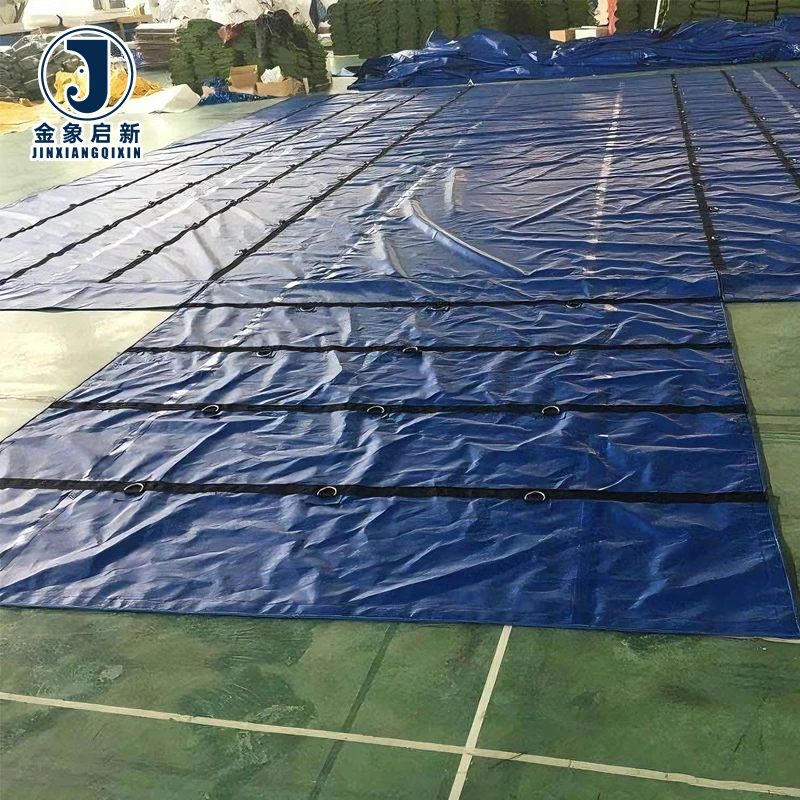
Coating Weight Control — Every roll of technical grade PVC coated tarpaulin we produce is monitored across all three production stages to ensure the coating weight and base fabric adhesion meet the specified GSM target without deviation.
Technical Specifications
| Parameter | Value |
|---|---|
| Product Type | PVC Coated Tarpaulin |
| Coating Method | Knife Coated |
| Base Fabric | High-tenacity polyester woven scrim |
| Waterproof | Yes — fully waterproof coated construction |
| Flame Retardant | Available in flame retardant grades — confirm the grade required for your market |
| Anti-Static | Available in anti-static grades — confirm the standard required for your application |
| Anti-Cold | Yes — formulated for low-temperature flexibility |
| Anti-Mildew | Yes — mildew-inhibiting treatment incorporated in coating |
| Outdoor Life Assurance | 1–3 years (source value — verify against manufacturer catalog for specific grade) |
| Weather Resistance | Suited to extended outdoor exposure |
| Customization | Size, color, printing, eyelets and reinforced hems available |
| Certifications | ISO / CE |
Application Suitability
| Application | Exposure & Requirement |
|---|---|
| Truck and trailer cargo covering | Constant road vibration, UV exposure, wind-driven rain, flexing at load contact points |
| Logistics fleet load protection | Daily handling abrasion, tie-down strap pressure, multi-climate transit |
| Construction equipment covers | Outdoor storage, dust and debris contact, seasonal temperature swings |
| Mining ventilation duct fabrication | Fire-retardant compliance, anti-static dissipation, underground moisture |
| Inflatable and membrane structure fabric | Tensile load under inflation, UV degradation over large surface area, weld seam integrity |
What "Flame Retardant" Really Means Without a Test Report
A flame retardant claim without a matching grade and test standard is a procurement risk, not a material property.
Technical buyers specifying PVC coated tarpaulin for transport or construction applications frequently encounter suppliers who list "flame retardant" as a blanket feature. In practice, flame retardant performance spans a wide range of classifications — from self-extinguishing grades suitable for general outdoor covers to grades meeting specific building material or vehicle interior standards. When the quotation states a property but the shipment arrives without a corresponding test report tied to the batch, site inspectors have no basis for acceptance. [NEED_CITE: flame retardant test standards for coated fabrics in transport and construction applications]
How Base Fabric and Coating Define Real-World Performance
The mechanical behaviour of a PVC coated tarpaulin is governed by the interplay between base fabric construction and coating application. The polyester scrim provides tensile and tear strength, while the PVC coating contributes waterproofing, chemical resistance, and the surface characteristics that determine weldability. A PVC coated truck cargo cover manufacturer that controls both the scrim selection and the knife coating process can deliver consistent performance roll after roll, rather than relying on pre-coated stock of uncertain origin.
Knife Coating and the Adhesion Advantage
Knife coating applies a measured layer of PVC compound directly onto the woven scrim under controlled tension and temperature. This method produces strong mechanical adhesion between coating and yarn, which directly influences how the fabric behaves during hot-air welding. When adhesion is weak, the coating delaminates at the weld line under load — a failure mode we see more often than outright fabric tearing. For buyers sourcing by the roll for secondary fabrication, knife-coated construction provides the weld consistency needed for reliable seam strength across long production runs. [NEED_CITE: coating adhesion test methods for PVC coated polyester fabrics per ISO 2411]
Reading the Specification Sheet Beyond GSM
GSM alone tells you how much a square metre weighs, but not what that weight is made of. Two PVC coated tarpaulins at the same GSM can perform very differently depending on the ratio of base fabric to coating. A heavier scrim with less coating yields higher tensile and tear strength but reduced surface waterproofing. A heavier coating with lighter scrim gives better chemical resistance and weldability but may crack under tension at low temperatures. The anti-cold formulation in this product addresses the low-temperature brittleness that affects standard PVC coatings in winter transit or cold-storage environments. Similarly, the anti-mildew treatment is compounded into the PVC layer rather than applied as a topical finish, maintaining its effectiveness through abrasion and cleaning cycles.
The Hidden Cost of Underspecified Material
Specifying material on price per kilogram alone creates downstream failures that are expensive to trace. Rolls that arrive lighter than the quoted GSM often reflect reduced coating weight, which shows up first as poor weld adhesion during fabrication or premature surface cracking in cold conditions. Batch-to-batch colour variation between rolls in the same order becomes visible only after installation, when panels sit side by side on a truck body or structure. [NEED_CITE: common causes of premature PVC tarpaulin failure in transport and outdoor applications]
Why Source This PVC Coated Tarpaulin Here
Three dedicated production lines and 36 sets of professional equipment support bulk roll output with consistent on-time delivery, even during peak demand cycles across logistics and construction seasons.
The 10-person R&D team handles material selection for specific performance requirements — matching base fabric denier, coating formulation, and treatment package to your application rather than offering only stock grades.
Dedicated QA and QC inspection at every production stage, with 100% pre-shipment roll inspection, catches GSM deviation and coating defects before material leaves the facility.
Samples are developed within days for custom width, colour, or treatment requirements, allowing you to verify weld behaviour and drape before committing to a production run.
Roll-to-roll colour consistency is maintained through batch-level pigment control and side-by-side comparison against approved colour references before dispatch.
Documentation & Verification
- Material specification sheet stating base fabric denier, weave density, coating type, and confirmed GSM per roll
- Third-party test reports for flame retardant and anti-static grades, with report numbers matched to production batch
- Pre-shipment inspection record covering weight verification, visual defect check, and colour consistency across the order
- Roll packing list with individual roll weight, length, and width for receiving-side audit
- ISO and CE certificates covering the production management system
Fabrication, Handling & Storage
- Hot-air welding temperature should be calibrated to the specific knife-coated PVC formulation to achieve full seam fusion without scorching
- Eyelet placement at stress points should account for the base fabric weave direction to prevent tear propagation under tie-down load
- Rolls must be stored upright on end-caps in a shaded, ventilated area to prevent flat-spot deformation of the coating surface
- Low-temperature transport requires careful unrolling — the anti-cold formulation maintains flexibility but forced bending of cold rolls can still cause crease marks
- Surface cleaning should use mild detergent without solvents that could attack the PVC coating layer or strip the anti-mildew treatment
What to Include in Your Enquiry
Specify the target market and any fire-safety or anti-static compliance requirements so we can match the correct treatment grade and supply the corresponding test documentation. Confirm whether you need rolls at standard or custom width, and whether the end use involves fabrication into finished covers or direct installation as supplied. [NEED_CITE: ISO 1421 tensile and tear test methods for coated fabrics]
Frequently Asked Questions
Q: Why do two PVC coated tarpaulins at the same GSM have different strength levels?
A: GSM measures total weight per square metre, combining both the polyester base fabric and the PVC coating. A higher proportion of base fabric yarn delivers greater tensile and tear strength, while a heavier coating layer improves waterproofing and weldability. Requesting a full specification breakdown — not just GSM — lets you compare the structural composition and select the correct balance for your application.
Q: How should flame retardant grades be verified before acceptance?
A: The supplier should provide a third-party test report referencing the specific standard relevant to your market, with the report number traceable to the production batch. On-site verification typically involves confirming that the delivered roll matches the batch documentation. Always specify the target standard at the enquiry stage rather than accepting a generic flame retardant claim.
Q: What controls colour consistency across multiple rolls in one order?
A: Batch-level pigment dosing and side-by-side comparison against approved colour references are performed before dispatch. For large orders spanning multiple production runs, requesting a retained sample from each run allows you to verify consistency at receiving. Specifying a Pantone or RAL reference at the enquiry stage sets a clear acceptance baseline.
Q: How does knife coating affect welding performance during fabrication?
A: Knife coating produces strong mechanical adhesion between the PVC layer and the polyester scrim. This adhesion directly determines how the material responds to hot-air welding — well-bonded coating fuses cleanly at the seam without delamination. Welding parameters should always be calibrated to the specific coating formulation, and sample welds tested for peel strength before full production begins.