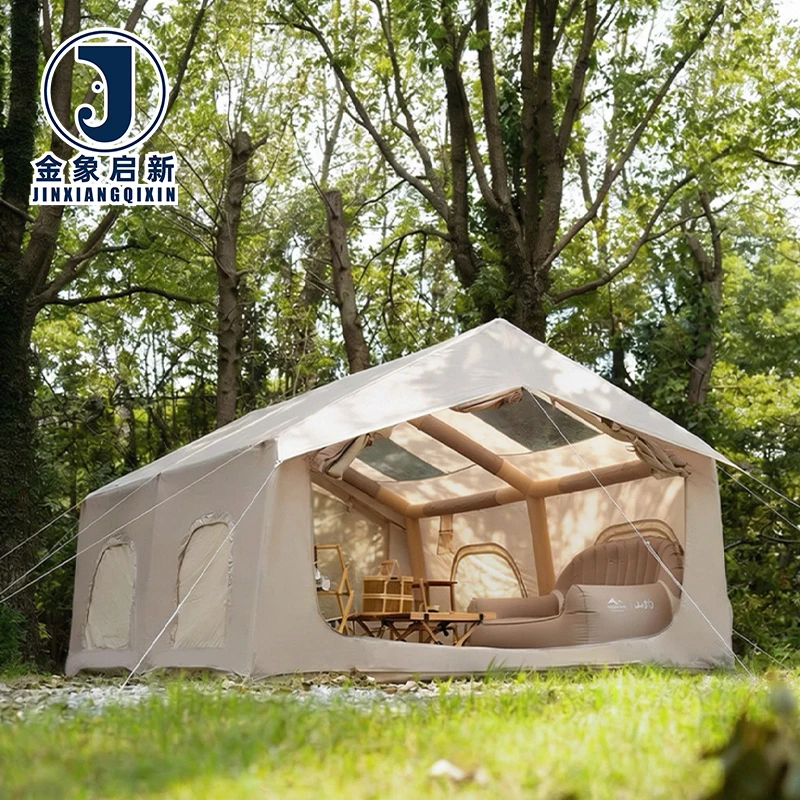
Coating Weight Control — Every roll of PVC inflatable tent fabric is verified for GSM at multiple production stages, ensuring the coated weight on the specification sheet matches the material you receive.
Technical Specifications
| Parameter | Value |
|---|---|
| Product Type | Inflatable Tent |
| Core Material | PVC tarpaulin |
| Tear Strength | 300N per ISO 13934-1 |
| Temperature Range | -20°C to 60°C |
| UV Treatment | UV-stabilized additives in fabric matrix (test basis not stated in source) |
| Waterproof Rating | Hydrostatic pressure resistance (specific value not stated in source) |
| Flame Retardant Grade | Available in flame retardant grades — confirm the grade required for your market |
| Anti-Static | Not stated in source |
| Construction | Single-layer |
| Customization | Dimensions, color, pattern printing, reinforcement locations (OEM & ODM) |
| Standards | ISO 9001, ISO 14001, ISO 45001, CE |
Application Suitability
| Application | Exposure & Requirement |
|---|---|
| Commercial outdoor event shelters | Sustained UV exposure, wind loading on inflated structure, rapid deployment and teardown cycles |
| Temporary exhibition spaces | Indoor-outdoor transition, repeated inflation-deflation, visual consistency across adjacent panels |
| Emergency response command centers | Open-site wind exposure, temperature extremes, requirement for immediate operational readiness |
| Industrial site temporary facilities | Dust, chemical splash proximity, heavy foot traffic contact with lower membrane sections |
| Inflatable structure manufacturers | Roll-to-roll batch consistency, heat-weld seam integrity, specification-driven material procurement |
Why Coating Adhesion Matters More Than GSM for Inflatable Structures
When an inflatable tent air beam loses pressure mid-event, the failure rarely originates from the base fabric tearing — it starts at the coating delaminating under cyclic pressure stress.
PVC inflatable tent fabric operates under constant internal pressure that flexes the coated layer against the base weave thousands of times per deployment cycle. A material may register the correct GSM on a scale yet still fail at the weld line if the coating bond to the base fabric is weak. The adhesion strength between the PVC coating and the polyester base yarns determines whether the seam holds through repeated inflation cycles or separates at the most stressed flex point [NEED_CITE: peel strength test methods for coated fabrics per ISO 2411]. Specifying only weight without verifying coating adhesion leaves inflatable structure manufacturers exposed to field failures that no GSM measurement could have predicted.
Coating Method and Its Effect on Weld Integrity
The PVC coating applied to this inflatable tent fabric determines how reliably heat-welded seams hold under air beam pressure. Knife coating and calendering each produce different surface textures and coating penetration depths, which directly influence the temperature window and dwell time required for consistent radio-frequency or hot-air welding. Manufacturers building inflatable structures need coating surfaces that melt and fuse uniformly at the weld interface, producing seams that match or exceed the base fabric tear strength.
Temperature Cycling and Coating Flexibility
This PVC inflatable tent fabric is validated through temperature cycling tests from -20°C to 60°C, confirming that the coating remains flexible at sub-zero temperatures without becoming brittle and does not soften excessively at high ambient heat. In cold conditions, a coating that loses plasticity will crack at fold lines during transport or at the curved surfaces of inflated beams. At the upper boundary, excessive softening can cause the membrane to sag between structural ribs, compromising the geometry that maintains aerodynamic stability in wind [NEED_CITE: low-temperature flexibility testing of PVC coated textiles].
Reading the Specification Sheet Beyond Weight
Tear strength at 300N per ISO 13934-1 reflects the combined contribution of base fabric denier, weave density, and coating penetration rather than weight alone. A heavier GSM achieved through thick coating with a loosely woven base will tear more easily than a lighter material built on a high-density polyester weave. The single-layer construction of this PVC inflatable tent fabric balances transport weight against structural demand — lighter panels reduce the load on inflation systems and speed deployment logistics, while the base fabric construction carries the mechanical load. Waterproof performance relies on the continuity of the PVC coating across the entire surface, and hydrostatic pressure resistance depends on coating thickness uniformity rather than total weight. UV-stabilized additives are integrated into the fabric matrix to resist degradation under continuous sunlight exposure, though buyers should request the specific test basis when project documentation requires verified UV endurance data.
The Hidden Cost of Specifying on Price Per Square Metre Alone
Buyers who select inflatable tent fabric based solely on the lowest cost per square metre often encounter problems that only surface during production or in the field. Coating that is thinner than expected may pass an initial weight check but fail to hold a weld seam through repeated inflation cycles. Colour variation between rolls ordered at different times becomes visible when panels are installed side by side on a large inflatable structure, forcing costly panel replacement. Material that lacks documented temperature cycling validation may crack during winter deployment or deform at weld points in summer heat, triggering warranty claims and damaging the manufacturer’s reputation with end clients [NEED_CITE: field failure analysis of inflatable membrane structures].
What Production Process Control Delivers for Your Order
Jinan Jinxiang operates three full production lines with 36 sets of professional processing equipment, giving capacity to fulfil bulk roll orders while maintaining batch consistency across the entire quantity. A 10-person R&D team handles material selection and sample development, producing custom samples within days when buyers need to validate colour, coating weight, or weld behaviour before committing to production volume. Dedicated QA and QC staff inspect at every production stage with 100% pre-shipment inspection, meaning every roll of PVC inflatable tent fabric is checked against the specification before it leaves the facility. The production process controls coating weight application and adhesion at a level that comes from nearly 30 years of focused coated fabric manufacturing experience.
Documentation & Verification
- Material specification sheet stating GSM, base fabric denier, coating weight, and colour reference per roll
- Test reports for UV resistance and tear strength per ISO 13934-1 available by order number
- ISO 9001, ISO 14001, ISO 45001, and CE certificates supplied with each shipment
- Pre-shipment inspection record including coating weight verification against stated specification
- Certificate of origin and customs documentation provided for international dispatch
Fabrication, Handling & Storage
- Heat-weld parameters must be matched to the PVC coating method — test weld samples before full production runs
- Single-layer construction reduces roll weight, but store rolls upright to prevent flat-spot deformation on the coating surface
- Allow material to acclimatise to workshop temperature before unrolling to avoid stress cracking in cold PVC coating
- Use compatible PVC adhesive for field repairs on single-layer inflatable tent membrane panels
- Cut pattern layouts should account for weld seam allowance on curved inflatable beam sections to maintain structural geometry
Before You Request a Quote
To ensure the PVC inflatable tent fabric specification matches your production requirements, provide the intended deployment climate and the temperature extremes the structure will face. Specify whether you need roll stock for your own fabrication line or require cut-to-size panels with welded seams. Include your target market’s fire safety compliance requirements so the correct flame retardant grade can be confirmed before sampling.
Frequently Asked Questions
Q: How is the UV stabilization validated — what test basis supports the anti-UV claim for this PVC inflatable tent fabric?
A: UV-stabilized additives are integrated into the fabric matrix during coating. The specific test basis for UV endurance should be confirmed for your project documentation requirements. Request the applicable test report by order number when compliance documentation is needed for building permits or event safety approvals.
Q: What base fabric denier and coating weight are used, and how do they relate to the ISO 13934-1 tear strength result?
A: The 300N tear strength per ISO 13934-1 reflects the combined effect of base fabric construction and PVC coating weight. Specific denier and coating weight values are provided on the material specification sheet for each order, allowing buyers to verify that the structural performance matches their inflatable design engineering calculations.
Q: Is flame retardant treatment available for inflatable tent fabric, and which grade or standard can be certified?
A: Flame retardant grades are available for this PVC inflatable tent fabric. The specific grade required depends on the fire safety regulations in your target market and the end-use application. Confirm the grade needed — such as B1, M2, or NFPA 701 — at inquiry stage so the correct treatment and test certification can be arranged.
Q: What coating method is applied — knife coated or calendered — and how does it affect seam welding performance?
A: The coating method directly influences weld temperature settings and seam peel strength. The specific coating technique used for your order is documented on the material specification sheet. Buyers should run test welds on sample material to establish the correct RF or hot-air welding parameters before commencing full production.
Q: How is batch-to-batch colour consistency controlled across rolls of PVC coated tarpaulin for inflatable structures?
A: Colour consistency is managed through controlled pigment dosing and verified during the 100% pre-shipment inspection process. When ordering multiple rolls for a single inflatable structure, specify the colour reference at inquiry and request batch-matched production to ensure uniform appearance when panels are installed adjacent to each other.