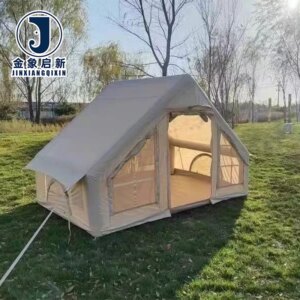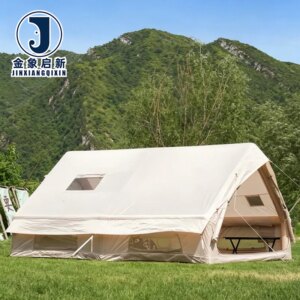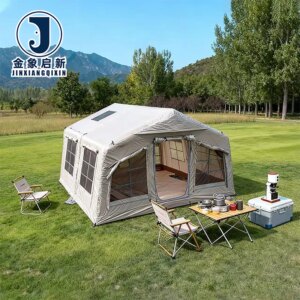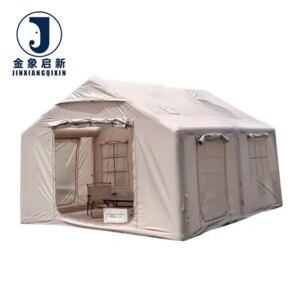
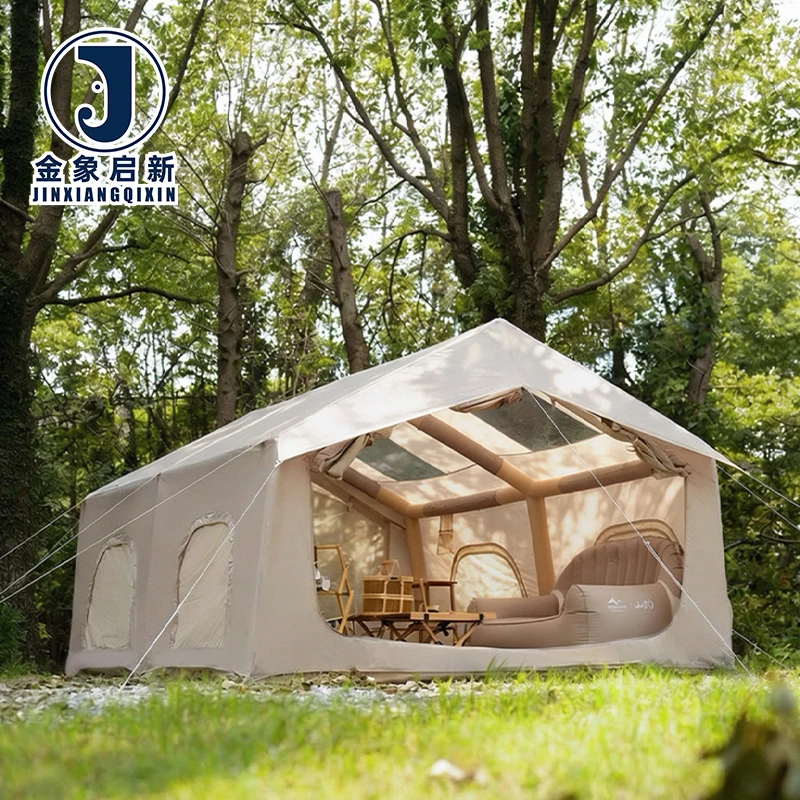
Proven Coating Expertise — Three full production lines and 36 sets of professional equipment apply decades of PVC formulation knowledge to every roll of inflatable tent fabric we produce.
Technical Specifications
| Parameter | Value |
|---|---|
| Product Type | Inflatable Tent |
| Core Material | PVC Tarpaulin |
| Product Forms | Single Layer Inflatable Tent |
| Key Features | Waterproof, UV-resistant (test basis not stated in source), Tear-resistant (test basis not stated in source), Fire-retardant (grade not stated in source), Anti-static (standard not stated in source) |
| Customization Service | Sample customization, pattern printing, OEM & ODM services |
| Standards | ISO9001, ISO14001, ISO45001, CE |
Application Suitability
| Application | Exposure & Requirement |
|---|---|
| Emergency response command centers | Rapid deployment cycles, repeated inflation and deflation, high visibility requirements |
| Temporary disaster relief storage | Continuous weather exposure, moisture ingress prevention, UV degradation resistance |
| Remote equipment maintenance shelters | Abrasive terrain contact, wind loading on inflatable beams, temperature fluctuation |
| Infrastructure inspection field stations | Transport damage during transit, frequent relocation, rapid setup on unprepared ground |
Why "Fire-Retardant" Means Nothing Without a Verified Grade
Confirm the specific fire classification your jurisdiction mandates before approving any PVC inflatable tent fabric order.
A fabric labeled flame retardant without a test standard attached creates a compliance gap that only surfaces during site inspection or after an incident. Technical buyers sourcing a PVC Inflatable Tent Fabric manufacturer often receive certificates that reference a general category rather than the precise classification — such as B1 per DIN 4102 or NFPA 701 — required by local fire marshals [NEED_CITE: fire classification standards for temporary industrial structures]. Emergency shelters deployed at construction or mining sites face immediate rejection if the material documentation does not match the safety plan filed with the site authority. The cost of replacing an entire batch of inflatable tent fabric after failed inspection exceeds the procurement savings of skipping verification by a wide margin.
Coating Adhesion and Inflatable Beam Integrity
The single layer inflatable tent relies entirely on heat-welded seams to maintain internal air pressure across the beam structure. When coating adhesion to the base fabric is insufficient, the welded joint separates under cyclic inflation loads long before the PVC material itself reaches its tear limit. Our production process controls coating weight and substrate penetration at every stage, ensuring the weld zone performs as a continuous structural element rather than a failure point.
UV Formulation for Extended Field Deployment
Emergency and industrial inflatable tents remain deployed for weeks or months in direct sunlight, making UV stabilization a non-negotiable material property. The PVC Inflatable Tent Fabric manufacturer formulates the coating compound with UV inhibitors distributed through the full thickness of the layer, not merely applied as a surface finish that wears away after initial exposure [NEED_CITE: UV degradation mechanisms in plasticized PVC coatings]. Request the specific test basis for UV resistance to verify the formulation matches the expected deployment duration in your operational region.
Material Composition and Structural Behavior
The PVC tarpaulin core material combines a woven polyester base fabric with a plasticized PVC coating applied to both faces. The base fabric denier and weave density determine how the material resists tear propagation — a critical factor when inflatable beams flex under wind load or when the tent is dragged across rough ground during repositioning. The coating weight, expressed in GSM, contributes to overall stiffness and puncture resistance but does not act alone; a heavy coating on a low-density base will crack at the fold points during packing and transport. Fire-retardant and anti-static treatments are available in grades that must be confirmed against your market’s specific safety codes — always request the batch test report before final order approval [NEED_CITE: tensile and tear test methods for coated fabrics per ISO 1421]. Surface finish options influence how the material handles during fabrication and how it cleans after field use in dusty or muddy environments.
The Hidden Cost of Skipping Batch Verification
When GSM stated on the quotation is not verified on arrival, the inflatable tent fabric may be lighter than agreed, reducing puncture resistance and accelerating wear at ground contact points. Fire-retardant treatment claimed without a supporting test report leaves the buyer exposed to site safety audits and potential shutdown orders. Color variation between rolls in the same shipment becomes visible once multiple inflatable tents are erected side by side at a disaster relief staging area, undermining the professional appearance expected by coordinating agencies. Weld seams that fail before the fabric does — typically at the beam-to-wall junction where flexing concentrates — trace back to inconsistent coating adhesion across the production batch [NEED_CITE: seam strength testing protocols for inflatable structures].
Why Source From This Production Facility
Three full production lines running dedicated PVC tarpaulin coating allow us to hold batch consistency across large-volume inflatable tent fabric orders without cross-contamination from unrelated product runs. The 10-person R&D team develops custom formulations and sample prototypes within days, letting you validate fire-retardant grades and anti-static properties against your specific compliance framework before committing to full production. Dedicated QA/QC inspection at every coating and winding stage catches GSM deviation and color drift before the roll reaches the packing area. Full documentation — from material specification sheets to pre-shipment inspection records — accompanies every dispatch so your receiving team can verify against the purchase order immediately. Pattern printing and branding services integrate directly into the production flow, eliminating a separate conversion step that adds lead time and handling damage risk.
Documentation & Verification
- Material specification sheet stating GSM, base fabric construction, and coating type for each roll
- Batch test report for fire-retardant and anti-static grades where applicable to the order
- ISO9001, ISO14001, ISO45001, and CE certificates matching the product category
- Pre-shipment inspection record with weight verification against stated GSM before dispatch
- Roll packing list and certificate of origin for customs clearance support
Fabrication, Handling & Storage
- Heat weld parameters must match the PVC coating thickness; confirm temperature and dwell time on sample pieces before full production
- Store rolls upright on pallets to prevent flat-spot deformation that affects inflatable beam roundness during inflation
- Avoid dragging single layer inflatable tent panels across abrasive surfaces during assembly to preserve the coated surface integrity
- Clean deployed PVC tarpaulin with mild detergent only; solvent-based cleaners can extract plasticizers and embrittle the coating
- Repair field punctures with compatible PVC patch material heat-welded at the same parameters used during original fabrication
- Cut patterns to maximize material yield from the available roll width, minimizing offcut waste on beam and panel sections
Requesting a Technical Quotation
Provide the intended deployment environment, including expected temperature range and wind exposure, so we can recommend the appropriate coating formulation and fire-retardant grade. Specify whether you require rolls for your own fabrication or finished single layer inflatable tent units cut and welded to your drawings. Confirm the fire classification and anti-static standard mandated by your target market’s safety regulations, along with annual volume estimates and any pattern printing or branding requirements.
Frequently Asked Questions
Q: What fire-retardant grades are available and how do they map to different markets?
A: Fire-retardant treatment is available in multiple grades — the specific classification required depends on your target market’s building and temporary structure codes. We supply the batch test report referencing the applicable standard so you can cross-check against local fire marshal requirements before order confirmation.
Q: How is UV resistance validated for long-term outdoor deployment?
A: UV-resistant formulation is integrated into the PVC coating compound. The specific test basis for UV performance should be confirmed against your expected deployment duration and regional solar exposure conditions — request the test documentation during the sampling phase.
Q: What anti-static certifications support mining and industrial compliance?
A: Anti-static treatment is available for environments where static discharge poses an ignition risk. The applicable standard must be confirmed against your site safety plan; we provide the corresponding test report with each production batch for compliance verification.
Q: Can custom dimensions and branding be accommodated on inflatable tent orders?
A: Yes. Pattern printing, custom sizing, and full OEM or ODM services are available. The R&D team develops samples within days so you can validate color consistency, weld seam integrity, and print registration before authorizing bulk production.
Q: How do you control color consistency across a multi-roll shipment?
A: Color is matched against a reference standard at the coating stage, and dedicated QA/QC inspection checks every roll before packing. Request a pre-production sample to establish the approved color baseline for your order, especially when multiple tents will be deployed adjacent to each other.