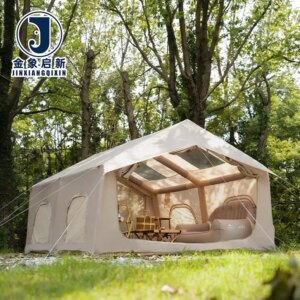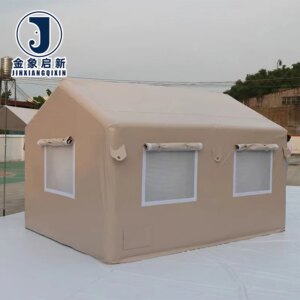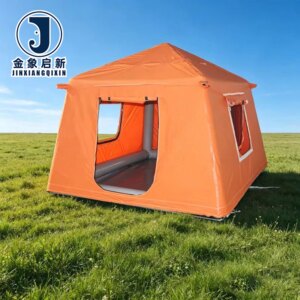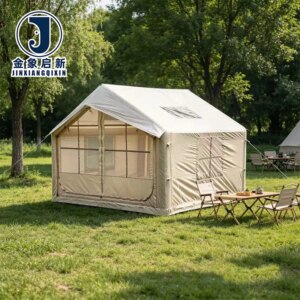
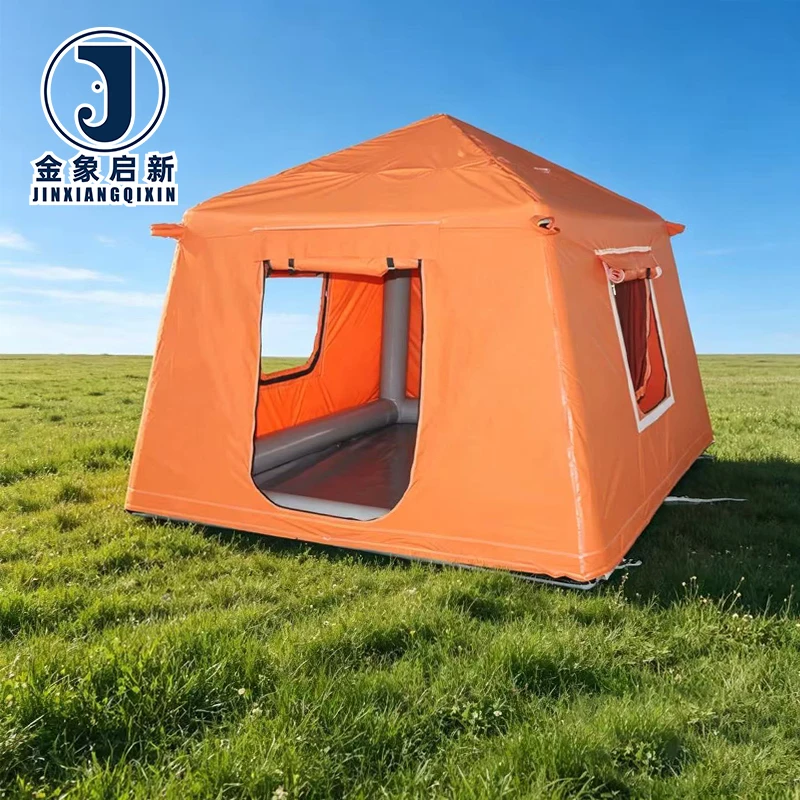
Deep Process Control Over Coated Fabric — three full production lines maintain consistent coating weight and adhesion across every roll of 420D Oxford inflatable tent material we ship.
Technical Specifications
| Parameter | Value |
|---|---|
| Product Type | Inflatable Tent |
| Core Material | 420D Oxford |
| Capacity | 5-8 Person |
| Season Suitability | 4-Season |
| Opening Mechanism | Quick Automatic Opening |
| Construction Type | Single Layer |
| Design Type | Extended Type |
| Certifications | ISO9001, ISO14001, ISO45001, CE |
| Customization Service | OEM & ODM (Sample customization, pattern printing) |
| Production Facility Area | 9,180 square meters |
| Production Lines | 3 full production lines |
| Processing Equipment | 36 sets of professional processing equipment |
| R&D Team Scale | 10 technicians |
Application Suitability
| Application | Exposure & Requirement |
|---|---|
| Emergency disaster relief shelters | Rapid deployment under time pressure, exposure to wind, rain and variable terrain, need for structural stability without heavy framing |
| Construction site temporary facilities | Dust, debris impact, UV exposure from open-site conditions, repeated inflation and deflation across project phases |
| Logistics mobile storage units | Outdoor ground contact, moisture ingress risk, handling abrasion from loading and unloading operations |
| Field medical or command posts | Temperature fluctuation across seasons, requirement for clean interior environment, frequent relocation between sites |
Why Base Fabric Denier Matters More Than Marketing Claims for Inflatable Tent Fabric
420D Oxford defines the load-bearing skeleton of the inflatable chamber — everything else is surface treatment.
When international buyers source custom inflatable tent material, the focus often lands on coating thickness or colour consistency while the base fabric specification receives less scrutiny. I have reviewed field reports where inflatable structures failed not because the coating cracked, but because the underlying yarn structure could not contain the internal air pressure during temperature spikes. The denier rating directly governs how much stress each yarn can carry before the weave distorts and the coating layer separates. [NEED_CITE: relationship between base fabric denier and coating adhesion under pneumatic stress per ISO 1421]
How 420D Oxford Handles Pneumatic Stress in Field Conditions
The 420D Oxford base fabric provides a yarn structure dense enough to distribute internal air pressure across the entire panel surface rather than concentrating stress at seam junctions. For an inflatable tent fabric manufacturer, selecting this denier means the material can sustain repeated inflation cycles without progressive weave deformation. This matters particularly when the tent serves as an emergency response facility deployed across multiple disaster zones.
Season Suitability and the Four-Season Performance Boundary
A 4-season rating on an inflatable tent requires the material to remain flexible at low temperatures without becoming brittle, and stable at elevated temperatures without softening the coating bond. The single-layer construction of this product relies entirely on the 420D Oxford substrate to maintain dimensional stability. When the inflatable tent material faces freezing conditions, the base yarn must resist micro-fracturing that would compromise air retention over extended use. [NEED_CITE: low-temperature flexibility test methods for coated technical textiles]
Reading the Specification Sheet Beyond the Headline Numbers
The 420D denier refers to the weight in grams of 9,000 metres of yarn, which establishes the tensile capacity of each individual filament in the weave. Combined with the Oxford weave pattern — a basket weave that pairs two warp yarns over and under a single weft — the fabric gains tear resistance because a propagating tear must break multiple yarn intersections rather than following a single straight path. The extended type design amplifies this requirement, as longer panels experience greater cumulative stress during inflation. The quick automatic opening mechanism depends on the fabric folding and unfolding without crease damage, which the 420D structure supports through its inherent recovery characteristics.
The Hidden Cost of Underspecifying Inflatable Tent Fabric
When buyers accept a lighter base fabric to reduce unit cost, the failure typically appears not on day one but after several deployment cycles. The coating may hold initially, but as the weave stretches under repeated pneumatic loading, micro-gaps open between yarns and the coating begins to delaminate at stress concentration points. For emergency relief organisations, this means a shelter that passes initial inspection but fails during a critical deployment window. [NEED_CITE: field failure analysis of underspecified coated fabrics in temporary structure applications]
Batch-to-batch inconsistency compounds the problem. If one production run uses a slightly different yarn tension during weaving, the resulting fabric may inflate unevenly, creating visible bulges and structural weak points that only manifest under full pressurisation.
Why Buyers Specify This Material Through Our Facility
Our 10-person R&D team reviews each inflatable tent project against the deployment environment before confirming the 420D Oxford specification is appropriate, adjusting coating formulation where the application demands additional chemical or abrasion resistance. Every production run moves through dedicated QA and QC checkpoints, with in-process inspection catching coating weight deviations before they propagate across an entire batch. The 36 sets of professional processing equipment support both roll-stock output and finished tent fabrication, so buyers can source the custom inflatable tent material at whatever stage of completion their supply chain requires. Sample development happens within days for projects requiring pattern printing or non-standard sizing, allowing physical validation before the full order enters production.
Documentation & Verification
- Material specification sheet stating 420D Oxford base fabric, coating type and weight per batch
- Test reports for applicable performance properties, referenced to recognised standards where available
- ISO9001, ISO14001, ISO45001 and CE certificates available for compliance submission
- Pre-shipment inspection record confirming panel dimensions and inflation chamber integrity
- Certificate of origin and customs documentation for international shipment clearance
Fabrication, Handling & Storage
- Heat welding parameters must account for the 420D Oxford coating thickness to achieve full seam fusion without substrate damage
- Store rolls upright on pallets in dry conditions to prevent permanent creasing of the 420D Oxford surface
- Use compatible cleaning agents that do not degrade the coating bond on the single-layer construction
- Allow material to reach ambient temperature before unfolding in cold conditions to avoid coating micro-cracking
- Pattern printing should be test-verified on sample panels to confirm ink adhesion to the 420D Oxford surface finish
What We Need From Your Enquiry
To provide an accurate specification recommendation for your inflatable tent fabric requirements, share the deployment environment including expected temperature range, wind loading and ground conditions. Let us know whether you need roll stock for your own fabrication line or finished units with quick automatic opening mechanism integrated. If your market requires specific fire classification or compliance documentation, state the target standard so we confirm availability before sampling. Colour requirements, pattern printing details and annual volume estimates help us structure the production run for batch consistency across your order.
Frequently Asked Questions
Q: What customization options are available for inflatable tent projects?
A: We offer OEM and ODM services including sample customization and pattern printing on 420D Oxford material. Our R&D team can adjust dimensions, colour and branding to match project specifications. Samples are developed within days for physical validation before committing to full production volume.
Q: How does the 4-season design perform in extreme weather conditions?
A: The 420D Oxford base fabric maintains structural integrity across a wide temperature range, supporting the single-layer construction through freezing and high-heat environments. We recommend sharing your specific deployment climate so we can verify the coating formulation matches the thermal boundary conditions your inflatable tent will face.
Q: What documentation accompanies bulk orders for compliance purposes?
A: Each shipment includes a material specification sheet, pre-shipment inspection record and applicable ISO and CE certificates. For projects requiring fire classification or additional test reports, confirm the target standard at enquiry stage so documentation is prepared before dispatch.
Q: Can sample units be provided before committing to large-volume purchases?
A: Sample development is available within days for custom requirements including non-standard sizing and pattern printing. We encourage buyers to validate the 420D Oxford material performance under their specific inflation and deployment conditions before the full order enters production.
Q: What is the typical deployment time compared to traditional tent structures?
A: The quick automatic opening mechanism significantly reduces setup labour compared to pole-and-canvas assembly. Actual deployment speed depends on tent size and site conditions. We recommend testing sample units with your field team to establish realistic deployment timelines for your operational procedures.