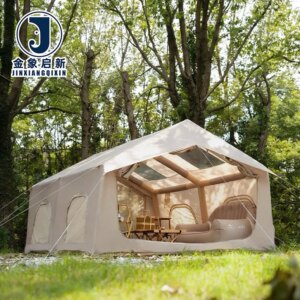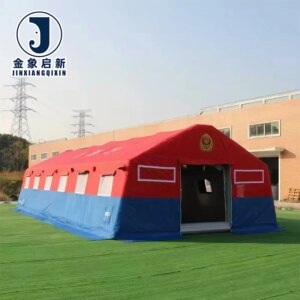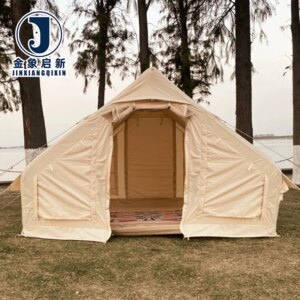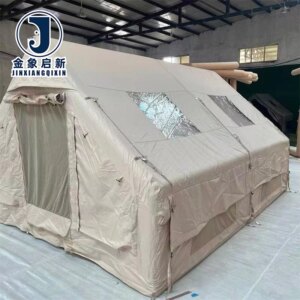
Coated Fabric Mastery — Nearly 30 years of focused PVC tarpaulin production with deep process control over coating weight, adhesion, and base fabric integrity, applied directly to inflatable tent fabric manufacturing for commercial deployment.
Technical Specifications
| Parameter | Value |
|---|---|
| Product Type | Inflatable Tent |
| Core Material | PVC Tarpaulin |
| Waterproof | Yes |
| UV-resistant | Available in UV-resistant formulations — confirm the test basis required for your market |
| Tear-resistant | Yes |
| Fire-retardant | Available in flame retardant grades — confirm the grade required for your local fire code |
| Anti-static | Available in anti-static treatments — specify the standard required for your application |
| Product Forms | Single Layer Construction, Extended Type |
| Customization Service | OEM & ODM (sample customization, pattern printing) |
| Standards | ISO9001, ISO14001, ISO45001, CE |
Application Suitability
| Application | Exposure & Requirement |
|---|---|
| Commercial Glamping Sites | Year-round weather cycles, guest comfort, fire code compliance, repeated inflation and deflation stress |
| Industrial Temporary Shelters | High-traffic internal movement, rapid setup demands, chemical or dust exposure depending on site |
| Large-Scale Event Accommodations | Crowd safety compliance, quick teardown between events, visual consistency across multiple units |
| Four-Season Camping Facilities | Freeze-thaw moisture cycles, sustained UV exposure in peak season, wind load on inflated structure |
Why Fire-Retardant Certification Without a Grade Is a Liability Risk
Request the specific fire classification standard before placing any bulk order for commercial inflatable tent structures.
Sourcing PVC inflatable tent fabric for glamping or event deployment involves navigating local fire safety regulations that vary widely across jurisdictions. A supplier claiming generic "flame retardant" status without a documented grade — such as B1 per DIN 4102, M2 per NF P 92-507, or NFPA 701 — leaves the buyer exposed at the permitting stage. [NEED_CITE: fire classification standards for temporary structures and tents] Facility operators have faced project shutdowns when inspectors demand the original test certificate and find only a marketing statement on the quotation. This is not a documentation inconvenience; it is a compliance failure that delays site opening and creates contractual disputes between the operator, the tent fabricator, and the material supplier. The procurement chain must close this gap before the material reaches the factory floor.
Coating Integrity and Air Retention Performance
Inflatable tent structures depend entirely on the airtight quality of the welded seams and the base PVC tarpaulin coating. The Inflatable Tent Fabric manufacturer process must ensure that coating adhesion to the base fabric is uniform across the entire roll width. Any delamination at the micro level creates a slow leak path that only reveals itself after the tent is inflated and under sustained internal pressure. This failure mode is particularly costly in commercial glamping operations where a deflated unit means a lost guest booking and an emergency maintenance call. Consistent coating weight application across all three production lines ensures that every roll meets the same baseline performance expectation.
UV Exposure and Long-Term Surface Degradation
Outdoor hospitality structures endure direct solar radiation for extended periods, and the PVC surface must resist embrittlement and chalking over successive seasons. [NEED_CITE: UV degradation mechanisms in plasticized PVC coated fabrics] The available UV-resistant formulations are designed to maintain coating flexibility and colour stability, but the specific test basis and exposure duration rating must be confirmed against the deployment climate. Operators in high-altitude or equatorial regions require a more aggressive stabilizer package than those in temperate zones. Discussing the target installation geography with the Inflatable Tent Fabric manufacturer during the specification stage prevents premature surface failure and unplanned tent replacement.
Reading Beyond the Spec Sheet for Inflatable Applications
The base fabric construction — the denier of the yarn and the density of the weave — determines how the material responds to the constant stress cycling that inflatable structures experience. A single-layer PVC tarpaulin construction must distribute inflation pressure evenly across the entire panel surface. High-denier yarns with tight weave density provide superior tear propagation resistance, which is critical when a puncture occurs and the structural integrity must hold until repair. The coating method and weight influence heat-seal performance: a properly matched coating allows the weld line to achieve bond strength approaching the base fabric itself, rather than becoming the weakest point in the structure. Fire-retardant grades and anti-static treatments add functional layers to the coating system, and each additive package affects the thermal behaviour during welding. Fabricators must adjust their heat-seal temperature and dwell time based on the specific formulation supplied, not assume generic PVC welding parameters apply universally. [NEED_CITE: relationship between coating chemistry and heat-seal parameters in PVC tarpaulins]
When Batch Inconsistency Disrupts a Commercial Rollout
Colour variation between rolls from the same purchase order is a recurring complaint when operators deploy multiple inflatable tents side by side at a glamping site. The visual mismatch is immediately visible to guests and undermines the premium positioning that commercial outdoor hospitality operations depend on. Beyond aesthetics, inconsistent coating thickness across batches can cause welders to experience variable heat-seal behaviour on the same production day, leading to rework and scrap. [NEED_CITE: coating thickness variation and heat-seal consistency in PVC coated fabrics] Dedicated QA/QC oversight at each production stage, with 100% pre-shipment inspection, addresses these risks before the rolls leave the factory. Procurement teams should require batch-specific quality inspection reports that document colour reference, coating weight, and visual assessment against the approved sample.
Why Material Sourcing Decisions Matter Here
The 10-person R&D team handles material selection, pattern printing, custom sizing, and sample development specifically for coated fabric applications like inflatable tent structures. This is not a generic textile operation — it is a focused PVC tarpaulin facility where coating formulation, base fabric sourcing, and finishing processes are controlled under one roof. Three full production lines and 36 sets of professional processing equipment support the volume requirements of commercial buyers without sacrificing the batch-to-batch consistency that multi-unit glamping deployments demand. Pre-production samples are developed within days for custom requirements, allowing fabricators to verify dimensional accuracy, coating feel, colour match, and heat-seal behaviour before committing to bulk production. ISO9001, ISO14001, ISO45001, and CE compliance documentation accompanies the commercial process, providing the traceability that regulatory bodies and insurance underwriters increasingly require for temporary accommodation structures.
Documentation & Verification
- Material specification sheet stating base fabric type, coating weight, and colour reference for each roll
- Test reports for fire-retardant grades and UV-resistant formulations where applicable to the order
- Batch-specific pre-shipment inspection record with order number traceability
- ISO9001, ISO14001, ISO45001, and CE compliance certificates included in shipment documentation
- Certificate of origin and customs support documentation for international PVC inflatable tent fabric shipments
- Roll packing list with individual roll identification for receiving verification
Fabrication, Handling & Storage
- Heat-seal temperature and dwell time must be calibrated to the specific PVC tarpaulin coating formulation supplied, not assumed from generic PVC parameters.
- Store rolls upright on end caps in a climate-controlled environment to prevent flat-spot deformation of the single-layer construction.
- Allow rolls to acclimatize to workshop temperature before unrolling and cutting to prevent dimensional distortion.
- Use compatible PVC-based repair patches and solvent cement matching the coating chemistry for field repairs on inflated structures.
- Protect cut edges with reinforced welding tape at all structural stress points where the inflatable frame joins the panel.
- Avoid dragging PVC tarpaulin sheets across abrasive surfaces during layup to preserve the coating surface integrity.
How to Specify Your Requirement
Provide the intended deployment environment, expected seasonal exposure, and local fire code classification so that the correct PVC tarpaulin formulation is matched to your project. Specify the target tent dimensions, inflation pressure requirements, and whether you require OEM sample customization or pattern printing before bulk production. Clarify the annual volume expectation and whether you need roll stock or finished cut panels to align the production scheduling accordingly.
Frequently Asked Questions
Q: How is the fire-retardant grade verified for local fire code compliance?
A: Fire-retardant performance is available in specific grades upon request. Buyers should provide the applicable local fire code standard — such as DIN 4102, NFPA 701, or equivalent — so that the correct formulation is applied and the corresponding test report is issued. The Inflatable Tent Fabric manufacturer includes the fire classification certificate with shipment documentation when the grade is specified at the order stage.
Q: What UV-resistance test basis supports long-term outdoor deployment?
A: UV-resistant formulations are available, but the specific test basis and exposure duration must be confirmed based on the deployment geography and expected service conditions. Buyers operating glamping facilities in high-UV environments should request the test methodology and results during the pre-production sample approval phase to ensure the formulation matches their climate exposure profile.
Q: How does OEM customization accommodate specific tent dimensions and patterns?
A: The Inflatable Tent Fabric manufacturer supports OEM and ODM customization including custom panel dimensions, pattern printing, and material specification adjustments. Pre-production samples are developed within days to allow fabricators to verify dimensional accuracy, visual appearance, and heat-seal compatibility before confirming bulk production. All custom parameters are documented in the purchase contract.
Q: What documentation accompanies each shipment for regulatory compliance?
A: Each shipment includes a material specification sheet, batch-specific inspection record, compliance certificates for ISO9001, ISO14001, ISO45001, and CE, and a certificate of origin. Fire-retardant test reports and UV-resistance documentation are included where applicable to the order specifications. This documentation package supports import clearance and local regulatory approval processes.
Q: How are batch consistency and colour matching controlled across multiple orders?
A: Dedicated QA/QC staff oversee every production stage with 100% pre-shipment inspection against the approved sample and colour reference. Batch-specific quality inspection reports document coating weight, colour match, and visual assessment. Buyers deploying multiple inflatable tent units at a single site should request these reports to confirm consistency before the rolls are dispatched from the factory.