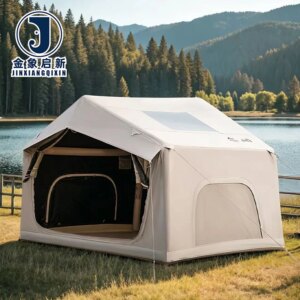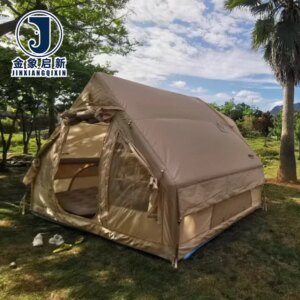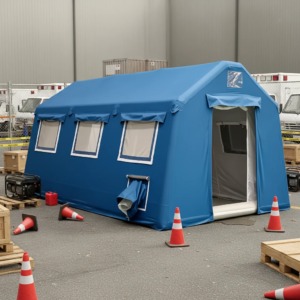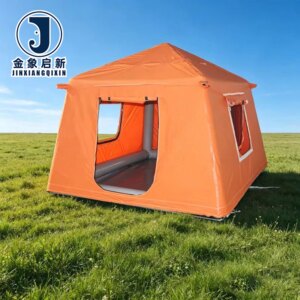
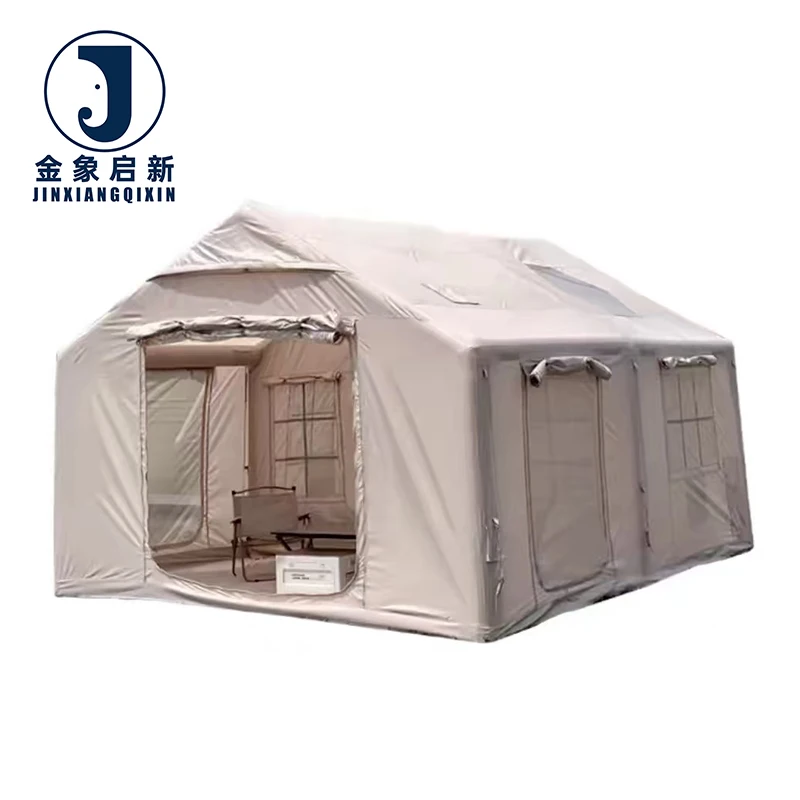
Deep Process Control — nearly three decades of coating weight and adhesion management ensures every roll of PVC inflatable tent fabric meets its stated specification before it leaves the factory floor.
Technical Specifications
| Parameter | Value |
|---|---|
| Product Type | Inflatable Tent Fabric / PVC Emergency Tent |
| Core Material | PVC knife-coated fabric |
| Design | Four-season, single layer, extended type |
| Capacity | 3–5 person |
| Waterproof | Fully waterproof coated construction |
| UV Resistance | UV-resistant coating (test basis not stated — confirm the UV grade required for your market) |
| Tear Resistance | Tear-resistant PVC knife-coated structure |
| Deployment | Quick automatic opening mechanism |
| Customization | OEM & ODM (size adjustments, material thickness variations, custom color options) |
| Quality System | Full-process inspection with dedicated QA & QC staff |
| Certifications | ISO 9001, ISO 14001, ISO 45001, CE |
Application Suitability
| Application | Exposure & Requirement |
|---|---|
| Industrial emergency command centers | Rapid setup, continuous occupation, weather exposure across seasons |
| Post-disaster equipment storage shelters | UV and moisture protection for critical assets during recovery phases |
| Temporary site offices in remote locations | Abrasion from ground contact, wind loading, repeated inflation cycles |
| Material staging and operational coordination | High traffic entry and exit, interior lighting compatibility, structural rigidity under load |
Why Material Certification Gaps Create Procurement Risk for Emergency Shelters
Verified test documentation separates compliant inflatable emergency shelters from untested field liabilities.
When industrial disaster response teams deploy PVC inflatable tent fabric structures without confirmed material grades, the consequences surface fast. Shelters fail UV exposure assessments during extended field operations. Procurement departments discover post-delivery that the flame-retardant or UV-resistant claims on the quotation lack the test report the site safety officer requires. Buyers sourcing custom inflatable emergency tents across multiple jurisdictions face rejection at the compliance checkpoint because the fabric documentation does not match the specification the tender demanded. [NEED_CITE: industrial site safety requirements for temporary emergency structures]
How PVC Knife-Coated Fabric Supports Structural Integrity in Inflatable Applications
The knife-coating process forces PVC compound directly into the weave of the base fabric under controlled tension, producing a bond that resists delamination during repeated inflation and deflation cycles. This matters for custom inflatable emergency tents because the air beams flex constantly under wind load and internal pressure changes. A coating that separates from the base yarn creates an air leak path that compromises the entire structure. PVC inflatable tent fabric manufactured through knife coating maintains coating adhesion across the beam joints and floor-to-wall transitions where stress concentrates most.
Four-Season Material Performance Under Variable Climate Stress
Emergency shelters do not choose their operating season. The single-layer construction of this PVC inflatable tent fabric balances weight for transport against the thermal and moisture demands of year-round deployment. In high-UV environments, the coating must resist surface chalking and plasticizer migration that leads to embrittlement. In cold conditions, the material must retain flexibility so the automatic inflation mechanism can unfold the structure without cracking at fold lines. Sourcing a custom inflatable emergency tent without confirming the material’s temperature performance range invites failure during the exact conditions it was procured to handle. [NEED_CITE: PVC coated fabric low-temperature flexibility and plasticizer migration behavior]
Reading the Specification Sheet Beyond the GSM Number
PVC inflatable tent fabric buyers often anchor decisions on grams per square meter, but GSM alone does not predict how the material will perform in an inflatable structure. The base fabric denier and weave density determine how load distributes across the yarn intersections when an air beam pressurizes. A lighter fabric with a tight weave can outperform a heavier loosely woven alternative in tear propagation resistance. Knife-coated PVC adds structural stiffness that affects how the tent folds and deploys — too stiff and the automatic opening mechanism fights the material; too soft and the beams lack rigidity. Understanding these relationships prevents the common mistake of selecting on weight alone when the application demands a specific balance of strength, flexibility, and deployment speed.
The Cost of Overlooking Weld Line Behavior in Inflatable Tent Procurement
Inflatable tents concentrate mechanical stress at the seams where air beams join the floor panel and where multiple beam sections connect. If the PVC inflatable tent fabric is not matched to the correct hot-air welding parameters, the weld line fails before the fabric itself does. This failure typically appears during the first full-pressure test or, worse, after deployment in the field. Buyers who specify material based only on the face weight discover that the coating formulation does not achieve adequate peel strength at the weld. The result is a batch of custom inflatable emergency tents that pass visual inspection but fail the inflation hold test. [NEED_CITE: hot-air welding parameters and peel strength testing for PVC coated fabrics]
Why Sourcing From a Coated Fabric Specialist Reduces Deployment Risk
Three full production lines and 36 sets of professional equipment allow the factory to maintain batch consistency across multiple inflatable tent orders running simultaneously. A 10-person R&D team develops pre-production samples so buyers can verify material behavior — including inflation response and weld compatibility — before committing to a full manufacturing run. Nearly 30 years of PVC coated fabric process control means coating weight and adhesion are managed at every stage, not sampled only at final inspection. Every roll undergoes 100 percent pre-shipment inspection with QA and QC staff documenting results against the purchase specification. Samples for custom inflatable emergency tent requirements are developed within days, compressing the approval cycle for time-sensitive disaster response procurement.
Documentation & Verification
- Material specification sheet stating PVC coating weight, base fabric construction, and color reference per order
- UV and flame-retardant test reports provided where applicable to the specified grade
- ISO 9001, ISO 14001, ISO 45001, and CE certificates included with shipment documentation
- Pre-shipment inspection record covering inflation testing and structural integrity verification
- Roll packing list with batch traceability for quality tracking through deployment
- Certificate of origin and customs documentation for international industrial procurement
Fabrication, Handling & Storage
- Hot-air welding temperature must match the knife-coated PVC formulation to achieve full peel strength at beam joints
- Store rolls upright on end caps to prevent compression creasing that weakens the coating at fold lines
- Inflate test structures in ambient temperatures above the material’s cold-flex threshold to avoid coating crack
- Use PVC-compatible cleaning agents only; solvent-based products can dissolve the knife-coated surface layer
- Repair field punctures with matching PVC patches heat-welded using portable welders calibrated to the fabric weight
- Allow full curing time after welding before pressurizing beams to prevent seam separation under load
What to Include in Your Inquiry for PVC Inflatable Tent Fabric
Provide the deployment environment — including typical temperature range, UV exposure duration, and wind conditions — so the correct coating grade and thickness can be recommended. Specify whether you require rolls of PVC inflatable tent fabric for in-house fabrication or finished custom inflatable emergency tents with welded beam structures and tested inflation performance. Confirm any fire-retardant or anti-static grades mandated by the destination market’s industrial safety regulations. State your target color and whether printed identification or branding is required on the tent exterior. Indicate your annual volume and whether pre-production samples are needed before bulk manufacturing authorization.
Frequently Asked Questions
Q: How do I verify the PVC coating weight and material specifications upon delivery?
A: Each shipment includes a pre-shipment inspection record documenting the measured coating weight and base fabric construction against your purchase specification. You can cross-reference this with the material specification sheet provided at order confirmation. If your procurement system requires independent third-party testing, samples can be drawn from the production batch for external lab verification before dispatch.
Q: What UV treatment documentation is available for outdoor deployment?
A: UV-resistant coating is applied during the knife-coating process, and test results are provided where the specified grade has been formally assessed. Because UV performance requirements vary by market and exposure duration, confirm the specific UV test standard your project demands so the correct grade is selected and documented before production begins.
Q: What custom dimensions and material thickness options are available?
A: OEM and ODM services cover size adjustments, material thickness variations, and custom color options for PVC inflatable tent fabric. The 10-person R&D team produces pre-production samples reflecting your exact specifications, allowing you to verify inflation behavior and structural performance before authorizing full-scale manufacturing. Minimum quantities depend on the customization scope.
Q: How long does sample development take for custom inflatable emergency tents?
A: Custom samples are typically developed within days once the specification — including dimensions, material thickness, and color — is confirmed. The sample undergoes the same QA process as production units, so inflation testing and weld integrity results from the sample stage reliably predict bulk production performance.
Q: What quality inspection documentation accompanies each shipment?
A: Every order ships with a material specification sheet, pre-shipment inspection record, ISO and CE certificates, roll packing list, and certificate of origin. The inspection record covers coating weight verification, visual defect checks, and inflation testing for finished tent units, providing full traceability for industrial procurement and compliance systems.