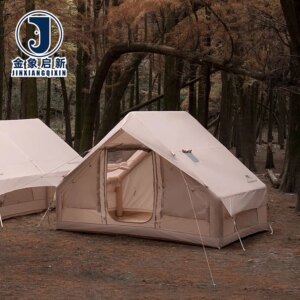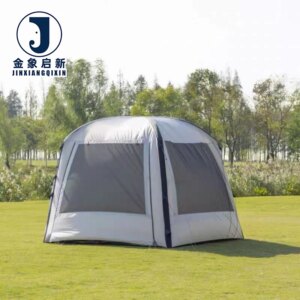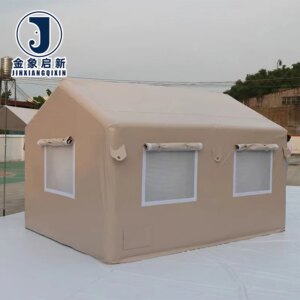
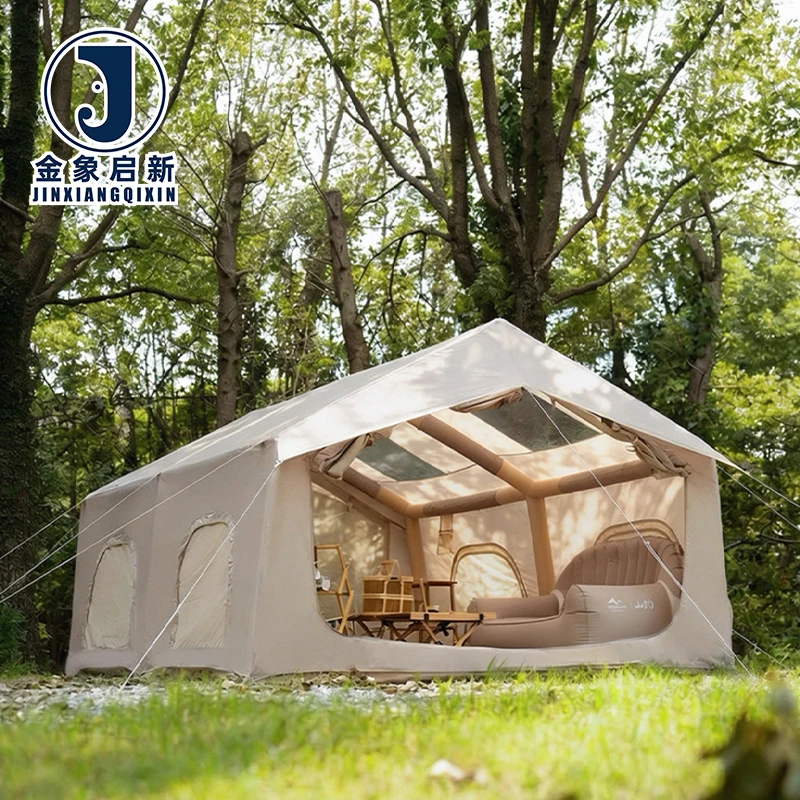
Coating Weight Control — Deep process oversight across three full production lines ensures PVC tarpaulin coating adhesion and GSM consistency for inflatable tent structures used in disaster relief.
Technical Specifications
| Parameter | Value |
|---|---|
| Product Type | Inflatable Tent |
| Core Material | PVC tarpaulin |
| Key Performance | Waterproof, UV-resistant (test basis not stated), tear-resistant |
| Season Rating | 4-Season |
| Capacity | 2-8 Person |
| Deployment Type | Quick Automatic Opening |
| Construction | Single layer |
| Configuration | Extended Type |
| Customization | OEM & ODM (sample customization, pattern printing) |
| Standards | ISO9001, ISO14001, ISO45001, CE |
Application Suitability
| Application | Exposure & Requirement |
|---|---|
| Emergency disaster relief staging areas | Immediate shelter deployment, continuous weather exposure, rapid inflation cycles |
| Temporary site command centers | High foot traffic, equipment movement, prolonged outdoor standing |
| Infrastructure recovery logistics hubs | Year-round variable weather, heavy-duty floor contact, frequent relocation |
| Field medical triage stations | Sterile environment maintenance, wind load resistance, 4-season thermal performance |
| Commercial event covered workspace | Quick setup and teardown, UV exposure, surface abrasion from furniture and equipment |
Why Material Consistency Matters More Than Stated Specifications
Buyers need batch-level traceability, not just a quotation figure, to trust the PVC inflatable tent fabric they deploy in life-critical scenarios.
When sourcing inflatable shelters for disaster relief, procurement teams often receive material that measures lighter than the agreed GSM once tested on arrival. In emergency deployments where tents must inflate reliably and hold pressure through storms, this discrepancy is not a paperwork issue — it is a structural failure waiting to happen. Batch-to-batch variation in coating weight also affects heat-seam parameters, meaning fabricators dial in weld settings for one roll only to find the next roll behaves differently on the production floor [NEED_CITE: tensile and tear test methods for coated fabrics per ISO 1421]. An Inflatable Tent PVC Fabric manufacturer that controls coating in-house and inspects every roll before dispatch removes this variable from your supply chain.
How PVC Tarpaulin Construction Supports Rapid Inflation
The single-layer PVC tarpaulin used in this inflatable tent is engineered to hold air pressure across extended beam structures without delamination under cyclic inflation. Quick automatic opening demands that the air beam fabric maintains dimensional stability the moment internal pressure rises — a property governed by the base fabric weave density and coating adhesion rather than thickness alone. For disaster relief teams deploying shelters in minutes rather than hours, this reliability under first-inflation conditions separates functional shelters from failed ones.
Coating Integrity Across Repeated Deployment Cycles
Every time an inflatable tent is deflated, folded, transported, and re-inflated, the PVC coating at fold lines and seam junctions undergoes mechanical stress. The tear-resistant construction specified for this product addresses the micro-cracking that develops at these stress concentration points over multiple deployment cycles. For organizations maintaining emergency stockpiles that may sit in storage for extended periods before urgent deployment, the coating must remain pliable and intact regardless of storage duration [NEED_CITE: DIN 4102 fire classification for building materials]. An Inflatable Tent PVC Fabric manufacturer with full-process QA can verify that each batch meets these repeatability requirements before it reaches your warehouse.
Reading the Specification Sheet Beyond the Headline GSM
The stated waterproof and tear-resistant performance of this PVC tarpaulin depends on the interplay between base fabric denier, weave count, and coating weight — not on GSM alone. A heavier coating does not automatically deliver higher tear strength if the underlying fabric uses a lower-denier yarn or a looser weave. For inflatable tent applications, the beam structure concentrates stress along longitudinal seams, meaning warp-direction tensile strength often matters more than overall weight. Specifying by application requirement — air-holding capacity, fold endurance, seam peel strength — rather than by GSM alone produces a material that actually performs in the field. The 4-season rating assigned to this product reflects its capacity to handle temperature-driven expansion and contraction across varying climates without coating embrittlement or excessive softening.
The Hidden Cost of Specifying on Price Per Kilogram Alone
Procurement teams that select inflatable tent fabric primarily on unit cost often discover downstream expenses that dwarf the initial savings. Rolls with inconsistent coating weight force fabricators to re-calibrate heat-sealing equipment between batches, generating scrap and downtime. Material that tests below the quoted GSM after delivery triggers rejection procedures, replacement orders, and deployment delays — consequences that are catastrophic when shelters are needed for active disaster response [NEED_CITE: coating weight verification methods for industrial tarpaulin]. An Inflatable Tent PVC Fabric manufacturer committed to 100% pre-shipment inspection eliminates these hidden costs by catching deviations before the material leaves the factory.
What This Supply Chain Delivers for Inflatable Tent Buyers
Coating formulation and application are controlled in-house across three dedicated production lines, giving direct oversight of the PVC layer that determines air-beam performance. A 10-technician R&D team handles material selection, pattern printing, and sample development specifically for inflatable structures, shortening the path from concept to approved prototype. Every production stage includes dedicated QA/QC checkpoints, with full inspection completed before dispatch — not sampled after the fact. OEM and ODM customization covers sizing adjustments, surface finish, and printed identification, all developed against your deployment specifications rather than from a standard catalogue.
Documentation & Verification
- Material specification sheet stating base fabric, PVC coating type, and confirmed GSM per roll
- UV-resistance and performance test reports provided where applicable to your market requirements
- ISO9001, ISO14001, ISO45001, and CE certificates included for cross-border procurement compliance
- Pre-shipment inspection record with batch-level traceability linked to your order number
- Roll packing list detailing quantities, dimensions, and net weights for customs clearance
- Certificate of origin and customs documentation supporting international disaster relief shipments
Fabrication, Handling & Storage
- Heat-seal PVC tarpaulin at manufacturer-recommended temperature and dwell time to prevent coating delamination at beam seams
- Allow folded inflatable tent fabric to acclimate to ambient temperature before inflation to avoid stress cracking at crease lines
- Store PVC tarpaulin rolls vertically on pallets in a covered area to prevent permanent compression marks on the coating surface
- Clean single-layer PVC surfaces with mild detergent only; solvent-based cleaners may degrade the coating finish over time
- Inspect welded seams at air-beam junctions before each redeployment to catch early signs of peel separation
- Plan cutting layout to minimize cross-grain seams in high-stress beam areas where tear resistance is directional
What to Include in Your Next Inquiry
Provide the intended deployment environment, expected inflation frequency, and any fire-safety or compliance requirements specific to your target market. Confirm whether you need finished tents in custom dimensions or roll stock for your own fabrication line, along with estimated annual volume and preferred colour or printing specifications. Sample approval before production ensures the PVC tarpaulin meets your air-beam pressure requirements and surface finish expectations before full-order commitment.
Frequently Asked Questions
Q: How is GSM and coating weight verified on arrival for inflatable tent fabric?
A: Every roll undergoes weight verification against the stated specification during pre-shipment inspection, with results documented per batch. On arrival, buyers can cross-reference the inspection record using their order number. If a discrepancy is found, the traceability system identifies the specific production run for resolution. Request the material specification sheet before dispatch to establish your acceptance baseline.
Q: What UV-resistance test data supports the outdoor exposure claims?
A: UV resistance is available as a treatment option; the specific test basis depends on the grade selected for your market. Buyers should request the applicable test report when confirming material specifications during the sampling stage. For disaster relief deployments in high-sunlight regions, specifying the required UV performance level at inquiry ensures the correct treatment is applied and documented before production begins.
Q: What OEM and ODM customization options are available for size, colour, and pattern printing?
A: Full customization covers dimensions, PVC tarpaulin material selection, colour matching, and pattern printing for organizational identification or instructional markings. The R&D team develops samples within days for custom requirements, allowing buyers to confirm specifications and print accuracy before committing to mass production. Both OEM branding and ODM design adjustments are supported across single-layer inflatable tent configurations.
Q: How is batch-to-batch colour consistency controlled across a multi-unit order?
A: Colour consistency is managed through controlled coating formulation and in-process QA checks at every production stage. For orders spanning multiple production runs, reference samples from the approved batch are used to verify subsequent rolls before dispatch. Buyers placing large-quantity disaster relief orders should request pre-shipment inspection records that document colour verification across all rolls in the shipment.
Q: What compliance documentation accompanies shipment for international disaster relief procurement?
A: Shipments include ISO9001, ISO14001, ISO45001, and CE certificates, a material specification sheet, pre-shipment inspection records, roll packing lists, and certificates of origin. Additional documentation such as customs support paperwork is provided based on destination country requirements. Buyers should confirm their specific compliance needs at the inquiry stage so all documents are prepared before dispatch.