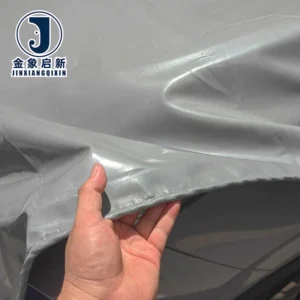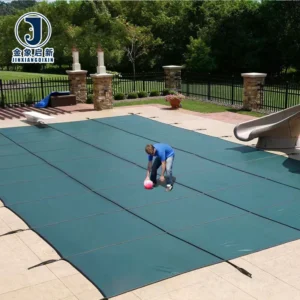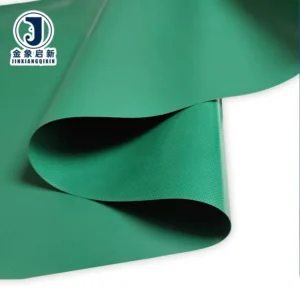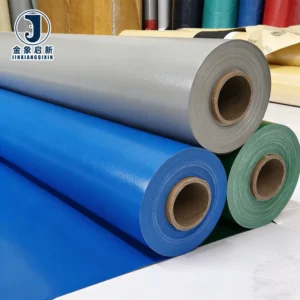
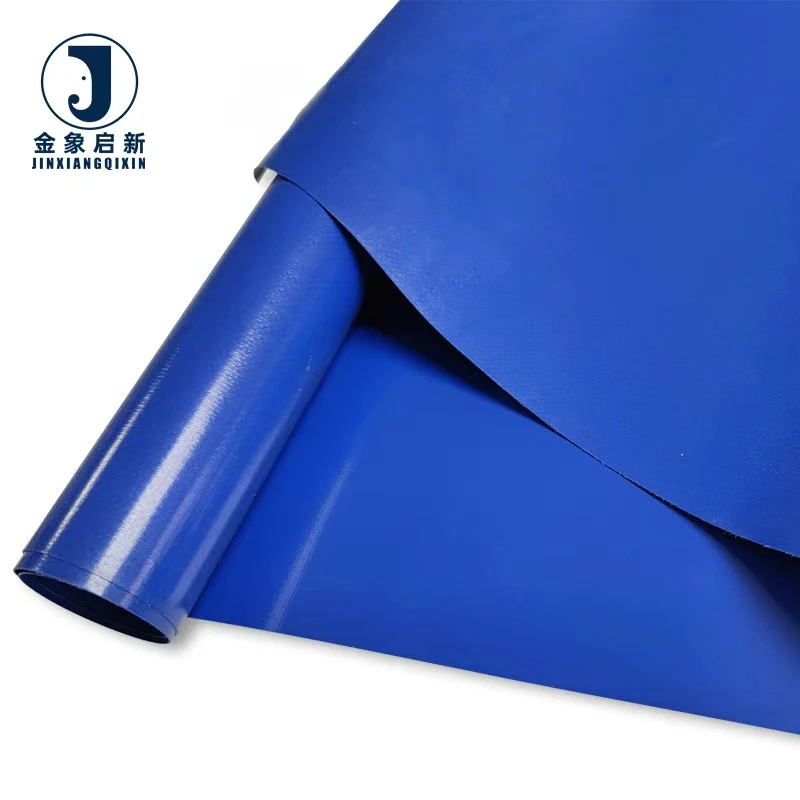
Coating adhesion control — verified across every roll through in-process peel strength checks and pre-shipment GSM validation, matching the specification sheet you approved.
Technical Specifications
| Parameter | Value |
|---|---|
| Product Type | PVC Tarpaulin Roll |
| Material Composition | PVC coating on high-strength polyester mesh fabric |
| Coating Method | Laminated technology; Hot-melt coating technology |
| Weight Options | 350gsm, 420gsm, 500gsm, 550gsm, 600gsm, 750gsm |
| Thickness Range | 0.32mm, 0.35mm, 0.4mm, 0.45mm, 0.5mm, 0.65mm |
| Standard Roll Size | 2m × 75m; 2.1m × 50m |
| Colour Range | Blue, Red, Yellow, Light blue, Grey (custom colours available) |
| Base Fabric | High-tenacity polyester yarn mesh |
| Key Features | Cold crack resistance, anti-mildew, waterproof, sunproof, good colour fastness |
| Optional Treatments | Flame retardant, anti-static, anti-cold, anti-mildew, 3P — confirm the grade required for your market |
Application Suitability
| Application | Exposure & Requirement |
|---|---|
| Truck side curtains and awnings | Constant flexing at hinges, road spray abrasion, prolonged sun exposure — demands high tear strength at weld lines |
| Construction and scaffolding enclosure | Wind loading, UV degradation, contact with mortar and chemicals — requires puncture resistance and coating adhesion |
| Temporary industrial and equipment covers | Outdoor storage, forklift handling, repeated deployment — needs abrasion tolerance and dimensional stability |
| Agricultural and pond liners | Permanent water contact, soil chemistry, root penetration risk — requires fully waterproof coated construction |
| Tent and inflatable structure fabric | Tensioned panels, thermal expansion cycles, fire safety compliance — demands consistent GSM and weld integrity |
| Marine and offshore maintenance covers | Salt spray, high humidity, deck abrasion — needs anti-mildew treatment and coating durability |
Why the Coating Process Matters More Than GSM Alone
The bond between the PVC layer and the polyester mesh determines whether your fabricated product survives its first season or delaminates under load.
Technical buyers reviewing a PVC coated tarpaulin roll specification often fixate on GSM as the primary strength indicator. But two rolls at identical weight can perform very differently depending on whether the coating was laminated or hot-melt applied, and how thoroughly the PVC penetrated the base fabric weave. A heavy roll with poor adhesion will separate at the weld seam before the fabric itself fails. [NEED_CITE: peel strength test methods for coated fabrics per ISO 2411]
I have reviewed field returns where the coating peeled cleanly away from the mesh at stress points, even though the stated GSM matched the purchase order. The issue was not weight — it was the coating bond. This is why understanding the manufacturing technology behind the roll is the first step in specifying material for fabrication.
How Laminated and Hot-Melt Coating Differ in Practice
Laminated technology bonds pre-formed PVC film to the polyester mesh under heat and pressure, creating a uniform coating thickness with strong adhesion across the full width. This PVC coated tarpaulin roll produced via lamination tends to show consistent peel strength values and predictable behaviour during high-frequency welding. The process suits applications where the fabricated seams must carry structural loads, such as tensioned membrane structures or truck curtain side panels that flex repeatedly at the weld line.
Coating Penetration and Its Effect on Weld Integrity
Hot-melt coating applies liquid PVC directly into the mesh, allowing the compound to flow between yarns before curing. The result is a mechanical lock between coating and base fabric that resists delamination under shear stress. [NEED_CITE: coating adhesion mechanisms for polyester mesh substrates] When you heat-weld two panels together, the seam strength depends on how much PVC is available at the surface to fuse — and hot-melt coated rolls typically provide a thicker surface layer for the weld to bond with. This matters for applications like pond liners or industrial ducting where seam failure means total system failure.
Reading GSM and Thickness as a System, Not Isolated Numbers
The weight-to-thickness ratio reveals the density of the PVC compound and the proportion of base fabric in the total construction. A 350gsm roll at 0.32mm suggests a thinner coating over a lighter mesh, suited to short-term covers and temporary enclosure. A 750gsm roll at 0.65mm indicates substantial coating mass on a heavier base fabric, built for sustained mechanical stress and long-term outdoor deployment. The gap between these grades is not just weight — it is the number of polyester yarns per centimetre in the weave and the denier of each yarn, both of which govern how a tear propagates once the surface is punctured.
What Happens When Material Is Specified by Weight Without Checking the Weave
A roll that meets the GSM target but uses a lower-denier yarn in a looser weave will have more PVC filler and less structural fibre. The weight checks out on the scale, but the tear resistance drops because there are fewer yarns to arrest a rip once it starts. This mismatch surfaces during fabrication: the material cuts and welds normally, but finished products fail prematurely at load-bearing seams. [NEED_CITE: relationship between yarn denier and tear propagation in coated textiles] Specifying the base fabric construction alongside GSM closes this gap and gives your QC team a second verification point at receiving.
Why Procurement Verification Protects Your Fabrication Line
Batch inconsistency in coating weight or colour shade forces fabricators to adjust welding parameters mid-production or reject panels after assembly. When multiple rolls in a single order vary in GSM, the weld temperature that works for one panel may under-fuse or over-fuse the next. Colour variation between rolls becomes visible the moment panels are installed side by side on a truck curtain or building facade. Requesting a roll-by-roll inspection record and shade reference before shipment prevents these downstream rework costs. [NEED_CITE: colour fastness and batch consistency standards for coated fabrics]
Why Source Directly From the Coating Line
Process control over coating weight and adhesion is maintained through dedicated QA at every production stage, with 100% inspection before any roll ships. The three full production lines and 36 sets of professional equipment support bulk volume without sacrificing batch-to-batch consistency. A 10-person R&D team handles material selection, custom GSM and colour matching, and sample development — typically delivering samples within days rather than weeks. ISO and CE certified production ensures documentation traces every roll back to its coating run, and the team exports to buyers across North America, Europe and Asia who require verified material data for compliance submissions.
Documentation & Verification
- Material specification sheet listing exact GSM, base fabric construction, coating method, and colour reference per roll
- Test reports for flame retardant and anti-static grades — confirm the standard applicable to your market
- Pre-shipment inspection record with measured GSM and coating weight per roll against stated values
- Roll packing list with batch numbers enabling full traceability to the coating production run
- Certificate of origin and customs documentation prepared per destination country requirements
Fabrication, Handling & Storage
- High-frequency welding parameters must be adjusted per GSM grade — 350gsm and 750gsm rolls require different dwell times and pressure settings
- Store rolls upright on pallets to prevent flat-spot deformation that affects coating adhesion at the compressed area
- Unroll and allow cold-stored material to reach ambient temperature before welding to avoid brittle fracture at the seam
- Anti-mildew treated rolls should not be stored in sealed plastic wraps where condensation promotes fungal growth on cut edges
- Custom-width rolls reduce offcut waste during panel layout — specify the exact panel dimensions to optimise roll width ordering
Before You Request a Quote
To match the correct coating technology and GSM grade to your project, share the end-use application, the mechanical loads the finished product will carry, and any fire safety or anti-static standards your market requires. If you are fabricating welded panels, provide the seam configuration and the welding method your shop uses so the coating formulation can be aligned to your equipment. For colour-matched orders across multiple rolls, specify the Pantone or RAL reference and the acceptable shade tolerance for side-by-side installation.
Frequently Asked Questions
Q: How do I verify the actual GSM of the PVC coated tarpaulin roll when it arrives?
A: Cut a measured sample from the roll interior, weigh it on a calibrated scale, and calculate grams per square metre. Compare the result against the material specification sheet provided with the shipment. Requesting the pre-shipment inspection record gives you a second data point to cross-reference before your own receiving QC begins.
Q: What test reports are available for flame retardant and anti-static treatments?
A: Test reports can be provided for the specific grade applied to your order. Confirm which standard your market requires — such as DIN 4102, NFPA 701, or a local building code classification — before production so the correct treatment is applied and documented on the material specification sheet.
Q: How does lamination versus hot-melt coating affect my welding setup?
A: Laminated rolls offer uniform coating thickness and predictable weld parameters across the full roll width. Hot-melt coated rolls provide*e slightly higher welding energy to achieve full fusion at the seam. Share your welding method so the correct coating type is recommended.
Q: Can colour consistency be guaranteed across multiple rolls in one order?
A: Production uses controlled pigment dosing and shade checking against a reference standard during the coating run. The pre-shipment inspection includes visual comparison between rolls. For projects where panels are installed side by side, specify your acceptable shade tolerance at the inquiry stage.
Q: What cold temperature can the anti-cold treatment withstand?
A: The cold crack resistance performance depends on the specific formulation applied. Request the test data for the anti-cold grade relevant to your operating environment, and confirm the minimum service temperature your application requires so the correct compound is selected.