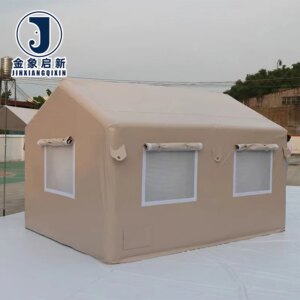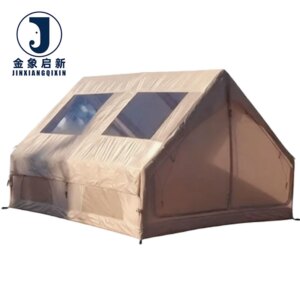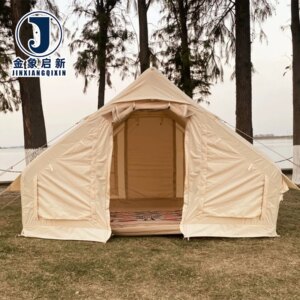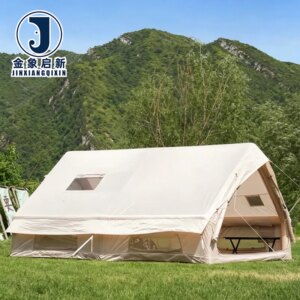
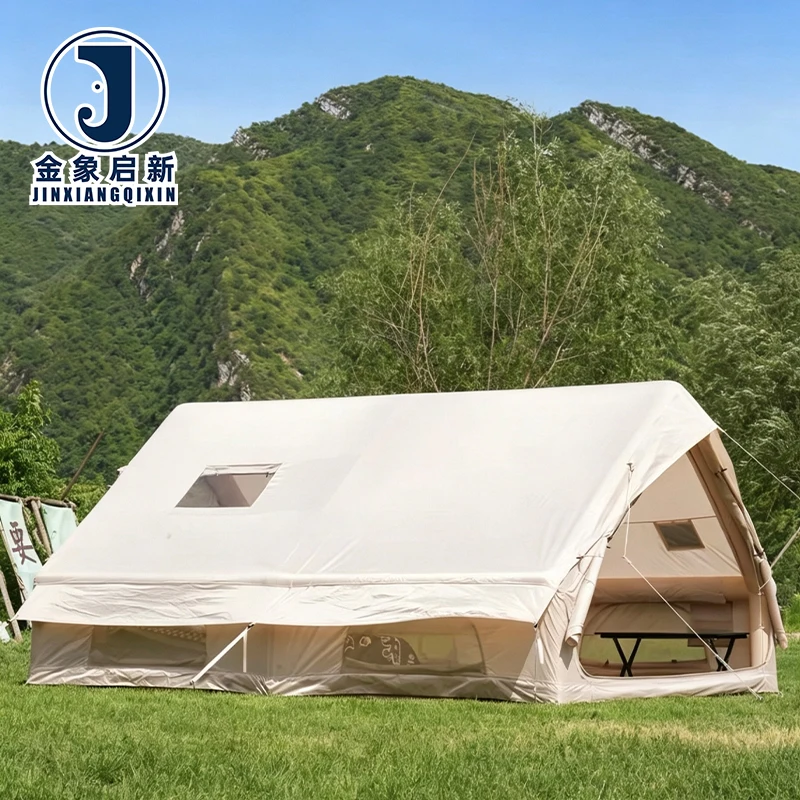
Controlled Coating Weight — digital gauge monitoring maintains ±2% thickness tolerance across every roll of Inflatable Tent PVC Tarpaulin Material, ensuring uniform behavior when multiple units are fabricated side by side.
Technical Specifications
| Parameter | Value |
|---|---|
| Product Type | Inflatable Tent PVC Tarpaulin Material |
| Core Material | PVC Tarpaulin |
| Waterproof Rating | 3000mm water column |
| Flame Retardant | EN 13501-1 (grade not stated in source — confirm required grade for your market) |
| UV Treatment | UV-resistant (test basis not stated in source — request test report) |
| Anti-Static | Stated (surface resistance or standard not stated in source) |
| Thickness Tolerance | ±2% across production batches |
| Raw Material Standard | GB/T 5761-2006 (virgin PVC resin) |
| Quality Assurance | 24-hour airtightness and structural stability test before shipment |
| Color Customization | Pantone color codes |
| Available Customization | OEM & ODM, sample customization, pattern printing, size adjustments, custom door/window configurations |
| Certifications | ISO9001, ISO14001, ISO45001, CE |
Application Suitability
| Application | Exposure & Requirement |
|---|---|
| Inflatable tent fabricators producing commercial camping structures | Repeated inflation cycles, prolonged outdoor UV exposure, waterproof integrity at seams and weld lines |
| Membrane and inflatable structure contractors for mining or aviation sites | Fire-retardant compliance on-site, anti-static performance, structural airtightness under continuous air pressure |
| Event management companies deploying temporary inflatable enclosures | Rapid deployment stress, wind load on welded seams, batch colour consistency across multiple units |
| Temporary workforce housing and field research stations | Extended weather exposure, thermal cycling, interior climate containment |
| Commercial adventure tourism base camps | High-frequency assembly and teardown, abrasion at ground contact points, UV degradation over prolonged seasons |
What "Flame Retardant" Means When No Grade Backs the Claim
Flame retardant is not a single standard — it is a range of classifications that vary by market and application.
Every purchasing specification for Inflatable Tent PVC Tarpaulin Material should name the exact fire classification required. A claim of "fire retardant" without a referenced grade leaves the fabricator exposed at the compliance audit stage, particularly when inflatable structures are deployed at commercial event venues or industrial work sites where inspectors demand documented proof. [NEED_CITE: EN 13501-1 fire classification system for construction and building materials] Fabric sourced without verified test documentation has been known to fail site inspections, forcing project delays and replacement orders that cost far more than the original material procurement.
Coating Method and Tensile Integrity
The base fabric denier and weave density work together with the coating weight to determine how the material performs under inflation pressure. Virgin PVC resin sourced to GB/T 5761-2006 provides consistent polymer behavior during heat sealing, reducing the risk of seam delamination at the stress points where air pressure concentrates. When recycled material enters the resin mix, the melt viscosity becomes unpredictable, and weld lines can separate before the fabric itself reaches its tensile limit.
Airtightness Validation Before Dispatch
Inflatable structures depend on continuous air pressure for structural stability, making the fabric’s airtightness a non-negotiable property. Every production batch undergoes a 24-hour inflation test that monitors pressure retention and seam behavior under sustained load. This test identifies coating pinholes, weak heat-seal bonds, and base fabric inconsistencies that shorter spot checks would miss. [NEED_CITE: airtightness testing protocols for inflatable membrane structures]
Reading the Specification Sheet Correctly
A 3000mm water column rating tells you the hydrostatic pressure the coated fabric can resist before water penetrates — relevant for inflatable tents deployed in heavy rainfall or standing water conditions. Thickness tolerance of ±2% across production batches matters when fabricators heat-seal multiple panels together; material that varies in thickness beyond this range causes uneven heat distribution at the weld, leading to inconsistent bond strength. The anti-static property addresses electrostatic charge buildup on the fabric surface, relevant in mining and aviation environments where discharge could ignite airborne particulates, though the specific surface resistance standard should be confirmed for your application. PVC coated fabric responds differently to temperature extremes than uncoated textiles, and understanding the low-temperature flexibility boundary is important for inflatable structures deployed in cold climates where the coating can become brittle.
The Hidden Cost of Specifying on Price Per Kilogram
When the deciding factor is cost per kilogram rather than verified coating adhesion and GSM consistency, the consequences appear at the fabrication stage. Rolls that arrive lighter than the quoted specification yield panels that do not hold inflation pressure as designed, forcing the manufacturer to add reinforcement layers or reject the batch entirely. [NEED_CITE: coating weight verification methods for PVC tarpaulin incoming inspection] Colour variation between rolls in the same order becomes visible when panels are installed side by side on a finished inflatable structure, triggering client rejection on aesthetic grounds even when the material is mechanically sound.
Why Technical Buyers Source Here
Three full production lines and 36 sets of professional equipment allow bulk roll orders to be completed with consistent lead times, even when custom widths or Pantone-matched colours are specified. A 10-person R&D team handles material selection, pattern printing, and sample development — meaning you can request a sample roll cut to your required width before committing to a full production run. Nearly 30 years of focused experience in coated fabric gives the production team process control over coating weight and adhesion that newer facilities are still developing. Dedicated QA and QC at every stage, with 100% inspection before shipment, means each roll is checked against the batch specification for thickness, tensile properties, and colour match. Custom samples are developed within days, so your fabrication team can validate heat-seal parameters and cutting patterns before the main order enters production.
Documentation & Verification
- Material specification sheet stating GSM, base fabric denier, coating material and method for every roll of Inflatable Tent PVC Tarpaulin Material
- EN 13501-1 flame retardant test report and UV resistance test report included with shipment documentation
- ISO9001, ISO14001, ISO45001, and CE certificates available for compliance submissions
- Pre-shipment inspection record with batch-specific thickness, tensile strength, tear resistance, and waterproof rating parameters
- Roll packing list with batch identification for traceability across multi-roll orders
- Certificate of origin and customs documentation support for cross-border shipments
Fabrication, Handling & Storage
- Set heat-seal temperature and dwell time based on the ±2% thickness tolerance range — test on a sample strip before production welding begins.
- Store rolls upright in a dry, shaded area to prevent compression marks on the PVC coating surface that affect print adhesion.
- Allow rolls to acclimatize to workshop temperature before unrolling — cold PVC tarpaulin can crack along the fold line.
- Match cutting patterns to available roll width to minimize offcuts and seam count on large inflatable panels.
- Clean the coated surface with neutral pH detergent only; solvent-based cleaners can degrade the UV treatment layer.
- Repair minor coating damage on-site with compatible PVC adhesive patches applied to a clean, dry surface.
Before You Request a Quote
Provide your target deployment environment, the fire classification required by your local authority, and the roll width that fits your fabrication equipment. Confirm whether you need plain rolls or finished panels with custom door and window configurations, and specify your Pantone colour references if batch consistency across multiple orders is critical. State your annual volume so production scheduling can accommodate your lead time requirements.
Frequently Asked Questions
Q: How do I verify the GSM and coating weight when rolls arrive?
A: Request the pre-shipment inspection record that documents weight per square meter for each roll. On arrival, cut a measured sample from the roll edge and weigh it on a calibrated scale. Compare the result against the material specification sheet supplied with your order. Any discrepancy beyond the stated thickness tolerance should be reported with the batch number for resolution.
Q: What does EN 13501-1 cover, and how does it map to my market’s fire safety requirements?
A: EN 13501-1 is a European classification system that rates construction products by reaction to fire, including ignitability, flame spread, and smoke production. Different markets reference different standards — confirm whether your project specification requires EN 13501-1 or an equivalent national classification. Request the test report to see the specific sub-grade achieved by this Inflatable Tent PVC Tarpaulin Material.
Q: What causes seam failure before fabric failure in inflatable structures?
A: Heat-sealed seams fail prematurely when coating adhesion is inconsistent or when heat-seal parameters do not match the material thickness. Virgin PVC resin to GB/T 5761-2006 provides predictable melt behavior, but the fabricator must calibrate temperature and pressure to the specific batch. Always run a test weld on sample material before committing to full panel production.
Q: How is colour consistency maintained across multiple rolls in one order?
A: All rolls in a single production run use the same Pantone-referenced pigment batch and pass through the coating line under identical conditions. The pre-shipment inspection record documents colour values per roll. For orders placed at different times, request a production sample from the new batch to verify colour match against your previous material before full fabrication.
Q: Can I order sample rolls before placing a bulk order?
A: Sample rolls are developed within days of receiving your specification, including custom width, colour, and treatment requirements. Use the sample to validate your heat-seal parameters, cutting patterns, and inflation test procedures. Once the sample is approved, the main production run follows the same material formulation and process settings.