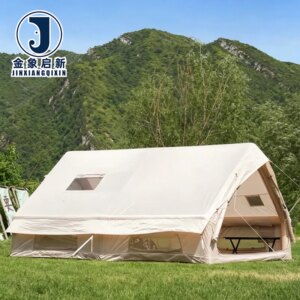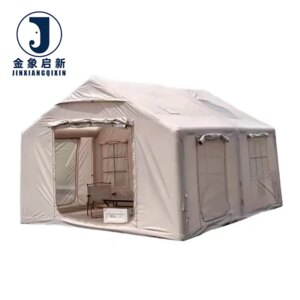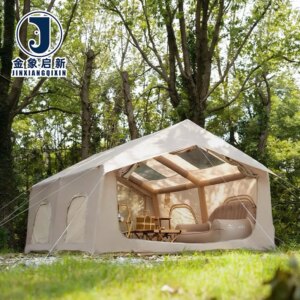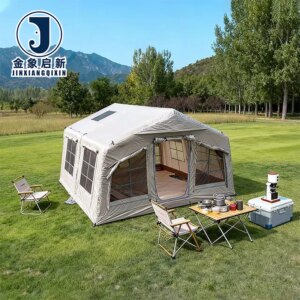
Proven Coating Expertise — Nearly 30 years focused on PVC coated fabric translates into controlled coating adhesion and consistent seam integrity for inflatable tent structures.
Technical Specifications
| Parameter | Value |
|---|---|
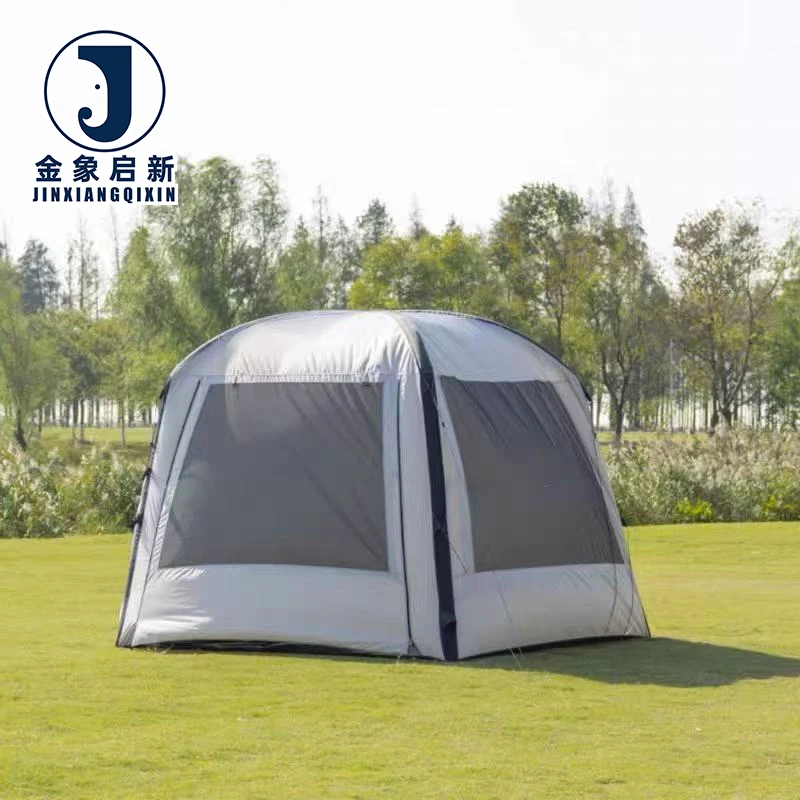
| Product Type | Inflatable Glamping Tent |
| Core Material | PVC tarpaulin |
| Construction | Single-layer PVC |
| Capacity | 6-Person |
| Opening Mechanism | Automatic opening |
| Season Rating | Four-season |
| Waterproof | Yes |
| UV-Resistant | Available (test basis not stated — confirm required exposure rating) |
| Tear-Resistant | Yes |
| Fire-Retardant | Available in flame retardant grades (grade not stated — confirm the grade required for your market) |
| Anti-Static | Available (standard not stated — confirm target compliance requirement) |
| Certifications | ISO9001, ISO14001, ISO45001, CE |
| Customization | OEM & ODM: size adjustments, pattern printing, material thickness modifications |
| Inflation Testing | 24-hour leak test before shipment |
Application Suitability
| Application | Exposure & Requirement |
|---|---|
| Commercial camping grounds | Year-round UV and weather exposure, rapid turnover deployment, guest comfort and safety |
| Outdoor hospitality setups | Premium aesthetic with branded surfaces, four-season thermal and wind stability |
| Event infrastructure | Temporary high-visibility shelter, repeated assembly and teardown cycles |
| Industrial temporary shelters | Fire safety compliance on work sites, wind and dust resistance |
| Tourism operator sites | Quick-setup accommodation, resistance to frequent inflation and deflation cycles |
| Premium outdoor gear manufacturing | Reliable inflatable tent fabric sourcing with consistent batch quality |
Why Airtight Seam Integrity Matters More Than Fabric Weight Alone
A tent that holds pressure for 24 continuous hours in the factory is a tent that will not deflate on your guest’s first night.
When inflatable glamping tents fail in the field, the rupture rarely starts in the body of the PVC tarpaulin. It starts at a welded seam where coating adhesion could not match the flexing forces of repeated inflation cycles. Buyers often focus on base fabric denier or total GSM while overlooking the heat-weld parameters that determine whether the seam outlasts the panel. A PVC inflatable tent fabric manufacturer that skips post-production air-hold testing leaves the buyer to discover weak welds only after deployment. [NEED_CITE: tensile and tear test methods for coated fabrics per ISO 1421]
Single-Layer PVC Construction for Commercial Deployment
Single-layer PVC construction reduces overall packed weight and volume without sacrificing the airtight performance that inflatable structures demand. For glamping operators managing multiple units across a site, the lower transport mass means faster repositioning between seasons and reduced storage footprint during off-months. The PVC inflatable tent fabric manufacturer designs this construction to balance panel rigidity when inflated against foldability when deflated, supporting commercial logistics where turnaround time between guest bookings is measured in hours.
Coating Adhesion and the 24-Hour Inflation Protocol
Every finished unit undergoes a continuous 24-hour inflation leak test before it leaves the production floor. This protocol verifies that the PVC coating has bonded to the base fabric with sufficient peel strength to resist delamination under sustained internal pressure. The R&D team of 10 technicians monitors coating weight and adhesion at each stage of the three full production lines, adjusting heat-weld temperature and dwell time to match the specific material thickness in use. [NEED_CITE: peel strength testing for coated technical textiles]
Reading the Specifications That Actually Determine Field Performance
The waterproof claim rests on the continuity of the PVC coating across the entire panel surface and through every welded seam — a break in either renders the rating void. UV resistance depends on the additive package dispersed through the coating compound, and the effective service life under sun exposure varies significantly between additive grades; buyers should request the specific test basis before committing to a production run. Fire-retardant performance is equally grade-dependent: a B1 classification per DIN 4102 satisfies different jurisdictions than an NFPA 701 rating, and the correct grade must be matched to the installation site’s regulatory framework. Anti-static treatment matters where tents are deployed near sensitive electronic equipment or in dusty environments where static discharge poses an ignition risk. Single-layer PVC construction concentrates all of these treatments into one coating pass, making consistency across the roll critical to uniform performance panel by panel.
The Cost of Overlooking Batch Consistency in Inflatable Fabric Orders
When color shifts between rolls in the same shipment, the variation becomes visible the moment two panels are welded side by side on an inflated structure. Batch inconsistency in coating weight also means that some panels may pass the 24-hour inflation test while adjacent panels from a different roll sit at the margin of acceptable peel strength. Buyers who accept delivery without reviewing the pre-shipment inspection record risk discovering these defects only after the tents are anchored on-site and pressurized. Correcting a seam failure in the field is far more expensive than catching it at the factory gate. [NEED_CITE: quality control standards for PVC coated fabric batch consistency]
What This Production Setup Means for Your Inflatable Tent Project
Three full production lines and 36 sets of processing equipment support volume orders without forcing buyers to accept extended lead times on custom thickness or printed branding. The 10-technician R&D team develops material samples within days, allowing buyers to validate weld parameters and color accuracy before the main run begins. A dedicated QA/QC protocol inspects every production stage, and 100% pre-shipment inspection with the 24-hour inflation test ensures that only units with verified airtight integrity are dispatched. ISO9001, ISO14001, ISO45001, and CE certifications are held at the facility level, providing a documented quality management framework for commercial buyers who must demonstrate supply chain compliance to their own clients.
Documentation & Verification
- Material specification sheet stating base fabric type, PVC coating weight, and all surface treatments applied to each roll
- Batch-specific inspection report covering waterproof integrity, tear resistance, and visual consistency checks
- 24-hour inflation test record attached to each unit confirming airtight seam performance before dispatch
- ISO9001, ISO14001, ISO45001, and CE certificates supplied with shipment documentation
- Fire-retardant and anti-static test reports provided where the specified grade has been confirmed at order stage
Fabrication, Handling & Storage
- Heat-weld temperature and dwell time must be matched to the specific PVC material thickness ordered for inflatable tent panels
- Reinforce all inflation valve mounting points with additional PVC patches to distribute stress across the single-layer construction
- Store rolls upright in a climate-controlled environment to prevent permanent creasing that compromises airtight coating continuity
- Allow cold-transported PVC tarpaulin to acclimate to workshop temperature before unrolling to avoid coating micro-cracking
- Use only PVC-compatible cleaners on finished tent surfaces to preserve the UV-resistant and fire-retardant treatment layers
Before You Request a Quote
Provide your intended deployment climate and the regulatory fire-safety classification your local authority requires for temporary inflatable structures. Specify the tent dimensions, material thickness preference, and whether you need the PVC inflatable glamping tent material custom printed with branding. Confirm your annual volume and whether you require finished units with automatic opening mechanisms or roll stock for your own fabrication line, and indicate if a pre-production sample is needed to validate weld settings.
Frequently Asked Questions
Q: How is the fire-retardant grade verified and does it meet my target market’s safety regulations?
A: Fire-retardant performance is available in multiple grades, and the correct classification depends on your installation jurisdiction. We supply the applicable test report — such as DIN 4102 or NFPA 701 — once you confirm the grade required for your market. Request the specific standard at the inquiry stage so the production formulation matches your compliance target from the first roll.
Q: What UV resistance test basis supports the outdoor exposure claim for inflatable tent fabric?
A: UV resistance is achieved through additives compounded into the PVC coating, and the test basis varies by grade. We provide the relevant exposure test documentation when you specify the required performance level. Share your deployment latitude and expected months of direct sun exposure so we can recommend the appropriate additive concentration.
Q: What customization options exist for size, thickness, and pattern printing on inflatable tent material?
A: Our OEM and ODM capability covers dimensional adjustments to tent panels, material thickness modifications to suit your inflation pressure requirements, and custom pattern printing for branded surfaces. The 10-technician R&D team develops samples within days for your approval before bulk production begins on any of the three dedicated production lines.
Q: How is batch-to-batch color and material consistency controlled across large inflatable tent orders?
A: Every production run follows a controlled coating formulation protocol with in-process QA checks at each stage. The 100% pre-shipment inspection includes visual comparison across rolls to flag color deviation before dispatch. A batch-specific quality report accompanies your order, documenting coating weight and visual consistency results for your records.
Q: What documentation ships with each order for compliance audits and site inspections?
A: Each shipment includes a material specification sheet, batch inspection report, 24-hour inflation test record, and all relevant ISO and CE certificates. Fire-retardant and anti-static test reports are supplied when the applicable grade has been specified. This documentation package supports compliance submissions to local authorities and client audit requirements.