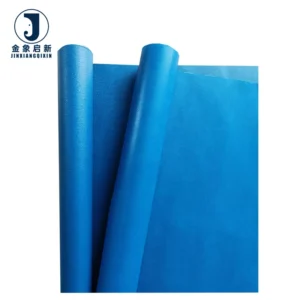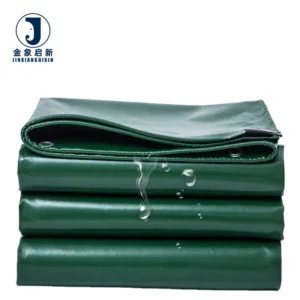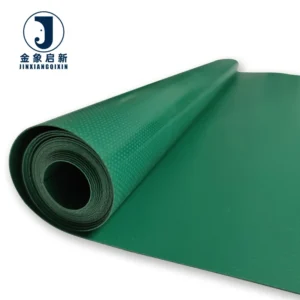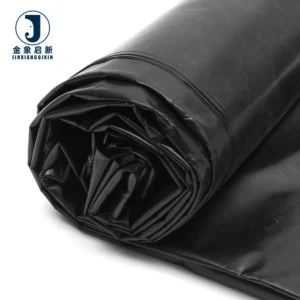
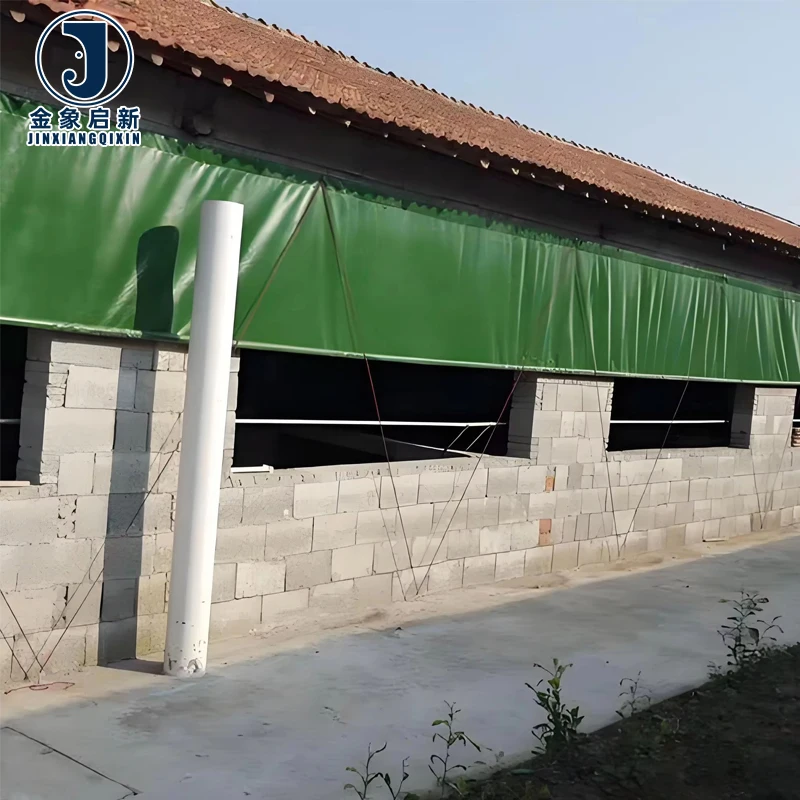
Precision Coating Control — three full production lines with dedicated QA at every coating stage ensure consistent GSM and adhesion across every roll of warp knitted PVC tarpaulin destined for agricultural fabricators.
Technical Specifications
| Parameter | Value |
|---|---|
| Product Type | PVC Coated Tarpaulin Roll |
| Coating Material | PVC |
| Base Fabric Type | Warp knitted polyester |
| Weave Style | Plain woven |
| Waterproof | Yes — fully coated construction |
| Anti-Static | Claimed (test standard not stated in source — verify surface resistance value) |
| Tear Resistance | Claimed (test standard not stated in source — confirm applicable method) |
| Color | Customizable colors available |
| Usage Grade | Industrial / heavy-duty |
| Certification Reference | ISO, CE (cross-reference with supplier documentation) |
Application Suitability
| Application | Exposure & Requirement |
|---|---|
| Poultry house side curtains | Ammonia, moisture, mechanical abrasion from bird contact, ventilation cycling |
| Livestock shelter covers (pig, sheep, cattle) | Continuous moisture, animal impact, wind load on stretched panels |
| Agricultural tent and temporary structure fabric | Seasonal UV exposure, rain ingress, repeated assembly and teardown |
| Farm equipment and stockpile enclosures | Abrasion from contact surfaces, water pooling, dust accumulation |
Why a Coating Weight Figure Without a Test Report Is a Procurement Risk
A quoted GSM value means nothing unless it is verified roll-by-roll at dispatch against a documented method.
Technical buyers sourcing PVC coated tarpaulin roll for farm covers regularly encounter material that arrives lighter than the specification sheet promised. The coating weight directly governs waterproof integrity and the load-bearing capacity at welded seams and eyelet zones. When anti-static or UV treatments are claimed without an accompanying test report, the fabricator has no basis to confirm whether the material meets the environmental requirements of a livestock enclosure. [NEED_CITE: coating weight verification methods for PVC tarpaulin per ISO testing protocols]
How Warp Knitted Construction Influences Farm Cover Performance
The warp knitted polyester base fabric provides dimensional stability under tension, which matters when panels are stretched across livestock shelter frames and subjected to wind load. Unlike loosely woven substrates, the interlocking loop structure of warp knitting distributes stress across multiple yarns, limiting tear propagation from puncture points. PVC coated tarpaulin roll for farm applications relies on this base fabric integrity to maintain panel shape through seasonal temperature shifts and repeated mechanical stress from animal contact.
Coating Adhesion and Waterproof Integrity in Agricultural Environments
The PVC coating method determines how thoroughly the polymer penetrates the warp knitted substrate, which in turn controls waterproof performance and long-term peel resistance. In poultry and livestock environments, panels face constant exposure to moisture, ammonia vapour, and biological residue that can degrade poorly bonded coatings. A coating that delaminates at the seam or eyelet zone compromises the entire panel. Specifying verified coating adhesion data protects fabricators from field failures that appear only after installation. [NEED_CITE: PVC coating adhesion test methods for coated technical fabrics]
Reading GSM, Base Fabric Denier, and Coating Weight Together
GSM alone does not determine tensile or tear performance — it is the combination of base fabric denier, yarn density, and the weight of PVC applied to each side that governs how the material behaves under load. A heavier coating on a low-denier base may achieve the target GSM but still tear easily at stress points. Conversely, a high-denier warp knitted fabric with a moderate coating weight can outperform a heavier, loosely constructed alternative. Understanding this relationship allows technical buyers to specify PVC coated tarpaulin roll for farm structures that genuinely match the mechanical demands of the installation, rather than relying on a single number.
The Hidden Cost of Underspecified Coating Weight on Farm Projects
When roll stock arrives below the quoted coating weight, the consequences compound through the fabrication process. Lighter-coated fabric produces weaker thermal welds at seam lines, and eyelet zones pull through more readily under tie-down tension. For poultry house curtains that cycle open and closed daily, underspecified material fatigues at fold lines far earlier than expected. Batch-to-batch colour variation between rolls forces fabricators to sort and rematch panels on the workshop floor, adding labour cost and delaying site delivery. These are avoidable failures rooted in inadequate incoming inspection. [NEED_CITE: common failure modes in PVC tarpaulin agricultural installations]
What Consistent Roll Production Means for Fabricators
Jinxiang operates three full production lines with 36 sets of professional equipment, giving capacity to fulfil container-volume orders of PVC coated tarpaulin roll for farm cover fabrication without splitting production across disparate machines. The 10-person R&D team handles material selection and sample development for custom colours and widths, with samples turned around in days rather than weeks. Every roll passes through 100% pre-shipment inspection where GSM, coating weight, and colour reference are checked against the purchase order. ISO and CE certified production supports documentation requirements for export markets across North America, Europe, and Asia.
Documentation & Verification
- Material specification sheet stating base fabric denier, coating method, and confirmed GSM per roll
- Anti-static test report with surface resistance value where treatment is specified on the order
- Colour reference code with roll-to-roll shade consistency confirmed at pre-shipment inspection
- Roll packing list detailing net weight, dimensions, and roll count for container loading
- Certificate of origin and customs documentation prepared for destination country requirements
Fabrication, Handling & Storage
- Thermal welding parameters should match the PVC coating thickness to ensure full seam fusion without burn-through on warp knitted substrate
- Eyelet reinforcement zones require backing patches sized to distribute tie-down load across the warp knitted base fabric
- Store rolls upright on pallets to prevent flat-spotting and permanent creasing of the PVC coated surface
- Allow cold-stored rolls to reach ambient temperature before unrolling to avoid coating crack on the warp knitted base
- Use neutral pH cleaners on installed farm covers to preserve PVC coating integrity against ammonia and biological residue
What to Include in Your Enquiry
Provide the target GSM range, base fabric denier preference, and the specific environmental exposure the finished cover will face — moisture levels, ammonia concentration, and wind load expectations all influence material selection. Confirm whether anti-static or flame-retardant treatment is required by the destination market and which test standard applies. Specify roll width, colour reference, and whether you need sample approval before bulk production.
Frequently Asked Questions
Q: What GSM and base fabric denier are recommended for poultry farm side curtains versus roof covers?
A: Side curtains experience repeated flexing and mechanical contact, so a warp knitted base with higher denier supports tear resistance at fold lines. Roof covers bear static water load and require adequate coating weight for waterproof integrity. The specific GSM and denier combination depends on frame span and local wind conditions — request a material specification sheet matched to your structure design.
Q: How is anti-static performance verified and what test standard applies to agricultural environments?
A: Anti-static claims require a surface resistance value measured under a defined test method. For poultry and livestock environments where dust and static discharge are concerns, request the test report with the specific standard referenced. If the purchase order specifies anti-static treatment, confirm the measurement basis before production begins to ensure the delivered roll meets your compliance requirement.
Q: Can I order mixed colours in one container and still get batch consistency on each colour?
A: Yes. Each colour run is produced as a separate batch with its own colour reference code verified at pre-shipment inspection. Rolls within the same colour are checked side by side for shade consistency before packing. This allows fabricators to install panels from the same colour group without visible variation across the finished farm cover.
Q: What is the standard roll width and length, and can custom dimensions be produced?
A: Standard roll dimensions serve common fabrication layouts, but custom widths and lengths are available to reduce offcuts and improve material yield for specific farm cover designs. The R&D team develops samples in the requested dimensions for approval before bulk production. Confirm your cutting pattern requirements at enquiry stage to optimise roll sizing.
Q: How do I specify flame-retardant treatment for farm structures and what certification do I receive?
A: Flame-retardant treatment is available in grades matched to different market requirements. Specify the fire classification standard applicable in your destination country and request the corresponding test report. The material specification sheet and documentation package will reference the grade supplied, allowing your project to pass site compliance inspection.