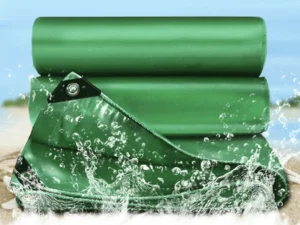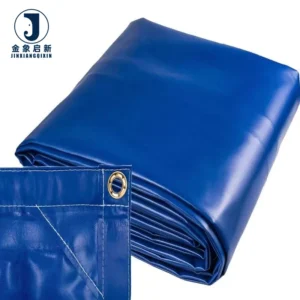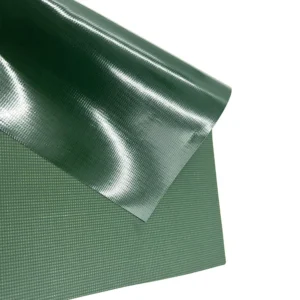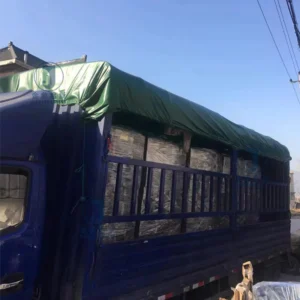
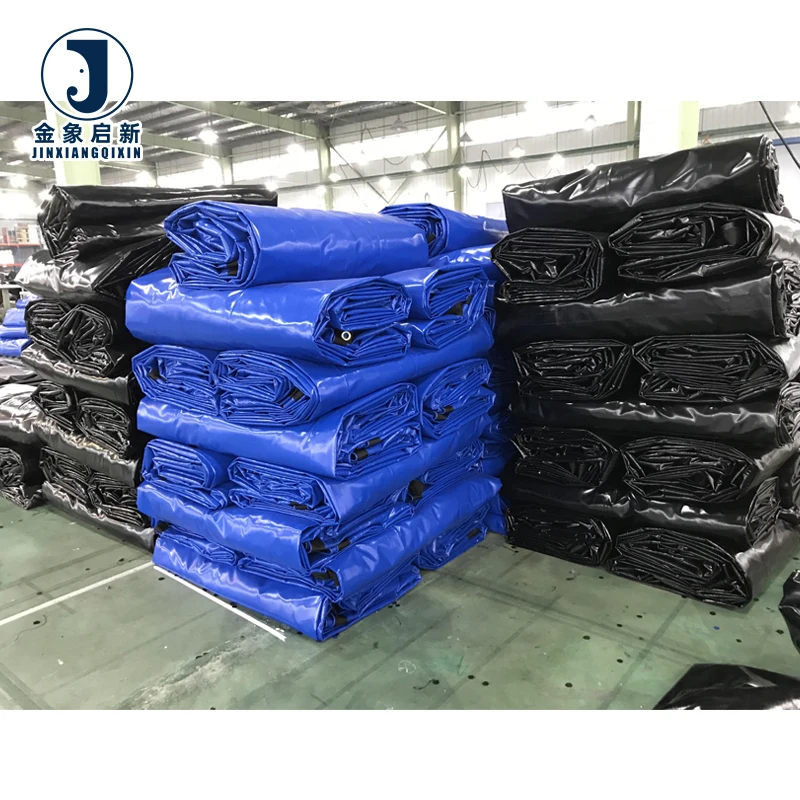
Controlled Coating Process — Every roll of 650 Gsm PVC Coated Tarpaulin Roll ships with measured weight data, reflecting nearly 30 years of process discipline where GSM on paper matches GSM on the scale.
Technical Specifications
| Parameter | Value |
|---|---|
| Product Type | PVC Coated Tarpaulin Roll |
| Weight | 650 GSM |
| Coating Material | PVC |
| Waterproof Construction | Yes |
| Flame Retardant | Available in flame retardant grades — confirm the grade required for your market |
| UV Treatment | Available with UV stabilisation — request test basis for your climate zone |
| Anti-Mildew | Antibacterial and mildew proof (standard not stated) |
| Oil & Stain Resistance | Yes |
| Acid & Alkali Resistance | Yes |
| Temperature Resistance | High temperature and cold resistant (specific range not stated) |
| Anti-Oxidation | Yes |
| Flexibility & Cracking Resistance | Highly flexible, resistant to cracking |
| Surface Finish | Self-cleaning surface |
| Welding Compatibility | HF, Hot Air, Sewing |
| Tensile Strength | Grade available on request |
| Tear Strength | Grade available on request |
| Peeling Resistance | Grade available on request |
| Key Features | Fully waterproof, anti-mildew, acid and alkali resistant, anti-oxidation, self-cleaning finish |
Application Suitability
| Application | Exposure & Requirement |
|---|---|
| Tensile and membrane structures | Permanent tension loading, wind uplift cycles, UV and thermal cycling, welded seam integrity at stress points |
| Stadium architectural membranes | High-profile visibility requiring colour consistency across rolls, fire classification compliance, long-term UV stability |
| Airport hangar fabric covers | Wide-span exposure, wind load, fuel and chemical splash, fire safety standards for aviation environments |
| Tent and marquee fabrication | Repeated assembly and pack-down, flex at fold lines, water ingress at seams, UV degradation on outer surface |
| Shade systems and awnings | Continuous sun exposure, thermal expansion and contraction, aesthetic appearance retention over time |
| Portable storage structures | Mechanical abrasion from handling, weather sealing at entry points, structural load from snow or wind |
What "Flame Retardant" Means When the Grade Is Missing
Fabric specified as flame retardant without a stated classification cannot be verified against your local building or safety code.
Technical buyers sourcing PVC coated tarpaulin roll for tensile structures or public-venue membranes face a recurring problem: the quotation claims fire resistance, but the test report never arrives, or it references a standard that does not map to the project jurisdiction. A 650 Gsm fabric installed in a stadium canopy must meet whatever fire classification the local authority demands — B1 per DIN 4102, M2 under French regulation, or NFPA 701 for North American venues — and a generic "flame retardant" label satisfies none of them. [NEED_CITE: fire classification systems for architectural textile membranes vary by jurisdiction]
The same gap appears with UV treatment. Manufacturers state UV stabilisation without specifying the test method or the exposure hours validated. For a membrane that will face direct sunlight on a tensile roof, the difference between a verified UV test and an unverified claim surfaces within the first few seasons as chalking, colour shift, or embrittlement at coated surfaces. Requesting the test basis up front avoids specifying a material that underperforms against the project’s design life. [NEED_CITE: UV degradation test methods for PVC coated textiles]
Coating Adhesion and Seam Integrity at 650 Gsm
At 650 GSM, PVC coated tarpaulin roll carries enough coating mass to produce strong, continuous weld seams through high-frequency or hot-air welding. The coating thickness must bond fully to the base fabric so that peel forces at the weld line exceed the forces the membrane will encounter under tension and wind loading. When adhesion is controlled at every production stage, the seam does not delaminate before the fabric itself reaches its tensile limit.
This balance matters for tensile structure fabricators who stretch the material over steel or cable frameworks. The welded seams at corners and anchor points carry concentrated loads. If coating adhesion is inconsistent roll to roll, the weld parameters that worked on the first roll may produce weak seams on the next, leading to on-site failures that are costly to repair once the structure is installed.
Welding Compatibility Across Fabrication Methods
This PVC coated tarpaulin roll supports high-frequency welding, hot-air welding, and industrial sewing — the three primary joining methods used by membrane and tent fabricators. HF welding produces clean, waterproof seams ideal for tension structures where appearance and weather sealing matter. Hot-air welding allows field repairs and on-site adjustments when a panel needs trimming or an additional gusset.
Sewing with sealed thread and taped seams offers an alternative for applications where mechanical fastening is preferred or where the fabrication shop does not have HF equipment. The 650 GSM weight grade provides sufficient body for the material to feed through industrial sewing machines without excessive distortion, while remaining flexible enough to fold and pack for transport to the installation site. [NEED_CITE: coated fabric welding methods per industry fabrication standards]
Reading the Specification Sheet Beyond the Weight Number
A 650 GSM label tells you the total mass per square metre, but not how that mass is distributed between the base fabric and the PVC coating. A heavier base yarn denier with a leaner coating will tear differently than a lighter base with a thicker coating, even at the same total GSM. The base fabric construction — yarn denier, warp and weft density, and weave pattern — determines tensile and tear behaviour, while the coating weight governs surface durability, weld performance, and chemical resistance.
The self-cleaning surface finish on this material reduces particulate adhesion, meaning installed membranes stay cleaner between maintenance cycles. Acid and alkali resistance extends service options to industrial environments where airborne chemicals would degrade untreated fabrics. Anti-oxidation additives protect the PVC compound itself from thermal and oxidative breakdown, maintaining flexibility across temperature swings. [NEED_CITE: relationship between base fabric denier and tear propagation in coated textiles per ISO 1421]
The Cost of Overlooking Batch-to-Batch Consistency
When multiple rolls arrive for a single membrane project and the colour shifts visibly between them, the entire installation may need to be reordered. For a tensile roof spanning a public space, adjacent panels cut from different rolls must match in shade and surface gloss — otherwise the structure looks patchwork under direct sunlight. This problem typically traces back to inconsistent pigment dispersion or coating thickness variation during production.
Similarly, if GSM on arrival does not match the quoted value, the fabric may be lighter than designed, with lower tensile reserves than the structural engineer calculated. Weld behaviour also shifts when coating weight varies: a roll that is 30 grams lighter than specified will melt at different temperatures, forcing the fabrication team to recalibrate weld settings mid-production. [NEED_CITE: batch consistency failures in coated fabric procurement]
Why Fabricators Source This Material Here
Three full production lines and 36 sets of professional equipment maintain output capacity so that roll-to-roll coating consistency holds across large orders, not just sample cuts. The 10-person R&D team develops custom colour matches and width specifications with samples produced within days, letting fabricators validate weld parameters and shade accuracy before committing to bulk.
Dedicated QA/QC at every production stage means each roll of 650 GSM PVC coated tarpaulin roll is inspected for coating weight, surface finish, and dimensional accuracy before it leaves the facility. Pre-shipment inspection records document measured values per roll, so buyers receive verification data rather than relying on batch averages. ISO and CE certified processes underpin the documentation package that accompanies every dispatch.
Documentation & Verification
- Material specification sheet stating 650 GSM, base fabric denier, coating method, and colour reference
- Test reports for UV and flame retardant grades supplied when applicable to project requirements
- Pre-shipment inspection record with measured GSM and coating weight per roll
- ISO and CE certificates included with full customs documentation for cross-border shipment
- Roll packing list with individual roll dimensions, weight, and batch number
Fabrication, Handling & Storage
- HF welding at 650 GSM requires calibrated dwell time to achieve full coating fusion without scorching the self-cleaning surface
- Hot-air seam repairs on-site should match original weld temperature settings to avoid adhesion loss at the patch boundary
- Store rolls horizontally on pallets to prevent creasing that leaves permanent marks in the PVC coating layer
- Unroll in temperatures above the material’s cold-flex threshold to avoid micro-cracking during fabrication handling
- Use neutral pH cleaners on the self-cleaning finish to preserve the surface treatment over repeated maintenance cycles
Specifying Your Requirement
Share your application type — tensile membrane, tent, shade structure, or architectural canopy — along with the fire classification your jurisdiction requires. Confirm the roll widths that match your fabrication equipment and panel layout to minimise offcut waste. State any colour or surface finish requirements and whether you need sample rolls for weld testing before placing the production order.
Frequently Asked Questions
Q: How is the 650 GSM weight verified before shipment?
A: Each roll undergoes measurement during production and again at pre-shipment inspection. The inspection record states the measured GSM alongside the roll number so you can cross-check on arrival. We supply the material specification sheet with every order detailing the stated weight and the base fabric construction.
Q: Which flame retardant grades are available for this material?
A: The material is available in flame retardant grades suitable for architectural membrane and tent applications. The specific classification depends on your target market and project specification. Request the grade you need — such as DIN 4102 B1 or NFPA 701 — and we will provide the matching test report.
Q: How is colour consistency maintained across multiple rolls in one order?
A: Production runs for a single order use matched pigment batches, and each roll passes visual inspection against the approved colour reference before packing. If your project requires panels installed side by side, we recommend ordering the full quantity in one batch to maintain shade uniformity.
Q: What welding method works best at 650 GSM?
A: High-frequency welding produces the strongest and cleanest seams at this weight, particularly for tensile structures. Hot-air welding suits field repairs and modifications. Sewing with sealed thread is viable for applications where mechanical joining is preferred. Sample rolls are available so you can test your preferred method.
Q: Can I order custom widths or colours?
A: Custom widths, lengths, and colours are available with samples developed within days for approval before bulk production. Confirm your required roll width against your fabrication equipment capacity, and provide a colour reference or sample for matching. Minimum order quantities apply and vary by specification.