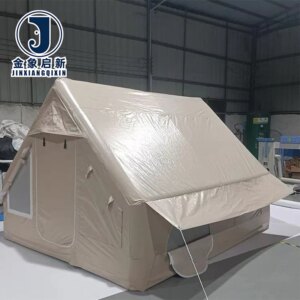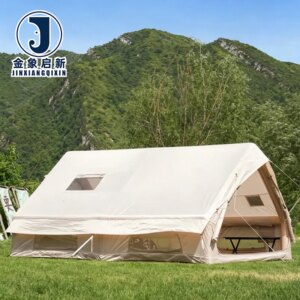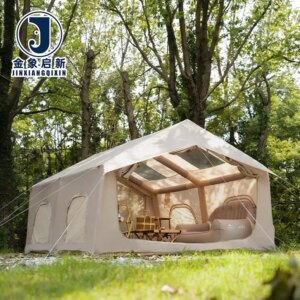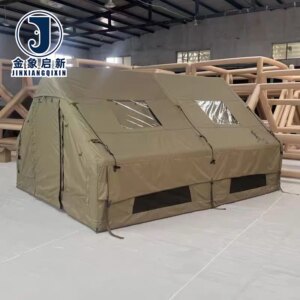
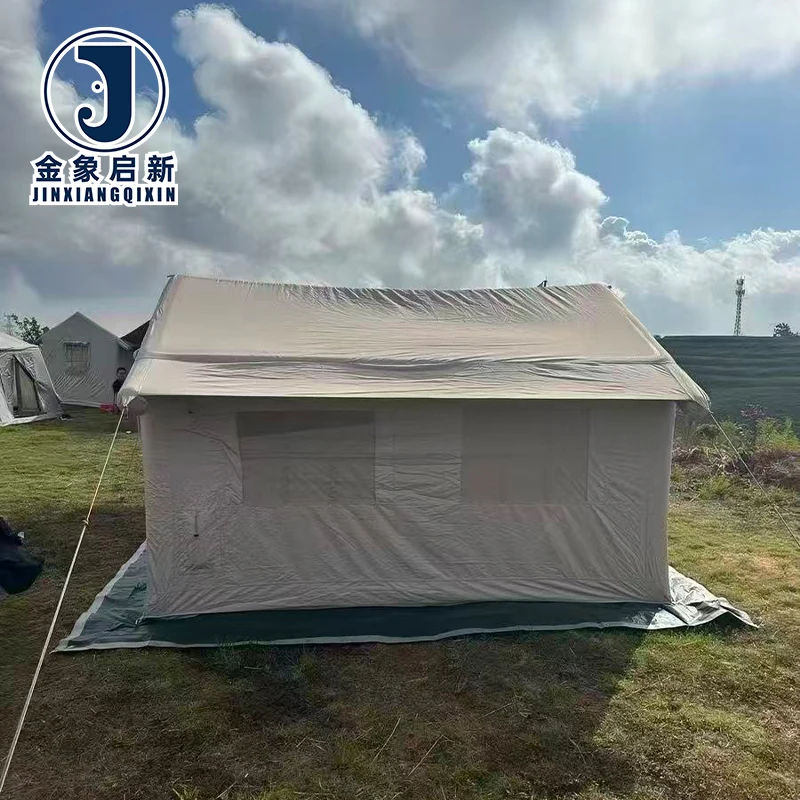
Deep Process Control Over Coating Weight and Adhesion — our three full production lines and 10-person R&D team ensure that every roll of inflatable tent fabric leaving our 9,180 m² facility meets the stated waterproof rating, thickness tolerance, and colour reference without batch-to-batch deviation.
Technical Specifications
| Parameter | Value |
|---|---|
| Product Type | Inflatable Tent Fabric |
| Core Material | Oxford Waterproof Fabric |
| Waterproof Rating | ≥10,000mm H₂O |
| UV Treatment | UPF 50+ (test basis not stated in source) |
| Temperature Tolerance | -30°C to 70°C |
| Tensile Strength | ≥300N/5cm (test standard not stated in source) |
| Tear Resistance | ≥150N (test standard not stated in source) |
| Waterproof Durability | 5,000 cycles of water pressure testing |
| Dimensional Tolerance | ±2cm |
| Material Thickness Tolerance | ±0.1mm |
| Design | Four-Season, Single Layer, Extended Type |
| Deployment | Automatic Opening |
| Customization | OEM & ODM, sample customization, pattern printing |
| Certifications | ISO9001, ISO14001, ISO45001, CE |
Application Suitability
| Application | Exposure & Requirement |
|---|---|
| Disaster relief staging structures | Rapid deployment under severe weather, high moisture contact, repeated inflation cycles |
| Construction site temporary shelters | Abrasion from ground contact, wind load stress, UV exposure over extended installation periods |
| Logistics mobile storage enclosures | Water ingress protection for stored goods, flex stress at inflation seams during transport |
| Outdoor industrial event covers | Continuous UV exposure, crowd contact abrasion, temperature fluctuation across seasons |
| Emergency preparedness rapid-response shelters | Cold-weather deployment down to -30°C, waterproof integrity under sustained hydrostatic pressure |
Why Batch Colour Consistency Matters When Your Inflatable Tent Panels Sit Side by Side
Colour drift between rolls is the number one reason inflatable tent orders get rejected at the installation site.
When a fabricator cuts panels from different rolls to assemble a single inflatable structure, even a slight shade difference becomes visible once the panels are heat-welded together and inflated. We have seen orders returned because the front-facing panels showed a noticeable tone shift against the side walls — not a defect in any single roll, but a mismatch across the batch. For inflatable tent fabric sourced in volume, roll-to-roll colour and coating uniformity is not a cosmetic concern; it is a structural acceptance criterion. The custom inflatable structure fabric you specify on paper must arrive looking identical from the first roll to the last.
Base Fabric and Coating Formulation for Inflation Loads
An inflatable tent structure places sustained internal pressure on every square centimetre of fabric. The Oxford waterproof fabric core used in this Inflatable Tent Fabric provides a tight weave foundation that distributes inflation load across the warp and weft rather than concentrating stress at seam junctions. The coating formulation is engineered to maintain flexibility across the stated temperature range, preventing the stiffening that causes micro-cracking when a structure is deployed in sub-zero environments.
Seam Integrity Under Cyclic Inflation and Deflation
Every time an inflatable tent is inflated, held under pressure, then deflated and packed, the heat-welded seams undergo a full stress cycle. This Inflatable Tent Fabric is designed for single-layer construction where welded seams carry the primary structural load. The coating adhesion to the Oxford base must be sufficient to prevent delamination at the weld zone — the point where most inflatable structures fail first. Our in-process QA checks coating adhesion at intervals throughout each production run to catch deviations before they reach the finished roll. [NEED_CITE: heat weld strength testing for coated technical textiles per ISO 1421]
Reading the Specification Sheet Beyond the Headline Numbers
The ≥10,000mm H₂O waterproof rating tells you the fabric can withstand substantial hydrostatic pressure before water penetrates — relevant for shelters deployed in sustained heavy rain or where ground water contact is expected. However, the tensile strength of ≥300N/5cm and tear resistance of ≥150N must be understood together: tensile strength governs how the fabric behaves under uniform inflation pressure, while tear resistance determines whether a small puncture from a sharp ground surface propagates into a structural failure. Neither number alone predicts field performance. The four-season temperature range of -30°C to 70°C means the coating formulation must resist both cold-embrittlement and high-temperature softening — a balance that depends on plasticiser selection and coating thickness control, not just the base fabric. UPF 50+ treatment is available for extended outdoor exposure; confirm the UV test basis required for your target market before placing a bulk order.
What Happens When the Wrong Fabric Grade Reaches the Weld Table
A fabricator who receives inflatable tent fabric with inconsistent coating thickness across the roll width will discover the problem only when the heat-welding parameters that worked on one section cause burn-through or poor adhesion on another. The result is welded seams that fail under inflation pressure before the fabric itself reaches its rated tensile limit. In disaster relief or emergency preparedness deployments, a seam failure in the field means the entire structure must be deflated, patched, and re-inflated — costing time when hours matter. For commercial inflatable tent manufacturers, batch inconsistency drives up scrap rates and forces re-work on welded panels that should have been production-ready. [NEED_CITE: common failure modes in inflatable fabric structures at weld junctions]
Why Fabricators Source This Material Here
Nearly 30 years of focused coated fabric production means our process parameters for Oxford waterproof fabric are not being learned on your order. Three full production lines with 36 sets of professional equipment support bulk capacity, so multi-roll orders for large inflatable tent projects ship within typical production windows rather than being delayed by capacity constraints. The 10-person R&D team handles custom width, pattern printing, and sample development in-house, reducing the back-and-forth between fabricator and mill. Dedicated QA/QC runs at every production stage — not just a final pre-shipment check — catching coating weight drift and colour deviation before rolls are packed. Samples for custom inflatable structure fabric specifications are developed within days, allowing fabricators to validate welding parameters and colour match before committing to a full production run. [NEED_CITE: quality management system requirements for coated technical fabrics per ISO 9001]
Documentation & Verification
- Material specification sheet confirming Oxford base fabric type, coating composition, and colour reference per roll
- Waterproof rating test data verifying ≥10,000mm H₂O performance on production batch samples
- UV performance documentation with test basis stated for UPF 50+ rating where applicable
- Pre-shipment inspection record with dimensional tolerance (±2cm) and thickness (±0.1mm) verification per roll
- ISO9001, ISO14001, ISO45001, and CE certificates included with each shipment
- Certificate of origin and customs documentation for international roll stock dispatch
Fabrication, Handling & Storage
- Heat-weld temperature profiles must be calibrated to the single-layer Oxford coating thickness; request our recommended parameter sheet before first production run
- Cut panels with allowance for the ±2cm dimensional tolerance to avoid assembly misalignment during inflation
- Store rolls horizontally on pallets in a dry, shaded environment to prevent surface creasing that affects weld quality
- Avoid folding the fabric below -30°C during cold-climate transport; the coating may stiffen and develop stress marks at fold lines
- Use mild, non-solvent cleaners on the finished inflatable structure to preserve the waterproof coating integrity and UPF 50+ surface treatment
What to Include With Your Inquiry
To provide an accurate specification and sample for your inflatable tent fabric requirement, share the deployment climate and expected temperature extremes, the target waterproof and UV compliance standards for your market, the required roll width and estimated annual volume, and whether you need pattern printing or custom colour matching across multiple rolls. If you are fabricating finished inflatable structures, let us know your preferred welding method so we can recommend the appropriate coating formulation.
Frequently Asked Questions
Q: How is batch-to-batch colour consistency controlled across rolls for inflatable tent fabrication?
A: Dedicated QA/QC runs at every production stage, not just before shipment. Each roll is checked against the approved colour reference under controlled lighting conditions. If a batch deviates beyond acceptable tolerance, it is held and reworked before packing. We provide a pre-shipment inspection record so you can verify colour consistency across your entire order before it leaves our facility.
Q: What UV test basis supports the UPF 50+ rating for long-term outdoor inflatable structure use?
A: The UPF 50+ treatment is applied as part of the coating formulation for extended outdoor exposure. The specific test standard supporting this rating can be confirmed against your target market requirements — please specify whether you need testing to AS/NZS 4399, AATCC 183, or another regional standard so we can arrange the appropriate documentation with your shipment.
Q: How are welded seams validated to ensure they hold at flex points under inflation pressure?
A: In-process coating adhesion checks are performed throughout each production run to ensure the Oxford base and coating bond is sufficient for heat-welding. We recommend fabricators request a sample roll to validate their welding parameters before bulk production. Seam peel strength testing can be included in the pre-shipment inspection upon request.
Q: What custom width, length, and pattern printing options are available for inflatable tent fabric orders?
A: Custom widths and lengths are produced on our three full production lines to minimise offcuts at your fabrication table. Pattern printing and branding are handled in-house by our R&D team. Samples are developed within days for custom specifications, allowing you to confirm print registration and colour before authorising the full production run.
Q: What documentation and certifications accompany each roll shipment for international compliance?
A: Each shipment includes a material specification sheet, ISO9001, ISO14001, ISO45001, and CE certificates, a pre-shipment inspection record with per-roll verification data, a roll packing list, and a certificate of origin. Additional test reports for waterproof rating and UV performance are provided where applicable to support customs clearance and end-market compliance.