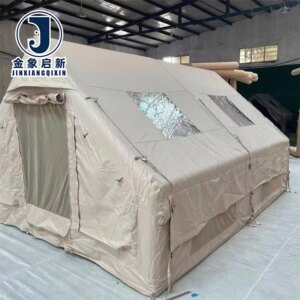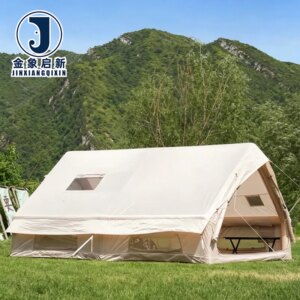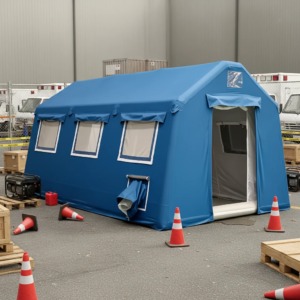
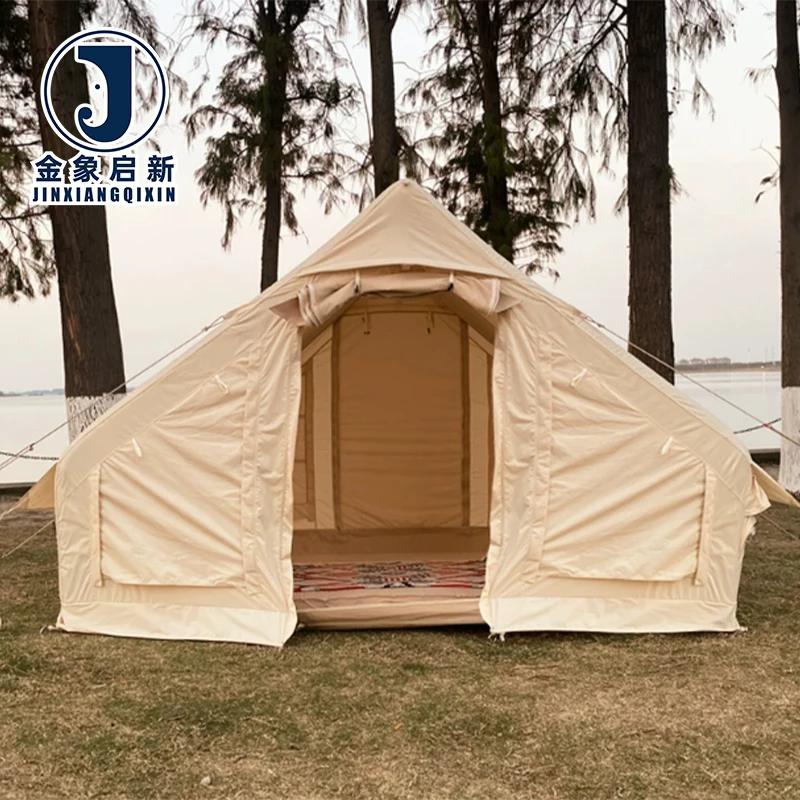
Coating Process Mastery — Nearly three decades of PVC coating development applied to inflatable tent structures, where consistent adhesion and seam integrity determine shelter reliability under field conditions.
Technical Specifications
| Parameter | Value |
|---|---|
| Product Type | Inflatable tent |
| Core Material | PVC tarpaulin |
| Product Forms | Inflatable, extended type, single layer construction |
| Key Performance | Waterproof, windproof, 4-season suitable, quick automatic opening |
| Flame Retardant Grade | Available in flame retardant grades — confirm the grade required for your market |
| UV Treatment | Available with UV treatment — test basis to be confirmed per order |
| Anti-Static | Not confirmed for this product line |
| Customization Service | OEM & ODM (sample customization, pattern printing) |
| Production Facility | 9,180 m² with 3 full production lines and 36 sets of professional equipment |
| R&D Capability | 10-person technical team |
| Quality Control | Full-process QA/QC with dedicated staff |
| Certifications | ISO9001, ISO14001, ISO45001, CE |
Application Suitability
| Application | Exposure & Requirement |
|---|---|
| Construction site temporary shelters | Continuous outdoor weather, wind load on inflatable frame, ground abrasion at base contact points |
| Logistics mobile storage facilities | Rain and snow ingress prevention, frequent inflation/deflation cycles, UV exposure during extended deployment |
| Field command centers for engineering management | Rapid deployment under time pressure, all-season thermal and weather protection, repeated relocation |
| Disaster recovery temporary workspaces | Emergency deployment speed, waterproof integrity in unprepared terrain, wind resistance in exposed locations |
| All-weather outdoor industrial environments | Prolonged UV and moisture exposure, chemical-laden dust, mechanical contact with equipment and materials |
Why Inflatable Tent Fabric Demands More Than a GSM Number
Weld integrity and coating adhesion matter more than fabric weight alone when an inflatable structure holds its shape under wind and rain.
Procurement teams often specify PVC inflatable tent fabric by weight per square metre and assume the coated fabric will perform reliably in the field. The problem surfaces when welded seams split under inflation pressure or when coating delaminates from the base fabric during folding and transport. A heavier fabric with poor adhesion between coating and substrate will fail faster at the seams than a lighter material with controlled coating penetration. [NEED_CITE: tensile and peel strength test methods for coated fabrics per ISO 1421]
Base Fabric Architecture Behind the PVC Coating
The base fabric denier and weave density determine how well the PVC coating bonds to the substrate and how the material distributes stress across the inflatable frame. A tighter weave provides more anchoring points for the coating compound, improving peel strength at welded joints where inflation pressure concentrates force. For PVC inflatable tent fabric, the base fabric construction directly influences whether the shelter holds shape during sustained wind events or gradually deforms at stress points.
Single Layer Design and Deployment Efficiency
Single layer construction reduces overall weight and packed volume, which matters when inflatable disaster relief tents must be transported to remote or infrastructure-damaged sites. The trade-off is that thermal insulation and acoustic dampening depend entirely on the PVC tarpaulin thickness and surface treatment. This configuration suits rapid-deployment scenarios where speed of inflation and ease of relocation take priority over long-term occupant comfort. The quick automatic opening mechanism relies on uniform fabric stiffness, which in turn depends on consistent coating weight across the entire roll. [NEED_CITE: inflatable structure deployment standards for emergency shelter applications]
Coating Weight, Adhesion, and Weld Behaviour
The PVC coating applied to the base fabric serves two distinct functions: environmental protection and weld integrity. Coating weight affects waterproof performance and surface durability, but the coating formulation and application method determine how well the material responds to high-frequency or hot-air welding. Knife-over-roll coating typically produces stronger peel resistance at welded seams compared to lamination methods, because the coating compound penetrates the base fabric weave rather than sitting on the surface. For inflatable tent applications, seam failure under inflation pressure is a deployment-critical risk, making coating adhesion more important than coating thickness alone. Surface finish — whether glossy or matte — also influences print adhesion for branding and identification markings on the shelter exterior.
What Happens When Inflatable Tent Fabric Specifications Miss the Mark
Colour variation between rolls in the same order becomes immediately visible when multiple inflatable units are deployed side by side at a construction site or disaster recovery zone. Batch inconsistency signals deeper process control issues that often extend to coating weight and adhesion variability. Welded seams that fail before the fabric itself tears indicate a mismatch between the coating formulation and the welding parameters used during fabrication. These failures rarely appear during initial inspection — they emerge after repeated inflation cycles or when wind load flexes the structure at the seam junction. [NEED_CITE: failure analysis of welded seams in PVC coated technical textiles]
Fabrication, Handling & Storage
- Heat welding parameters must match the PVC coating formulation — confirm temperature and dwell time for this specific PVC tarpaulin grade
- Single layer construction reduces roll weight, but store rolls horizontally on racking to prevent permanent creasing in the coated surface
- Clean PVC tarpaulin surfaces with mild detergent only — solvent-based cleaners may degrade the coating bond at welded seams
- Pattern printing adhesion depends on surface finish — verify ink compatibility with the specified glossy or matte treatment before production
- Inflate test units within days of delivery to confirm weld integrity before long-term storage compresses the fabric structure
- Avoid dragging inflatable tent fabric across unprepared ground — base contact points abrade the coating and expose the base fabric to moisture
Documentation & Verification
- Material specification sheet stating PVC coating weight, base fabric denier, and weave construction for this inflatable tent grade
- Batch quality inspection report linked to order number, confirming coating adhesion and weld test results per production run
- Flame retardant test certificate where applicable — grade and test standard documented per shipment
- ISO9001, ISO14001, ISO45001, and CE certificates available for project compliance submissions
- Pre-shipment inspection record covering fabric weight verification, colour consistency, and weld seam sample testing
- Certificate of origin and customs documentation supporting international shipment of PVC inflatable tent fabric
Why Procurement Teams Source Inflatable Tent Fabric Here
Three full production lines and 36 sets of processing equipment provide the capacity to fulfil bulk inflatable tent fabric orders without compromising coating consistency across rolls. The 10-person R&D team develops custom material specifications, pattern printing layouts, and sample prototypes within days, allowing buyers to validate fabric performance before committing to volume production. Dedicated QA and QC staff inspect coating weight, base fabric adhesion, and weld integrity at every production stage rather than relying on end-of-line sampling only. [NEED_CITE: DIN 4102 fire classification for coated textile building materials] OEM and ODM capability covers dimensional customization, structural design adjustments, and surface branding, all managed within the same production facility to maintain process control.
Project Specification and Sample Request
Provide your intended deployment environment, expected inflation frequency, and any flame retardant or compliance requirements specific to your operating region. Share target dimensions, colour references, and whether pattern printing or branding is required on the inflatable structure surface. Specify if you need roll stock for your own fabrication line or finished inflatable tent units with welded seams and valve integration. Request a sample cut from production stock to verify coating adhesion, weld response, and colour accuracy before confirming your order volume.
Frequently Asked Questions
Q: How is GSM and coating weight verified upon delivery for inflatable tent fabric?
A: Each production run includes a batch quality inspection report documenting coating weight and base fabric specifications. Weight verification is performed per roll against the stated GSM before dispatch, and results are available for review using your order number. We recommend conducting independent weight checks on receipt to confirm consistency across your shipment.
Q: What flame retardant or UV treatment grades are available, and which test standards apply?
A: PVC inflatable tent fabric is available in flame retardant grades and with UV treatment, but specific grades depend on your market compliance requirements. Share the applicable test standard for your region, and we will confirm availability with supporting documentation. Test reports are issued per order where treatment is specified.
Q: How is batch-to-batch colour consistency controlled across custom-printed inflatable tent orders?
A: Colour consistency is managed through controlled coating formulation and in-process inspection at each production stage. Pre-shipment inspection records document colour verification against your approved reference. For multi-roll orders with pattern printing, we recommend requesting a production sample to confirm colour accuracy before full-volume manufacturing proceeds.
Q: What OEM and ODM customization options exist for dimensions, pattern printing, and structural design?
A: Customization covers dimensional adjustments, single layer or extended type construction, pattern printing, and branding application on the PVC tarpaulin surface. Our R&D team develops samples for evaluation before production commitment. Share your structural design requirements and deployment conditions to receive a material specification recommendation suited to your inflatable tent application.
Q: How are welded seams tested to ensure they match or exceed the base fabric tear resistance?
A: Welded seam samples from each production run undergo peel and tensile testing to verify that the joint strength meets or exceeds the base fabric performance. Test parameters are matched to the specific PVC coating formulation used for your order. Results are documented in the batch inspection report provided with each shipment.