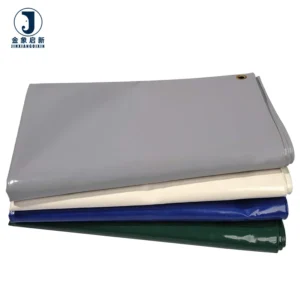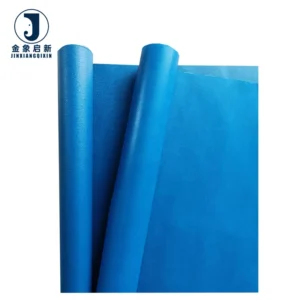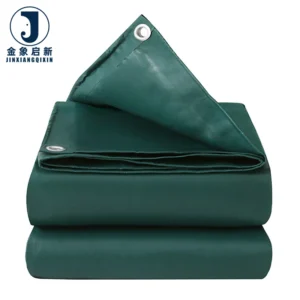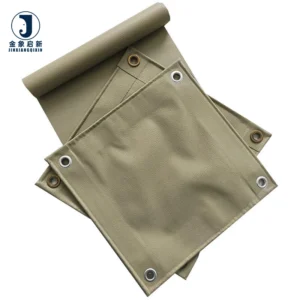
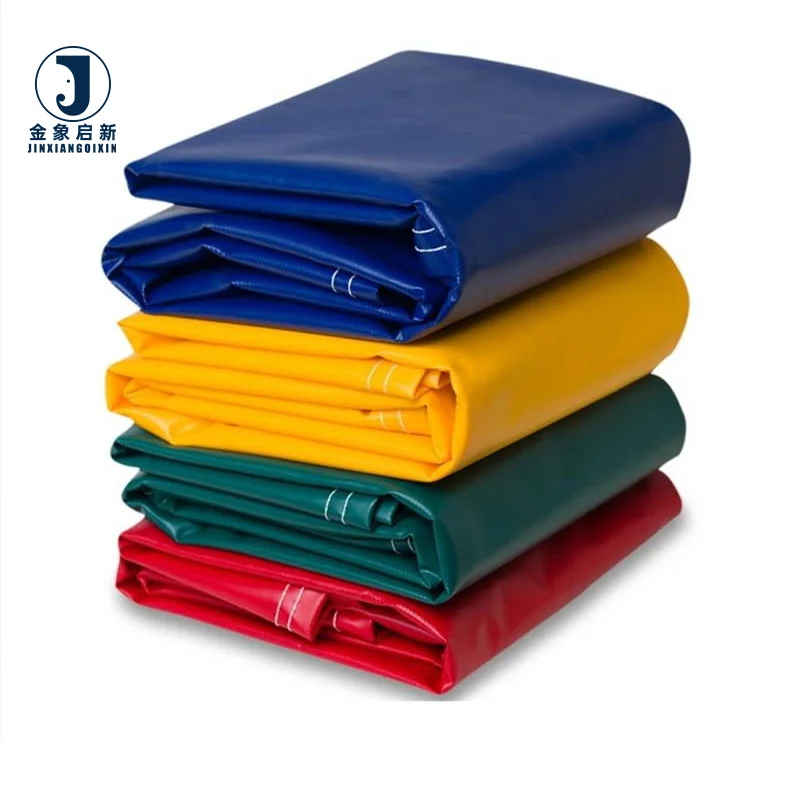
Precision Coating Control — Every roll of PVC coated fabric is verified against the stated GSM and base fabric denier before dispatch, ensuring the material you receive matches the specification you ordered.
Technical Specifications
| Parameter | Value |
|---|---|
| Product Type | PVC Coated Fabric |
| Material (Medium-Duty) | PVC coated fabric, 0.35–0.45 mm thickness, 400–500 GSM, 500D base fabric |
| Material (Heavy-Duty) | PVC coated cloth, 0.70–1.0 mm thickness, 700–1000 GSM, 1000D base fabric |
| Material (Super Heavy) | PVC coated fabric, 1.2–1.5 mm thickness, 1100–1500 GSM, 500D–2000D base fabric |
| Tensile Strength (Medium) | Longitude 1500–2000 / Latitude 1200–1800 N/5cm |
| Tensile Strength (Heavy-Duty) | Meridian 2000–2500 / Latitude 1800–2200 N/5cm |
| Tensile Strength (Super Heavy) | Warp 2500–3000 / Weft 2200–2800 N/5cm |
| Colors Available | Blue, Blue/Orange, Green, Grey, Black, Clear, Grey/Green, Orange, or custom |
| UV Treatment | Available (test basis not stated) |
| Key Features | Waterproof, washable, tear resistant, weather proof, sunproof, mildew proof, anti-aging |
| Certification | ISO, CE |
Application Suitability
| Application | Exposure & Requirement |
|---|---|
| Heavy truck tarpaulin and side curtains | Constant flexing at load points, road debris abrasion, prolonged UV and rain exposure |
| Tensioned membrane and inflatable structures | Sustained wind load, structural tension, demand for high tensile and tear resistance |
| Engineering protective cloth | Job-site dust, chemical splash, repeated handling and repositioning |
| Industrial pipe canopy covers | Outdoor weathering, thermal cycling, requirement for waterproof sealing |
| Construction site enclosures | Wind pressure, scaffold contact, temporary installation and removal cycles |
| Farm machinery covers | UV exposure, dust and moisture ingress, seasonal storage and retrieval |
Why Base Fabric Denier Defines Real Strength More Than GSM in PVC Coated Fabric
The denier of the yarn and the weave density determine how the material resists tearing under load, while GSM alone only tells you the total weight of coating and fabric combined.
Buyers often specify PVC coated fabric by GSM and then find that two rolls with identical weight behave very differently at the weld line or under sustained tension. A heavy coating on a low-denier base fabric inflates the GSM number without adding meaningful tensile capacity. The failure typically shows up months after installation when the coating cracks at a flex point and the base fabric, lacking sufficient yarn strength, tears along the warp or weft. [NEED_CITE: tensile and tear test methods for coated fabrics per ISO 1421] Understanding the relationship between denier, weave density, and coating weight is essential before you commit to a roll order for structural or transport applications.
Coating Weight and Base Fabric Interaction
The PVC coated fabric range covers three distinct tiers where coating weight and base fabric denier are matched to produce predictable mechanical behaviour. In the medium-duty tier, a 500D base fabric carries 400–500 GSM total weight, providing adequate strength for covers and light engineering wraps. The heavy-duty tier pairs a 1000D base with 700–1000 GSM, raising tensile capacity for truck side curtains and equipment enclosures that face daily flexing.
Super Heavy Grades for Structural Demand
The super heavy tier spans 500D to 2000D base fabrics at 1100–1500 GSM, designed for tensioned membrane structures and inflatable buildings where the material must carry sustained wind and snow loads. At this tier the coating thickness reaches 1.2–1.5 mm, which also improves puncture resistance during installation over sharp scaffold edges or uneven ground. Specifying the correct denier within this range is critical — a 2000D base delivers measurably higher tear propagation resistance than a 500D base at the same total GSM. [NEED_CITE: relationship between yarn denier and tear propagation in coated technical textiles]
Reading the Tensile Data Correctly
Tensile strength values are reported in both warp and weft directions because the base fabric weave is rarely symmetrical. For the super heavy grade, warp strength reaches 2500–3000 N/5cm while weft sits at 2200–2800 N/5cm. Fabricators designing side curtains or membrane panels should align the warp direction with the primary load path to exploit the higher strength axis. Ignoring this directional difference can lead to premature failure at stress concentration points such as eyelet lines or hem folds.
What Coating Method Means for Fabrication
The coating process directly affects how well the PVC layer adheres to the base fabric and how the material responds to heat welding. A well-controlled coating weight ensures that the weld zone has enough PVC to form a continuous bond without starving the joint or creating excessive squeeze-out. When adhesion is insufficient, the coating delaminates from the base fabric at the weld line long before the fabric itself reaches its tensile limit. Buyers should request adhesion data or conduct peel tests on sample pieces before approving a roll for production.
The Hidden Cost of Specifying on GSM Alone
When a roll arrives lighter than the GSM stated on the quotation, the financial impact extends beyond the missing material. The fabricator cuts and welds the material into finished products, and only then does the strength shortfall appear — typically as seam failure or coating crack at the first major flex cycle. For fleet operators, a truck cover that splits on the highway creates cargo damage liability far exceeding the cost difference between grades. Batch-to-batch weight variation within the same order compounds the problem because different panels of a single cover end up with unequal strength, causing the weakest panel to fail first. [NEED_CITE: field failure analysis of coated fabric at flex and weld points] Colour variation between rolls ordered in the same batch is another consequence of inconsistent production control — once panels are installed side by side on a trailer or structure, the difference becomes immediately visible and may force a full replacement.
Why Technical Buyers Source PVC Coated Fabric Here
Nearly 30 years of focused work on coated fabric gives this production team deep process control over coating weight accuracy and base fabric adhesion. Three full production lines and 36 sets of professional equipment support bulk roll orders with consistent output quality. A dedicated 10-person R&D team handles material selection, custom colour matching, and sample development so that you can validate the PVC coated fabric grade before committing to volume. QA inspection runs at every production stage with 100% coverage before shipment, catching GSM deviation and colour drift before rolls leave the facility. Custom widths, lengths, and colour references are developed as samples within days, reducing the risk of ordering the wrong specification for your application.
Documentation & Verification
- Material specification sheet listing GSM, base fabric denier, and coating type per roll
- UV and flame-retardant test reports provided where applicable grades are specified
- Pre-shipment inspection record covering weight, colour, and surface quality checks
- Roll packing list with individual roll weight and dimension for receiving verification
- Certificate of origin and customs documentation included with each dispatch
Fabrication, Handling & Storage
- Heat-weld super heavy 1100–1500 GSM rolls at higher temperature settings to ensure full coating penetration at the joint
- Allow rolled PVC coated fabric to acclimatise to workshop temperature before unrolling to avoid creasing in cold conditions
- Store rolls upright on pallets to prevent flat-spot deformation on the 0.70–1.0 mm heavy-duty grade
- Use sharp rotary blades when cutting 1000D base fabric to prevent yarn pull and frayed edges
- Clean finished surfaces with mild detergent only to preserve the coating integrity and UV treatment layer
Preparing Your Enquiry for PVC Coated Fabric
Provide the intended application, expected mechanical loads, and environmental exposure so the correct denier and GSM tier can be recommended. State your target market’s fire safety or compliance requirements early so that flame-retardant grades can be confirmed with supporting test documentation. Specify the roll width, colour reference, and estimated annual volume to receive accurate lead times and batch consistency commitments.
Frequently Asked Questions
Q: How is GSM verified on the finished PVC coated fabric roll?
A: Each roll is weighed and measured against the specification sheet before dispatch. Buyers can conduct a simple cut-and-weigh test on arrival: cut a known area, weigh it, and calculate grams per square metre. Any deviation from the quoted GSM should be reported immediately with the roll number for investigation and resolution.
Q: What is the relationship between base fabric denier and tensile performance?
A: Higher denier yarns carry greater individual tensile load before breaking. In the super heavy grade, a 2000D base fabric provides substantially higher tear propagation resistance than a 500D base at the same total GSM. The denier determines how the fabric resists tearing once a puncture or cut initiates, which GSM alone cannot predict.
Q: Can I receive a test report for UV treatment?
A: UV treatment is available across the PVC coated fabric range. However, the specific test basis should be confirmed before placing your order. Request the test report that matches your regional compliance requirement so that the UV stabiliser package is appropriate for your expected outdoor exposure duration.
Q: How does coating weight affect weld and seam behaviour?
A: Adequate coating weight ensures sufficient PVC material flows during heat welding to form a continuous bond. When coating is too thin, the weld starves and the joint fails before the base fabric reaches its tensile limit. Always test weld parameters on sample pieces from the actual roll batch before cutting production panels.
Q: How are colour differences controlled across multiple rolls in one order?
A: Roll-to-roll colour consistency is managed through batch mixing and in-line visual inspection against the approved colour reference. Pre-shipment inspection records document the colour check for every roll. Buyers should request batch documentation and inspect rolls side by side upon receipt before cutting into panels.