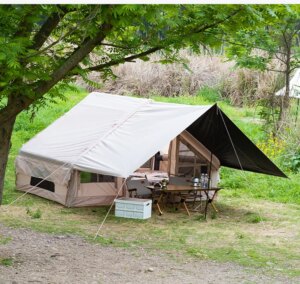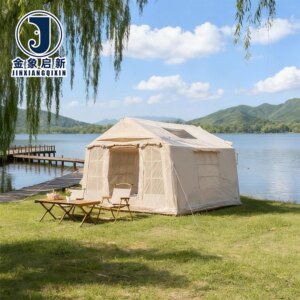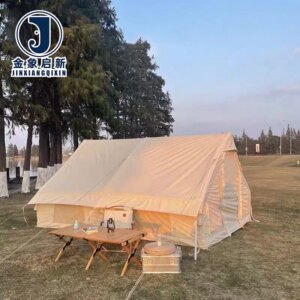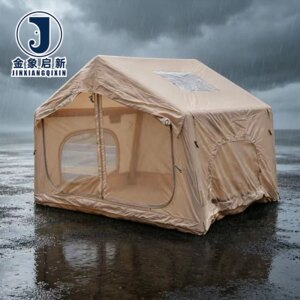
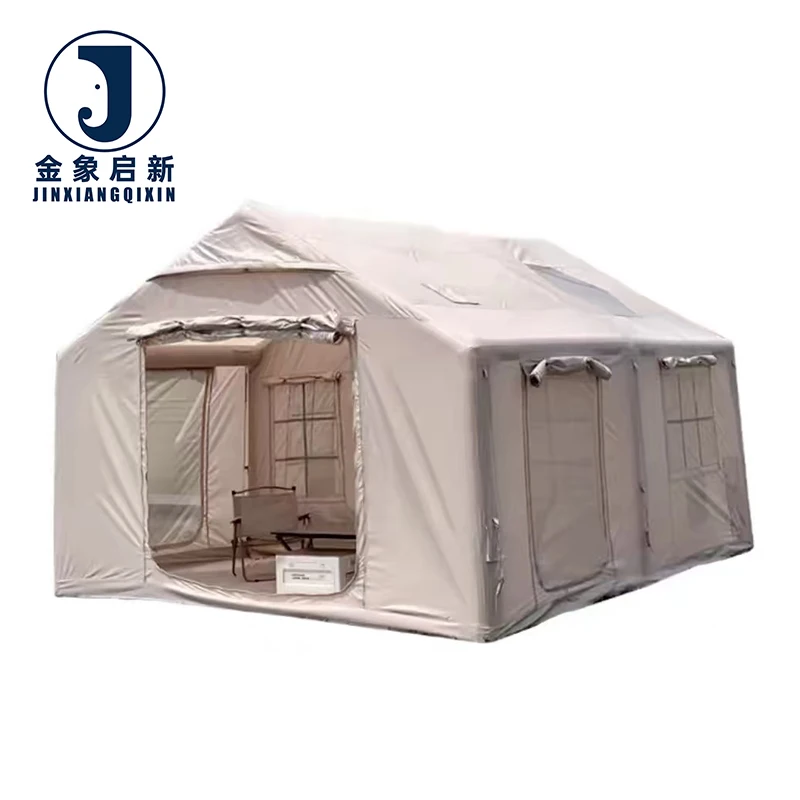
Coating Process Control — nearly 30 years of PVC coating expertise ensures consistent adhesion and weight distribution across every roll of inflatable tent fabric we produce.
Technical Specifications
| Parameter | Value |
|---|---|
| Product Type | Inflatable Tent |
| Core Material | PVC tarpaulin (PVC knife-coated fabric) |
| Capacity | 3-5 person |
| Design | Four-Season Use, Single Layer Construction, Extended Type |
| Waterproof | Yes |
| Tear-Resistant | Yes |
| UV Treatment | Available with UV-resistant coating — confirm test basis required for your market |
| Automatic Opening | Yes |
| Customization Service | OEM & ODM support |
| Standards | ISO 9001, ISO 14001, ISO 45001, CE |
Application Suitability
| Application | Exposure & Requirement |
|---|---|
| Emergency command centers during infrastructure recovery | Rapid deployment under severe weather, wind load on inflatable frame, prolonged UV exposure outdoors |
| Temporary site offices in post-disaster operations | Repeated inflation cycles, ground abrasion, temperature swings across four seasons |
| Equipment storage shelters for industrial disaster response | Waterproof integrity under sustained rain, puncture risk from stored machinery, tear stress at anchor points |
| Material staging and operational coordination hubs | High foot traffic abrasion on floor-contact zones, UV degradation risk during extended outdoor staging |
What Happens When UV Resistance Is Claimed Without a Test Report
Every grade of inflatable tent fabric we ship carries documentation that matches the performance claim — if UV resistance is specified, the test report travels with the batch.
When procurement teams source PVC inflatable tent aftermarket supplier options, UV treatment is often listed as a feature without any reference to how it was measured or what exposure duration it withstands. In emergency shelter deployments, this gap between marketing language and verifiable performance becomes a safety liability. Fabric that degrades under ultraviolet exposure loses tensile integrity at the seams first — exactly where the inflatable structure depends on airtight welds to maintain shape and rigidity. Field operators then face shelters that deflate unexpectedly or tear along stress lines during wind events, turning a planned contingency asset into an operational failure. [NEED_CITE: UV degradation mechanisms in PVC coated polyester fabrics]
Coating Adhesion and Its Role in Inflatable Structural Integrity
The PVC knife-coated construction used in this inflatable tent fabric delivers a direct bond between the coating compound and the base fabric weave. This adhesion method matters for inflatable shelters because the air-bearing frame depends on the fabric maintaining a continuous sealed surface under internal pressure. When coating adhesion is weak, delamination begins at fold lines or weld joints — the same zones that experience the highest cyclic stress during inflation and deflation. The inflatable tent fabric must hold its coating-to-substrate bond through repeated deployment cycles without developing micro-channels that compromise air retention.
Single Layer Design: Balancing Weight and Four-Season Field Performance
The single layer construction of this PVC inflatable tent fabric keeps packed weight and transport volume manageable for rapid disaster response logistics. Four-season emergency shelters face a tension between durability and portability — thicker multi-layer assemblies resist abrasion but add kilograms that slow deployment when minutes count. Our PVC knife-coated approach concentrates protective performance in one engineered layer, where the PVC inflatable tent aftermarket supplier specification covers waterproof integrity, tear resistance, and UV stability without requiring a separate inner liner. This makes the inflatable tent fabric suitable for stockpiling in emergency caches where storage space and weight directly determine how many units a facility can maintain on standby. [NEED_CITE: material selection criteria for emergency shelter deployment systems]
Reading the Specification Sheet Beyond Surface Claims
Understanding PVC knife-coated fabric performance requires examining how coating weight, base fabric density, and surface treatment interact. The knife-coating process forces PVC compound into the weave interstices, creating mechanical lock-in that governs peel strength — a critical value when heat-welded seams must match the parent fabric strength for airtight inflatable frames. Base fabric denier and yarn count determine how tears propagate once initiated; a higher-density weave arrests tear growth more effectively than a heavier but looser weave. UV treatment must be specified as an additive package within the PVC compound itself rather than a surface spray, since surface-applied treatments wear away with handling and cleaning cycles.
The Cost of Overlooking Weld Compatibility During Procurement
When inflatable tent fabric is sourced without confirming heat-weld compatibility, the seams become the weakest point in the entire structure. Inflatable emergency shelters operate under constant internal pressure that tests every weld line continuously — a seam that fails at a fraction of the parent fabric’s tensile capacity turns the shelter into a collapse hazard. [NEED_CITE: weld strength testing protocols for inflatable coated fabric structures] Buyers who focus exclusively on fabric weight or base denier may overlook the thermal profile the PVC compound requires for proper fusion. A coating formulated at a temperature range incompatible with standard hot-air welding equipment results in either under-fused seams that peel apart or overheated zones where the PVC degrades and becomes brittle. Batch-to-batch variation in coating chemistry compounds this risk, making pre-production weld trials essential before committing to full-quantity orders.
Why Source Inflatable Tent Fabric Through This Capability
Nearly 30 years of PVC coated fabric production provides process maturity that directly affects inflatable tent performance — coating weight consistency and adhesion control are maintained through established line parameters rather than trial-and-error adjustment. Three full production lines and 36 sets of professional equipment support the volume requirements of emergency preparedness programs that stockpile shelters across multiple facility locations. The 10-person R&D team handles material selection and sample development for OEM and ODM inflatable tent projects, adjusting thickness, color, and dimensional specifications to match deployment requirements. Dedicated QA and QC inspection at every production stage means each roll of inflatable tent fabric receives scrutiny before it reaches the welding or fabrication phase. Pre-shipment inspection covers 100 percent of output with batch-specific documentation, eliminating the uncertainty that arises when quality records are sampled rather than comprehensive.
Documentation & Verification
- Material specification sheet stating base fabric type, PVC coating method, and color reference for every batch of inflatable tent fabric shipped
- Test report for UV treatment included when UV-resistant grade is specified, covering the measurement basis applicable to your deployment region
- ISO 9001, ISO 14001, ISO 45001, and CE certificates provided as part of the shipment documentation package
- Pre-shipment inspection record confirming 100 percent inspection coverage with batch-linked quality data for each roll or cut panel
- Customs support documentation including certificate of origin and roll packing list for cross-border procurement
Fabrication, Handling & Storage
- Heat-weld parameters must be matched to the specific PVC knife-coated compound — request our recommended temperature and speed settings before production
- Store inflatable tent fabric rolls upright or on wide-diameter cores to prevent crease marks that weaken coating adhesion at fold lines
- Avoid dragging PVC coated panels across abrasive ground surfaces during deployment to protect the waterproof coating layer integrity
- Clean with mild soap solutions only — solvent-based cleaners can extract UV stabilizer additives from the PVC compound matrix
- Inflate-test each completed shelter unit before long-term storage to verify weld seam integrity across all air-bearing frame sections
- Cut pattern layouts should account for weld seam allowances to maintain structural airtightness at panel junctions
What We Need to Build Your Specification
To provide an accurate material recommendation and sample for your inflatable tent project, share your target deployment environment including expected temperature range and UV exposure conditions. Confirm whether your application requires fabric supplied by the roll for your own fabrication line or finished cut panels ready for welding assembly. Let us know your color requirements, dimensional specifications, and any regional compliance standards that apply to your end market.
Frequently Asked Questions
Q: What is the test basis for UV resistance claims on this inflatable tent fabric?
A: When UV-resistant grade is specified for your inflatable tent fabric order, we supply a test report documenting the measurement method and results. The specific test basis depends on your deployment region and application requirements. We recommend confirming which UV exposure standard applies to your market before sample development begins, so the compound formulation aligns with your verification protocol.
Q: What dimensions and thickness options are available through OEM and ODM customization?
A: Our OEM and ODM service covers size adjustments, material thickness variations, and custom color options for inflatable tent fabric. The single layer construction can be adapted to your capacity and deployment requirements. Share your target dimensions and intended use conditions, and our R&D team will develop a sample with full material specification documentation for your evaluation and approval.
Q: How does heat welding perform with this PVC knife-coated inflatable tent fabric?
A: The knife-coated PVC construction provides strong coating-to-fabric adhesion that supports heat-welded seam integrity essential for inflatable structures. Weld parameters must match the specific compound formulation. We recommend running weld trials with sample material before full production, and we provide recommended temperature and speed settings to ensure seam strength matches the parent fabric performance.
Q: What quality inspection documentation ships with each order?
A: Every batch undergoes 100 percent pre-shipment inspection with dedicated QA and QC staff. You receive a material specification sheet, pre-shipment inspection record with batch-linked quality data, and applicable test reports. ISO 9001, ISO 14001, ISO 45001, and CE certificates are included with shipment documentation, providing traceable quality records for your procurement and compliance files.
Q: How should the inflatable tent be stored to maintain PVC fabric performance?
A: Store the deflated tent in a dry environment away from direct sunlight and sharp objects. Avoid tight folding along the same crease lines repeatedly, as this can stress the PVC coating adhesion at fold zones. Inflate periodically during long-term storage to check weld seam integrity. Clean with mild soap before storage to prevent contaminant buildup from degrading the coated surface over time.