Precision Coating Control — Every roll of PVC Coated Polyester Fabric Tarpaulin ships with a verified material specification sheet mapping exact GSM, base fabric denier, and coating method to support incoming inspection and technical compliance.
Technical Specifications
| Parameter | Value |
|---|---|
| Product Type | PVC Coated Polyester Fabric Tarpaulin |
| Base Fabric | 100% High Tenacity Polyester Yarn |
| Coating Material | PVC |
| Coating Technology | Lamination and Hot Melt Coating |
| Weight (Medium) | 400-500 g/m² |
| Weight (Heavy-Duty) | 700-1000 g/m² |
| Weight (Super Heavy) | 1100-1500 g/m² |
| Thickness (Medium) | 0.35-0.45 mm |
| Thickness (Heavy-Duty) | 0.70-1.0 mm |
| Thickness (Super Heavy) | 1.2-1.5 mm |
| Base Fabric Denier | 500D / 1000D / 2000D |
| Tensile Strength (Medium) | Warp 1500-2000 / Weft 1200-1800 N/5cm |
| Tensile Strength (Heavy-Duty) | Warp 2000-2500 / Weft 1800-2200 N/5cm |
| Tensile Strength (Super Heavy) | Warp 2500-3000 / Weft 2200-2800 N/5cm |
| Key Features | Waterproof, Cold Resistant, Anti-Mildew, Anti-Static Treatment (grade not stated), Flame Retardant Option (grade not stated), UV Treatment (test basis not stated), Excellent Welding Tear Strength |
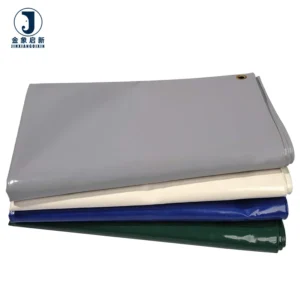
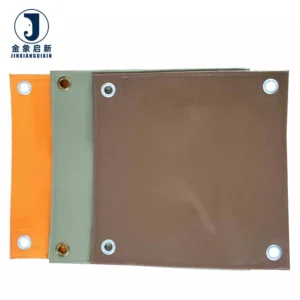
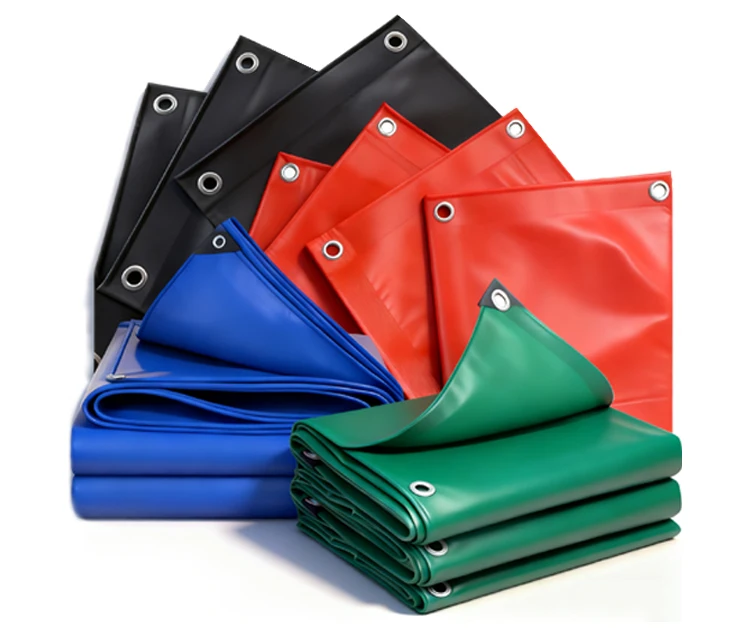
| Color Options | Blue, Green, Grey, Black, Orange, Clear, Custom Colors |
| Certifications | ISO, CE |
Application Suitability
| Application | Exposure & Requirement |
|---|---|
| Truck and Trailer Side Curtains | Constant flexing at load points, road debris abrasion, continuous UV exposure requiring high welding tear strength |
| Tensioned Membrane Structures | Sustained tensile load, wind uplift forces, requiring verified GSM and consistent coating adhesion across the panel |
| Industrial Pipe Canopies | Chemical-laden atmosphere, moisture accumulation, long-term outdoor weathering |
| Engineering Protective Covers | Mechanical impact, outdoor storage exposure, requiring puncture resistance and waterproof integrity |
| Inflatable Structures | Internal air pressure stress, repeated inflation cycles, requiring reliable heat-welded seam performance |
Why Stated GSM Without Coating Weight Leaves You Exposed
A single GSM figure tells you nothing about how the PVC coating bonds to the polyester base fabric under real-world load.
When technical buyers specify PVC coated fabric base fabric denier coating method gsm, they often receive a quotation listing a target weight. The material arrives, passes a quick scale check, and enters production. Weeks later, heat-welded seams begin to delaminate at the flex points of a truck curtain or the stress corners of a tensioned canopy. The failure is not in the base fabric or the PVC itself — it is at the interface between them. Without documentation showing the coating weight separate from the base fabric weight, and the lamination or hot melt method used, there is no way to predict how the two layers will behave when subjected to welding temperatures and mechanical stress. [NEED_CITE: ISO 1421 test methods for tensile properties of rubber- or plastics-coated fabrics]
Coating Method and Adhesion Behaviour
Lamination technology and hot melt coating technology are the two processes applied across this PVC Coated Polyester Fabric Tarpaulin range. Lamination bonds a pre-formed PVC film to the polyester base under heat and pressure, producing a uniform coating thickness that supports predictable heat-welding parameters during fabrication. Hot melt coating applies liquid PVC directly to the woven base, allowing the coating to penetrate the yarn interstices for stronger mechanical adhesion. Fabricators working with medium-duty 400-500 g/m² grades for lighter engineering covers may favour laminated stock for its consistent surface, while super-heavy 1100-1500 g/m² grades for membrane structures benefit from the deeper penetration of hot melt coating. The chosen method directly affects how the material responds to high-frequency or hot-air welding at seam construction.
Denier, Density, and the Mechanics of Tear Propagation
The base fabric denier — available in 500D, 1000D, and 2000D options — governs how a tear behaves once it starts. A 500D base in the medium-duty range distributes load across more, finer yarns per centimetre, limiting the energy concentrated on any single yarn when a puncture occurs. The 2000D base in the super-heavy range relies on fewer, thicker yarns that each carry higher individual load before rupture. [NEED_CITE: relationship between yarn denier and tear propagation in woven coated fabrics] When specifying PVC coated fabric for tensioned structures or heavy truck tarpaulins, the denier selection should align with the expected stress profile: distributed wind loads favour higher yarn count, while point loads from mechanical contact favour heavier individual yarns.
Reading the Specification Sheet Correctly
A technically complete specification sheet for PVC coated fabric base fabric denier coating method gsm lists each layer independently. The base fabric weight in denier and yarn count per centimetre, the PVC coating weight in g/m², and the total composite weight together allow a fabricator to calculate expected weld penetration depth and adjust machine settings accordingly. Thickness values ranging from 0.35 mm in medium grades to 1.5 mm in super-heavy grades correlate with coating build, not base fabric density. A 1.0 mm thickness achieved through heavy coating on a 500D base will behave differently under welding than the same thickness achieved with lighter coating on a 1000D base. Technical buyers should request the full breakdown before approving samples for production.
The Hidden Cost of Specifying on Weight Alone
When a buyer approves material based on total GSM without verifying the coating-to-base ratio, several downstream problems emerge. Heat-weld parameters set for one coating weight fail on material with a different ratio, producing seams that peel under tension rather than bonding through the full coating depth. Rolls from the same production batch may show visible colour variation when installed side by side on a fleet of trailers, forcing rework. Material claimed to carry flame-retardant treatment without a stated grade fails site inspection when the contractor cannot produce the test certificate the building authority requires. [NEED_CITE: common causes of coated fabric seam failure in fabricated products] These issues do not appear during incoming inspection — they surface during fabrication or after installation, when replacement costs multiply.
Why Technical Buyers Source This Range Here
Three full production lines and 36 sets of professional equipment support bulk output with maintained consistency across the medium, heavy-duty, and super-heavy PVC coated fabric grades. A dedicated 10-person R&D team handles material selection and sample development, producing test rolls within days so fabricators can validate welding parameters before committing to volume. QA inspection at every production stage includes roll-to-roll colour verification, addressing the batch consistency problem that surfaces only when panels are installed adjacent to each other. Pre-shipment inspection covers 100% of rolls against the stated specification sheet, ensuring the GSM and coating weight documented at quotation stage match what arrives at the factory door. This process control extends across all treatment options, from anti-static to flame-retardant grades.
Documentation & Verification
- Material specification sheet stating exact GSM, base fabric denier, and coating weight per roll
- Test reports for UV and flame-retardant grades supplied where applicable with stated test basis
- Pre-shipment inspection record confirming weight and thickness against quotation values
- Roll packing list detailing batch number, colour reference, and roll dimensions for traceability
- Certificate of origin and customs documentation supporting international shipment clearance
Fabrication, Handling & Storage
- Set hot-air weld temperature based on coating method — laminated and hot melt grades respond differently at the seam
- Allow super-heavy 1.2-1.5 mm rolls to acclimatise before unrolling to prevent creasing at the coating layer
- Store rolls horizontally on racking to avoid permanent compression marks on the PVC surface
- Use compatible PVC-based repair patches matching the coating method for field repairs on welded seams
- Calculate cut layout from available roll width to minimise off-cuts and reduce the number of welded joins in the finished panel
Before You Request a Quote
Provide the specific application and the environmental exposure profile — sustained tensile load, flexing frequency, chemical contact, or UV intensity in your operating region. State the fire classification or anti-static grade your local authority or site specification demands, so the correct treatment can be confirmed with supporting documentation. Indicate whether you require rolls at standard width for your own fabrication line, or finished panels cut to your pattern with welded hems and reinforcements.
Frequently Asked Questions
Q: How is the GSM of each roll verified and what documentation accompanies shipment?
A: Each roll is weighed and measured against the material specification sheet before dispatch. The shipment includes a specification sheet stating exact GSM, base fabric denier, and coating weight, along with a pre-shipment inspection record. This allows you to cross-check the received material against the original quotation values during incoming inspection.
Q: What test basis supports the flame-retardant and anti-static treatment claims?
A: Flame-retardant and anti-static treatments are available as special processes, and the applicable test standard depends on your market requirements. Request the specific grade needed for your jurisdiction or site specification, and the corresponding test report will be supplied with the shipment documentation to support compliance verification.
Q: How do tensile strength values relate to base fabric denier and coating weight?
A: Tensile strength is determined by the polyester base fabric denier and weave density, not by the PVC coating. Medium-duty 500D fabric delivers 1500-2000 N/5cm warp strength, while super-heavy 2000D grades reach 2500-3000 N/5cm. The coating adds puncture resistance and weather protection but does not contribute significantly to structural tensile performance.
Q: How do lamination and hot melt coating methods affect welding behaviour during fabrication?
A: Laminated fabric offers uniform coating thickness, allowing consistent heat-weld settings across the panel. Hot melt coated fabric has deeper PVC penetration into the base weave, requiring adjusted temperature and dwell time to achieve full bond at the seam. Fabricators should request sample rolls to calibrate welding equipment before production runs.
Q: How is batch-to-batch colour consistency controlled across multiple rolls?
A: Dedicated QA inspection at every production stage includes colour verification against the approved reference for each batch. Rolls within a single order are checked side by side before packing to ensure no visible variation when panels are installed adjacent to each other. Request the colour reference number with your quotation to maintain consistency across repeat orders.