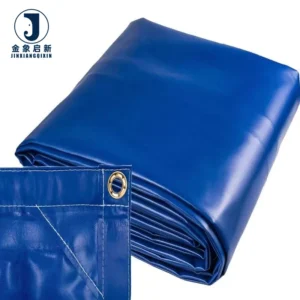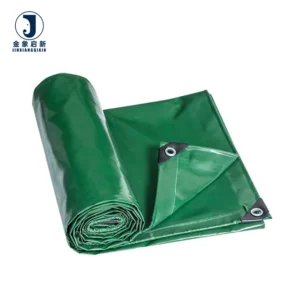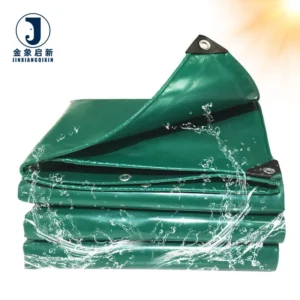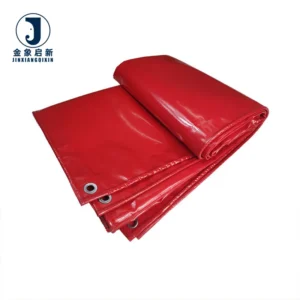
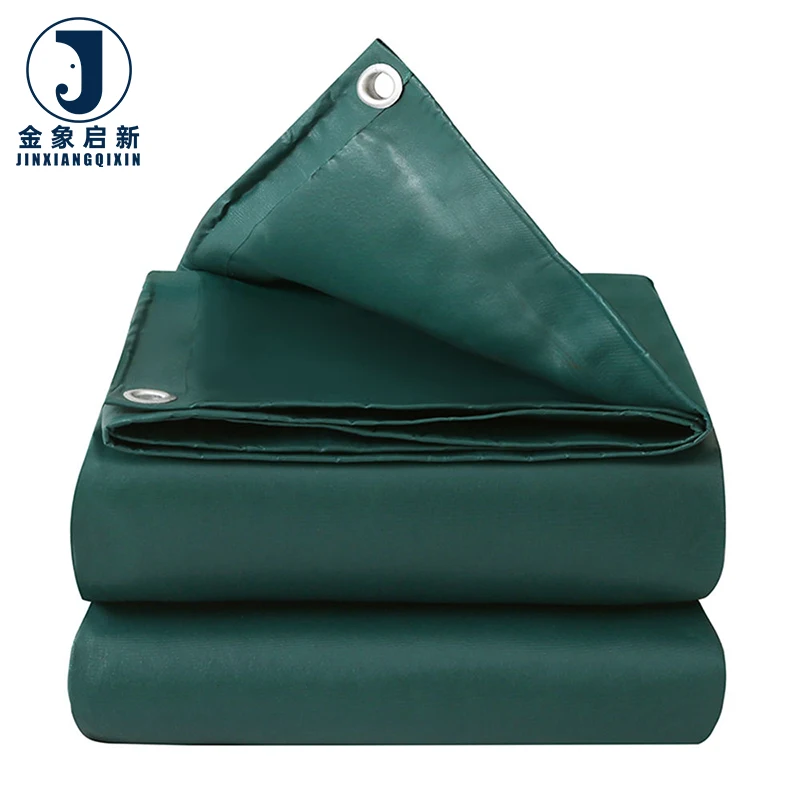
Coating Control Mastery — Every roll of PVC coated blackout tarpaulin undergoes weight verification at each coating stage, ensuring the GSM you specify is the GSM you receive.
Technical Specifications
| Parameter | Value |
|---|---|
| Product Type | PVC Coated Blackout Tarpaulin |
| Material | PVC + High-strength polyester mesh fabric |
| Weight (GSM) | 350gsm / 420gsm / 500gsm / 550gsm / 600gsm / 750gsm |
| Total Thickness | 0.32mm / 0.35mm / 0.4mm / 0.45mm / 0.5mm / 0.65mm |
| Coating Method | Laminated technology & Hot-melt Coating technology |
| Yarn | 100% High Tenacity Polyester Yarns with PVC coating |
| Roll Size | 2m width × 75m length / 2.1m width × 50m length |
| Finish Product Size | Custom items as per customer’s needs or sold by inventory |
| Color Options | Blue / Red / Yellow / Light Blue / Grey (Customized) |
| Flame Retardant | Available — confirm the grade required for your market |
| Anti-Static | Available — confirm surface resistance standard applicable |
| Key Features | Waterproof, sunproof, anti-mildew, cold crack resistance, best color fastness, outstanding tearing strength for welding |
| Standards | ISO, CE |
Application Suitability
| Application | Exposure & Requirement |
|---|---|
| Truck side curtain and load cover | Constant flexing at load points, road abrasion, weather exposure, weld seam integrity under tension |
| Construction site enclosure | UV exposure, wind load, scaffolding contact abrasion, temporary weather barrier |
| Tent and inflatable structure membrane | Tension loading, repeated assembly and disassembly, colour consistency across panels |
| Equipment and agricultural stockpile cover | Prolonged UV, moisture ingress risk, mildew in humid storage, puncture from sharp edges |
| Pond and reservoir liner | Permanent water contact, soil chemistry exposure, puncture resistance on uneven substrate |
| Marine and offshore cover | Salt spray, high UV, wind-driven rain, fabric must resist salt-induced degradation |
Why Coating Method Matters More Than Stated GSM for PVC Coated Tarpaulin
GSM tells you how much material is present — coating method tells you how well it stays bonded to the base fabric.
Technical buyers often receive PVC coated tarpaulin rolls where the GSM on the certificate matches the quotation, yet the material underperforms in the field. The issue is rarely weight alone. When laminated technology is applied without sufficient heat and pressure control, the PVC film separates from the polyester mesh under flex load. Hot-melt coating penetrates the yarn interstices and creates a mechanical bond that survives repeated folding at weld lines. Without understanding which coating method produced your roll, the GSM figure becomes a partial truth [NEED_CITE: tensile and tear test methods for coated fabrics per ISO 1421].
Adhesion Architecture in Hot-Melt vs Laminated Construction
The distinction between hot-melt coating and laminated technology is not cosmetic — it defines how the PVC coating layer interacts with the high-tenacity polyester mesh at the fibre level. Hot-melt coating forces plasticised PVC into the weave interstices under heat, creating a mechanical interlock that resists delamination at welded seams. Laminated technology bonds pre-formed PVC films to the base fabric surface, which can deliver consistent thickness but depends entirely on adhesive layer quality. For PVC coated tarpaulin used in truck covers and tensioned structures, hot-melt construction provides the weld integrity that fabricators depend on when seams carry load at flex points.
Weld Behaviour at Stress Concentration Points
Fabricators producing side curtains, truck awnings and inflatable structures need predictable seam performance. The tearing strength at the weld line is where most field failures originate — not in the body of the fabric but at the junction where heat has altered the coating chemistry. Hot-melt coated grades retain coating continuity through the weld zone because the PVC matrix is already integrated with the base yarn structure. When a fabricator heat-welds two panels of this PVC coated tarpaulin, the coating in the overlap zone re-melts and fuses rather than separating from the mesh [NEED_CITE: welding parameters for PVC coated polyester fabrics]. This is why material selection for welded applications must consider coating method alongside GSM.
Reading the Specification Sheet Beyond the Weight Column
A PVC coated tarpaulin specification sheet should connect each parameter to a performance outcome. The base fabric denier and weave density determine how tear propagation is arrested — a tighter mesh stops a puncture from running. The coating weight relative to total GSM reveals how much of the material is structural yarn versus protective coating. Thickness measured in millimetres correlates with puncture resistance but does not predict flexibility at low temperatures. Cold crack resistance depends on plasticiser formulation within the PVC layer, not simply on total thickness. When evaluating grades from 350gsm to 750gsm, buyers should request the breakdown showing base fabric weight versus coating weight per square metre to understand where the strength actually comes from.
The Hidden Cost of Specifying on GSM Alone
Selecting PVC coated tarpaulin by weight without verifying coating method and base fabric construction leads to predictable field failures. A roll that meets GSM on arrival can still delaminate within months if the adhesive bond between coating and mesh was inadequately controlled during production. Fabricators discover this when welded seams peel apart under load — the coating separates from the base fabric cleanly, indicating poor adhesion rather than material fatigue. Batch colour inconsistency compounds the problem when multiple rolls are installed side by side on a single structure, creating visible panel differences that trigger client rejection [NEED_CITE: colour consistency standards for architectural coated fabrics]. These are material specification failures, not installation errors.
Procurement Advantages Rooted in Process Control
Coating weight verification happens at each production stage across three dedicated coating lines, not only at final inspection. This means a 600gsm roll is confirmed at the base fabric stage, after first-side coating, and again after second-side finishing — catching drift before it compounds into a full-roll deviation.
A ten-person R&D team develops material samples within days when custom colours, widths or treatment combinations are required, allowing technical buyers to validate weld parameters and colour match before committing to production volume.
Every roll passes 100% inspection before dispatch, with dedicated QA/QC personnel checking coating adhesion, colour consistency under controlled lighting, and dimensional accuracy against the purchase order specification.
Flame retardant and anti-static treatments are available for this PVC coated tarpaulin range — confirm the grade and test standard required for your market so the correct formulation can be applied and documented.
Hot-melt and laminated coating technologies are both offered, enabling specifiers to select the construction method that matches their fabrication process and end-use stress profile.
Documentation & Verification
- Material specification sheet stating exact GSM, base fabric construction, coating method and colour reference per roll
- Test reports for flame retardant and anti-static grades supplied with shipment where applicable
- Pre-shipment inspection record covering coating adhesion, colour consistency and dimensional accuracy
- Roll packing list with individual roll weights and dimensions for receiving verification
- Certificate of origin and customs documentation for international coated fabric shipments
Fabrication, Handling & Storage
- Heat-weld overlap zones at temperatures suited to the coating method — hot-melt grades tolerate higher weld energy than laminated grades
- Store rolls horizontally on pallets to prevent edge deformation across the 2m or 2.1m width
- Allow cold-stored rolls to reach ambient temperature before unrolling to prevent coating crack at low GSM grades
- Use rotary cutters rather than shears on 750gsm grades to avoid edge delamination at cut lines
- Clean finished covers with mild detergent — solvent-based cleaners can attack the PVC plasticiser layer
Inquiry Guidance for Technical Buyers
When requesting a quotation, specify the coating method preference — hot-melt or laminated — as this affects both weld parameters and lead time for this PVC coated tarpaulin range. Include your target market’s fire safety or anti-static compliance requirements so the correct treatment grade can be confirmed with supporting test documentation. State whether you require roll stock at standard widths or custom slit widths, and indicate annual volume to establish batch consistency protocols across your production schedule.
Frequently Asked Questions
Q: How is GSM verified to match the quoted specification?
A: Each roll is weighed and measured at multiple production stages — after base fabric weaving, first-side coating, and final finishing. Sampling follows a defined protocol where test pieces are cut from roll ends and centre, weighed on calibrated scales, and recorded against the purchase order GSM before the roll is released for packing.
Q: What flame retardant grades are available for this material?
A: Flame retardant treatment is available across the PVC coated tarpaulin range, but the specific grade depends on your market’s fire classification requirements — standards such as DIN 4102, NFPA 701 or local building codes apply differently by region. State your required standard at inquiry stage so the correct formulation and test report can be prepared.
Q: How does hot-melt coating compare to laminated construction for welding?
A: Hot-melt coating penetrates the polyester mesh interstices, creating a mechanical bond that maintains coating continuity through the weld zone. Laminated technology bonds pre-formed films to the fabric surface, which depends on adhesive quality for weld integrity. Fabricators producing load-bearing seams typically prefer hot-melt construction for predictable peel strength.
Q: Can colour consistency be guaranteed across multiple rolls in one order?
A: Batch colour matching is controlled through standardised pigment formulation and verified under controlled lighting conditions before dispatch. For orders spanning multiple rolls of the same custom colour, all rolls are produced from the same coating batch where possible, and a colour reference sample is retained for cross-checking at receiving.
Q: What test reports accompany shipment for specialist treatments?
A: Where flame retardant or anti-static treatments have been specified, corresponding test reports are included with the shipping documentation. Reports reference the test method and classification achieved for the specific production batch, enabling buyers to present compliance evidence to site inspectors or regulatory authorities.