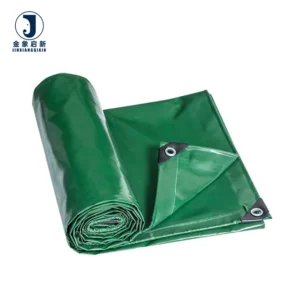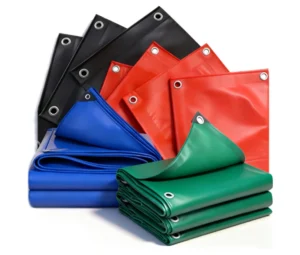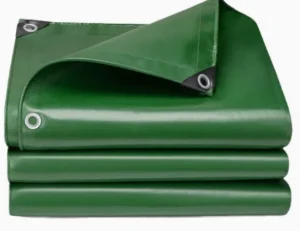
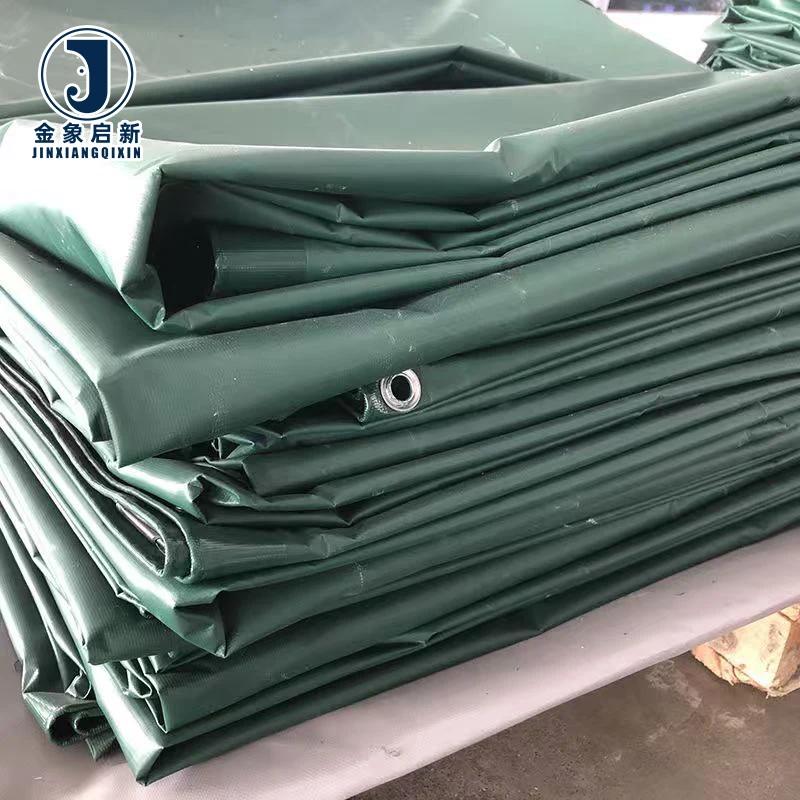
Coating Weight Verification — Every roll undergoes dedicated QA/QC inspection for coating weight and adhesion before dispatch, ensuring the stated GSM matches the delivered product.
Technical Specifications
| Parameter | Value |
|---|---|
| Product Type | PVC Coated Tarpaulin |
| Base Fabric | 100% high toughness polyester yarn |
| Coating Material | PVC |
| Coating Method | Lamination technology and hot melt coating technology |
| Weight (Medium-duty) | 400-500 g/m² |
| Thickness (Medium-duty) | 0.35-0.45 mm |
| Denier (Medium-duty) | 500D |
| Tensile Strength (Medium-duty) | Warp 1500-2000 / Weft 1200-1800 N/5cm |
| Weight (Heavy-duty) | 700-1000 g/m² |
| Thickness (Heavy-duty) | 0.70-1.0 mm |
| Denier (Heavy-duty) | 1000D |
| Tensile Strength (Heavy-duty) | Warp 2000-2500 / Weft 1800-2200 N/5cm |
| Weight (Super Heavy-duty) | 1100-1500 g/m² |
| Thickness (Super Heavy-duty) | 1.2-1.5 mm |
| Denier (Super Heavy-duty) | 500D-2000D |
| Tensile Strength (Super Heavy-duty) | Warp 2500-3000 / Weft 2200-2800 N/5cm |
| Waterproof | Yes |
| Cold Resistant Cracking | Yes |
| Mold Proof | Yes |
| Color Fastness | Best color fastness (grade not stated in source) |
| UV Treatment | Available in UV treated grades — confirm the standard required for your market |
| Flame Retardant | Available in flame retardant grades — confirm the grade required for your market |
| Anti-Static Treatment | Available in anti-static grades — confirm the standard required for your market |
| Outdoor Weather Resistance | 3-5 years (source value — verify against manufacturer catalog) |
| Standards | ISO, CE |
Application Suitability
| Application | Exposure & Requirement |
|---|---|
| Truck tarpaulin | Constant flexing at load points, road debris abrasion, prolonged UV and rain exposure |
| Heavy truck tarpaulin | High-tension tie-down loads, sustained highway-speed wind force, repeated folding and unfolding |
| Engineering protective cloth | Construction dust, moisture ingress, equipment impact and chemical splash |
| Industrial pipe canopy | Long-span tension, thermal expansion cycling, wind uplift on exposed sites |
| Tensioned structural fabric | Permanent tensile load, solar heat gain, architectural fire compliance requirements |
| Farm equipment covers | Prolonged sun exposure, fertilizer and pesticide contact, mechanical abrasion from handling |
PVC Coated Tarpaulin Fabric Technology: Why Coating Adhesion Determines Weld Seam Life
A tarpaulin that fails at the weld seam before the fabric itself has a coating problem, not a fabric problem.
When a truck cover flexes at every tie-down point and road vibration cycle, the welded seam concentrates stress exactly where the PVC coating bonds to the polyester base. If the adhesive strength between coating layers is inconsistent, the seam peels open while the body of the fabric remains intact. Technical buyers evaluating PVC coated tarpaulin fabric technology need to look beyond GSM and examine how the coating method controls adhesion at the point of greatest mechanical demand. [NEED_CITE: tensile and tear test methods for coated fabrics per ISO 1421]
How Lamination and Hot Melt Coating Shape Fabric Behaviour
Lamination technology bonds pre-formed PVC films to the polyester base under heat and pressure, producing a uniform coating layer with consistent thickness across the full width. This method gives fabricators predictable behaviour during high-frequency welding, as the PVC layer melts and fuses at a controlled temperature range. Hot melt coating, by contrast, applies liquid PVC directly onto the woven base, penetrating the yarn structure to create a mechanical bond that resists delamination under repeated flex cycles.
Each method serves different fabrication priorities. Laminated PVC coated tarpaulin performs well where clean weld lines and consistent surface finish are required, while hot melt coated grades suit applications demanding high peel strength at seams subjected to constant movement.
Base Fabric Construction and Its Role in Tear Propagation
The denier of the polyester yarn directly governs how a tear behaves once initiated. A 500D medium-duty base fabric offers adequate tensile strength for standard truck covers and equipment wraps, where loads are distributed and flex cycles are moderate. Stepping up to 1000D in heavy-duty grades, and up to 2000D in super heavy-duty options, increases individual yarn thickness so that a puncture or cut is less likely to propagate across the weave. [NEED_CITE: relationship between base fabric denier and tear resistance in coated technical textiles]
The knit density and weave pattern further control how force distributes across warp and weft directions. A tighter weave limits the distance a tear can travel before encountering a cross-yarn that arrests it. This is why the tensile strength data is specified separately for warp and weft — the two directions experience different loads depending on how the fabric is oriented during installation.
Reading the Specification Sheet Beyond GSM
GSM tells you the total mass per square metre of the finished coated fabric, but it does not distinguish between base fabric weight and coating weight. Two PVC coated tarpaulin rolls rated at the same GSM can have very different performance profiles if one carries a heavier coating on a lighter base fabric and the other reverses that ratio. A coating-heavy construction may feel stiff initially but lack the base fabric strength to resist tearing under load. A base-heavy construction may offer high tensile strength but insufficient PVC coverage to protect the yarn from moisture and UV degradation.
Coating method also affects thermal behaviour during fabrication. Laminated grades tend to have a sharper melting point during welding, requiring precise temperature control. Hot melt coated grades, where PVC penetrates the weave, often tolerate a wider welding temperature window. Thickness, measured from 0.35 mm in medium-duty through 1.5 mm in super heavy-duty, correlates with both puncture resistance and the amount of PVC available to form a strong weld bead. For tensioned structures and industrial pipe canopies, the 1.2-1.5 mm super heavy-duty range provides the body needed to maintain shape under sustained tensile load without excessive sag.
The Cost of Specification Mismatches in the Field
Ordering a medium-duty 500D grade for an application that demands heavy-duty flex endurance means the welded seams will fatigue before the fabric body reaches its service life. The result is not gradual wear but sudden seam failure at the highest-stress points, requiring full panel replacement rather than a simple patch repair.
Similarly, specifying a flame retardant grade without confirming the exact test standard accepted by the local authority means the material may arrive compliant in the manufacturer’s test report but fail the site inspector’s requirements. [NEED_CITE: flame retardant classification standards for temporary structures and transport covers] Colour inconsistency between rolls in the same order becomes visible only after panels are installed side by side on a truck fleet or building facade, forcing rework that delays project handover.
Why Source PVC Coated Tarpaulin From Jinxiang
Three full production lines and 36 sets of professional equipment support bulk roll output with consistent coating weight control from first roll to last in any production run.
A 10-person R&D team handles material selection, custom sizing and sample development, enabling fabricators to receive trial rolls with the exact coating method and treatment combination needed before committing to volume orders.
Dedicated QA/QC at every production stage, with 100% inspection before shipment, means coating adhesion and GSM are verified on every roll — not sampled from a production batch.
Deep process control over coating weight and adhesion, built across nearly 30 years of focused coated fabric production, reduces the risk of weld seam failure that generic suppliers cannot address.
Samples developed within days allow technical buyers to run their own weld tests and tensile checks before approving the specification for full production.
Documentation & Verification
- Material specification sheet stating exact GSM, base fabric denier, coating method and colour reference per roll
- Test reports for UV and flame retardant grades provided where applicable with stated test standards
- Pre-shipment inspection record confirming 100% QA/QC verification of coating weight and adhesion
- ISO and CE certificates included with full customs documentation and certificate of origin
Fabrication, Handling & Storage
- Hot melt coated grades tolerate a wider welding temperature range than laminated grades — adjust frequency and pressure accordingly
- Super heavy-duty 1.2-1.5 mm thickness requires higher welding energy and longer dwell time to achieve full seam fusion
- Store rolls upright on pallets to prevent flat-spot creasing that becomes visible after unrolling on site
- Allow cold-stored rolls to acclimatise before unrolling to prevent cracking in cold-resistant treated grades
- Clean laminated surfaces with neutral pH detergent to preserve the PVC coating finish without chemical degradation
Requesting a Technical Quotation
Provide the intended application, expected mechanical loads, and any fire safety or UV standards required by your local regulations. Specify whether you need roll stock for your own fabrication line or finished panels cut to dimension, and include the target colour reference if batch consistency across multiple rolls is critical. Confirm the coating method preference based on your welding equipment and process parameters.
Frequently Asked Questions
Q: How is GSM verified on arrival and what does the material specification sheet include?
A: Every roll is inspected during 100% pre-shipment QA/QC for coating weight and adhesion. The material specification sheet accompanying your shipment states the exact GSM, base fabric denier, coating method, thickness and colour reference for each roll, allowing you to cross-check the delivered product against your purchase order.
Q: What flame retardant grades are available and which test standards do they meet?
A: Flame retardant treatment is available across the product family. The specific grade and test standard — such as M2, B1 per DIN 4102, or NFPA 701 — depend on your market requirements. Provide the standard your local authority requires so the correct grade is matched with a supporting test report.
Q: How do lamination and hot melt coating methods differ in weld seam behaviour?
A: Lamination produces a uniform PVC surface layer that melts predictably during high-frequency welding, giving clean seam lines. Hot melt coating penetrates the polyester weave, creating a deeper mechanical bond that provides higher peel strength at seams subjected to repeated flexing and load movement.
Q: What base fabric denier and GSM grade should be selected for truck curtain versus tensioned structure use?
A: Truck side curtains typically use medium to heavy-duty grades in the 500D-1000D range, where flex endurance and weld seam integrity are priorities. Tensioned structures and industrial canopies require super heavy-duty grades up to 2000D and 1100-1500 g/m² to sustain long-span tensile loads without sag or deformation.
Q: How is colour consistency controlled across multiple rolls in one order?
A: Colour reference is documented on the material specification sheet for every roll. Production batches are matched to the approved sample, and rolls are inspected side by side during pre-shipment QA/QC to identify any variation before dispatch, reducing the risk of visible differences once panels are installed.