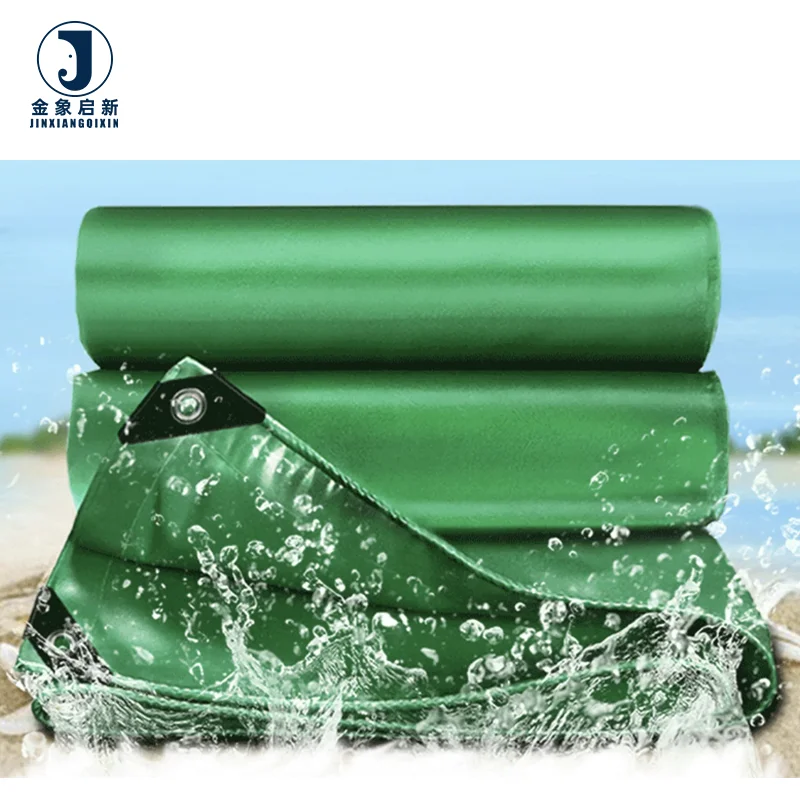
Consistent Coating Weight Control — every roll shipped with a documented GSM-to-denier mapping verified at production, so the PVC Coated Tarpaulin roll stock you specify is exactly what arrives at your warehouse.
Technical Specifications
| Parameter | Value |
|---|---|
| Product Type | PVC Coated Tarpaulin Roll |
| Coating Material | PVC |
| Base Fabric | High-strength polyester mesh fabric |
| Base Fabric Denier Options | 500D×500D / 500D×1000D / 840D×840D / 1000D×1000D / 2000D×2000D |
| Mesh Count Options | 20×20 / 18×25 / 30×17 / 18×18 / 23×24 / 15×15 / 30×30 |
| Weight Range (GSM) | 250GSM / 300GSM / 400GSM / 450GSM / 500GSM / 500GSM enforced / 560GSM / 600GSM / 650GSM / 680GSM / 950GSM / 1000GSM |
| Total Thickness | 0.32mm / 0.35mm / 0.4mm / 0.45mm / 0.5mm / 0.65mm |
| Coating Method | Laminated technology / Hot-melt Coating technology |
| Roll Width | 2m / 2.1m |
| Roll Length | 75m / 50m |
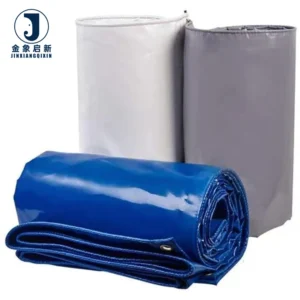
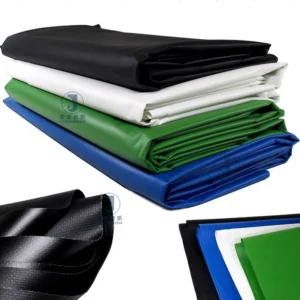
| Colour | Blue / Red / Yellow / Light blue / Grey / Custom |
| Anti-Mildew | Yes |
| Anti-Static | Yes (test basis not stated) |
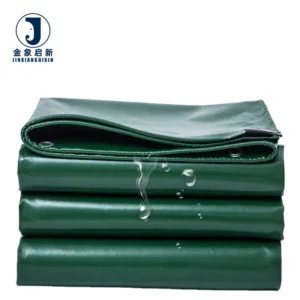
| Waterproof | Yes |
| UV Treatment | Sunproof (test basis not stated) |
| Flame Retardant | Available in flame retardant grades — confirm the grade required for your market |
| Cold Crack Resistance | Yes |
| Service Life | 3–7 years under normal circumstances |
| Printing Option | Custom printing of brand available |
| Certification | ISO / CE |
Application Suitability
| Application | Exposure & Requirement |
|---|---|
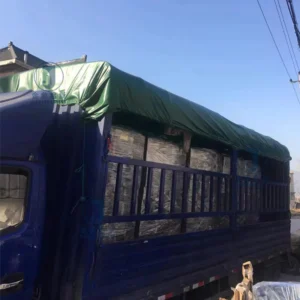
| Truck side curtain and load cover | Constant flexing at hinge points, road debris abrasion, continuous UV exposure, wind flutter stress on welded seams |
| Liquid storage bladder and water tank | Permanent water contact, hydrostatic pressure on seams, chemical exposure from stored liquid, puncture risk during installation |
| Tent and awning structural panels | Tension loading across spans, UV degradation over seasonal use, weld integrity at frame attachment zones, wind uplift forces |
| Cargo ship cover | Salt spray corrosion, heavy rain ingress, deck abrasion from shifting cargo, tie-down point stress concentrations |
| Goods yard and equipment dust cover | Outdoor weathering, particulate ingress prevention, handling abrasion from repeated deployment and folding |
Why GSM Alone Does Not Define PVC Coated Tarpaulin Performance
A stated GSM without the underlying base fabric denier and mesh count tells you nothing about how the material will behave under tension or at the weld line.
Technical buyers regularly receive rolls that meet the quoted GSM on a scale test but fail prematurely because the base fabric construction does not match the application’s mechanical demand. A 650GSM roll built on a 2000D×2000D base with a 15×15 mesh count delivers fundamentally different tensile and tear behaviour than a 650GSM roll on a 500D×500D base with a 30×30 mesh — yet both pass a simple weight check [NEED_CITE: tensile and tear test methods for coated fabrics per ISO 1421]. The PVC Coated Tarpaulin roll GSM denier specification must be read as a system: coating weight, yarn denier and weave density working together.
Coating Method and Its Effect on Adhesion
The distinction between laminated technology and hot-melt coating technology determines how the PVC layer bonds to the high-strength polyester mesh fabric. Laminated construction typically applies separate PVC films to each side of the base fabric under heat and pressure, producing a product where the coating encapsulates the yarn structure. Hot-melt coating involves applying molten PVC compound directly to the substrate. Each method produces different peel strength characteristics and responds differently to heat welding, which matters when fabricators are joining panels for truck curtains or liquid containment bladders.
How Denier and Mesh Count Drive Mechanical Performance
The base fabric denier — ranging from 500D×500D to 2000D×2000D across this PVC Coated Tarpaulin roll range — sets the baseline for tensile strength, while the mesh count determines how that strength is distributed across the fabric plane. A tighter mesh count like 30×30 spreads load across more yarns per unit area, resisting tear propagation in applications where puncture and subsequent tear expansion is the primary failure mode. A lower mesh count such as 15×15 with higher denier yarns provides greater individual yarn strength suited to applications with concentrated point loads [NEED_CITE: relationship between base fabric construction and coated fabric tear resistance].
Thickness, Welding Behaviour and Seam Integrity
Total thickness across grades spans from 0.32mm to 0.65mm. This measurement reflects the combined build of base fabric and PVC coating on both faces. For fabricators running high-frequency or hot-air welding equipment, thickness directly controls the energy input required to achieve consistent seam fusion. A 0.65mm grade demands different weld parameters than a 0.32mm grade, and inconsistent thickness within a roll causes weak spots at the seam — typically the exact location where a loaded truck cover flexes most during transit.
The Cost of Specifying on Weight Alone
When a technical buyer approves a grade based solely on GSM without verifying the base fabric denier and mesh count, the material may pass incoming inspection yet underperform in the field. Welded seams on truck side curtains fail not because the PVC coating is deficient but because the base fabric lacks the tensile capacity to hold the weld under cyclic loading. Colour variation between rolls in the same order — visible once panels are installed side by side — compounds the problem when batch consistency was never part of the specification dialogue [NEED_CITE: common causes of coated fabric field failures in transport applications]. These failures trace back to incomplete material specifications, not manufacturing defects.
Why Source PVC Coated Tarpaulin Roll Stock Here
Three full production lines with 36 sets of professional equipment handle bulk roll output while maintaining GSM and coating weight consistency across long production runs.
The 10-person R&D team manages material selection, matching specific base fabric denier and mesh count combinations to your application’s mechanical requirements before production begins.
Dedicated QA/QC operates at every production stage with 100% inspection before shipment, meaning every roll is checked against the specification sheet rather than sampled from a batch.
Material specification sheets document exact GSM, base fabric denier, mesh count and coating method — providing traceability from quotation to the roll on your warehouse floor.
Samples are developed within days for custom width, colour or treatment requirements, allowing you to verify weld behaviour and colour match before committing to full production.
Documentation & Verification
- Material specification sheet stating exact GSM, base fabric denier, mesh count and coating method for the grade supplied
- Test reports for UV and flame-retardant grades provided where applicable to your market requirements
- Pre-shipment inspection record documenting actual weight verification per roll against stated GSM
- Roll packing list recording roll count, individual weight and dimensions for container loading reconciliation
- ISO and CE certificates included with shipment documentation package
Fabrication, Handling & Storage
- Hot-air weld temperature and speed must be calibrated to the specific thickness grade — 0.32mm through 0.65mm require distinct parameter settings
- Store rolls horizontally on racking to prevent flat-spot deformation on the PVC coating surface, particularly in heavier GSM grades
- Unroll and allow material to acclimatise before fabrication when cold-crack resistant grades have been transported in low ambient temperatures
- Plan cutting layouts around 2m or 2.1m stock widths to minimise offcut waste and reduce the number of welded joins in finished panels
- Reinforced hems and tie-down points should distribute load across multiple yarn directions to prevent tear initiation at stress concentrations
What to Include in Your Material Enquiry
Specify the application and the mechanical loads the finished product will encounter — static tension, cyclic flexing, puncture risk or hydrostatic pressure. State any fire-retardant or anti-static certification your local regulations require so the correct treatment grade is quoted. Confirm whether you need stock roll widths or custom dimensions, and whether colour matching across multiple rolls is critical for your installation. Request a sample cut from production stock to verify weld behaviour and visual consistency before approving the full order.
Frequently Asked Questions
Q: How do you verify the GSM I ordered is the GSM you ship?
A: Every roll undergoes weight verification during pre-shipment inspection. The inspection record documents actual GSM measured against your specification sheet, not just a batch average. We provide this record with your shipment documentation so you can reconcile it against incoming goods at your facility.
Q: What is the difference between hot-melt coating and laminated fabric?
A: Hot-melt coating applies molten PVC compound directly to the polyester mesh, while laminated technology bonds pre-formed PVC films to each side under heat and pressure. Each produces different peel strength and weld characteristics. We recommend confirming which method suits your fabrication process before ordering.
Q: Can you provide a fire-retardant or anti-static test report with my shipment?
A: Flame retardant and anti-static treatments are available across multiple grades. Test reports are supplied where applicable — specify the standard required by your market or project specification at enquiry stage so the correct grade and documentation are matched to your order.
Q: Why do two rolls of the same colour sometimes differ when installed side by side?
A: Colour variation between rolls typically results from separate production batches with slight pigment or process differences. We manage roll-to-roll consistency by producing matched orders within a single production run and verifying colour against reference standards before dispatch.
Q: What base fabric denier should I choose for a truck side curtain versus a liquid storage tank?
A: Truck side curtains demand high cyclic flex resistance, typically suited to higher denier constructions like 2000D×2000D. Liquid storage tanks require puncture resistance and seam integrity under hydrostatic load, often calling for tighter mesh counts. Confirm your specific loading conditions so we can recommend the appropriate denier and mesh combination.