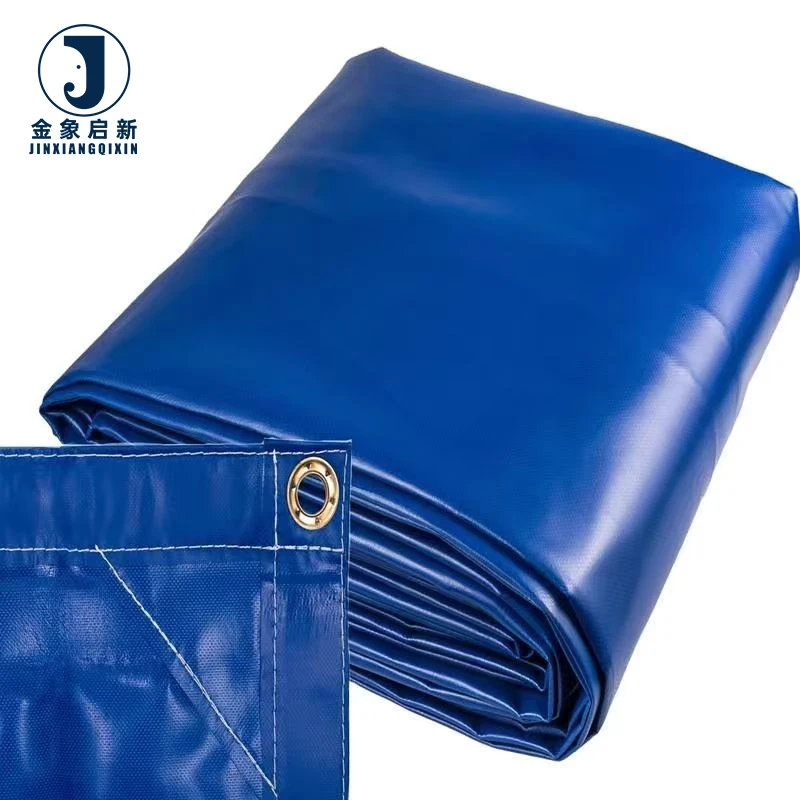
Material Integrity Guaranteed — Every roll ships with a documented specification sheet stating exact coating weight, base fabric construction, and verified GSM, so technical buyers can confirm material properties against their design requirements before fabrication begins.
Technical Specifications
| Parameter | Value |
|---|---|
| Product Type | PVC Coated Tarpaulin |
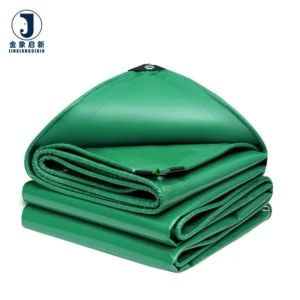
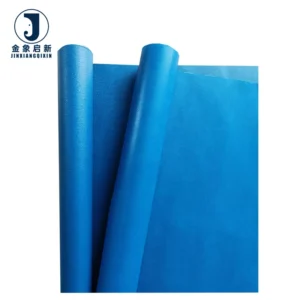
| Coating Material | PVC coated on polyester base fabric |
| Weight (GSM) | 500 to 800 grammes per square meter |
| Waterproof Rating | Anti-permeable ≥20KPa |
| Flame Retardant Grade | ≤10 seconds (grade not stated in source — confirm the standard required for your market) |
| Low-Temperature Flexibility | Remains flexible at -30°C without fracture |
| Coating Method | Heat combined with high-frequency welding |
| Base Fabric | Polyester |
| Tear Strength | Rip-stop construction |
| Chemical Resistance | Acid, alkali and brine corrosion resistant |
| Water Absorption | Almost no absorption, dries quickly after rain |
| Anti-Mildew | Mildew proofing properties stated |
| Reinforcement | Reinforced edges |
| Certification | ISO, CE |
Application Suitability
| Application | Exposure & Requirement |
|---|---|
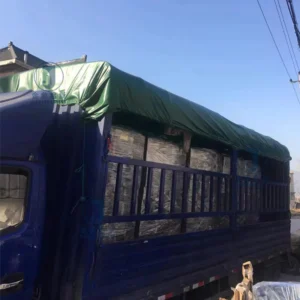
| Truck and trailer load covering | Constant road vibration, UV exposure, wind flex, and weather — requires high tensile strength and rip-stop tear resistance |
| Transport fleet side curtain and cargo enclosure | Repeated daily folding and unfolding, abrasion at contact points, demand for low-temperature flexibility in cold climates |
| Open-air outdoor equipment protection | Continuous rain and moisture exposure, chemical splash in industrial yards, long-term UV radiation |
| Industrial machinery and stock covering | Acid and alkali environments, brine corrosion in port or coastal storage, requirement for anti-permeable waterproofing |
Why the Stated GSM Often Fails to Match What Arrives on Your Dock
Actual coating weight and base fabric density must be documented per roll, not averaged across a product family.
Too often, a PVC Coated Tarpaulin GSM coating material specification looks correct on the quotation but the rolls that arrive feel lighter, flex differently at the weld line, and fail earlier than expected. The problem is not always fraud — it is frequently a supplier quoting from a range rather than a confirmed grade, or coating weight drifting between production runs without in-line verification. When you are specifying fabric for a fleet of side curtains or a batch of industrial covers, that variance means some rolls will pass your fabrication tests and others will not [NEED_CITE: tensile and tear test methods for coated fabrics per ISO 1421]. The only reliable defence is a material specification sheet that accompanies every roll, stating the measured GSM, base fabric denier, and coating weight for that specific production batch.
Coating Weight and Adhesion Control Across the Production Run
The performance of a PVC Coated Tarpaulin GSM coating material specification depends on more than the headline weight figure. The bond between the PVC coating and the polyester base fabric determines whether the material delaminates under tension or holds together at heat-welded seams. Heat combined with high-frequency welding, as used in this fabric construction, creates a molecular bond at the seam that is critical for applications where the load flexes during transit. Consistent coating adhesion across every metre of a roll is what separates a technical-grade fabric from a commodity product.
How Base Fabric Construction Influences Real-World Tear Behaviour
The rip-stop construction stated in the base fabric specification addresses a specific failure mode: once a tear initiates at a stress point — an eyelet hole, a fold line, a weld edge — it propagates through the weave. Rip-stop yarns interrupt that propagation, containing damage to a small area rather than allowing a full-width split. For truck covers that experience constant wind loading and for industrial covers lifted and repositioned frequently, this behaviour difference is significant [NEED_CITE: rip-stop weave tear propagation testing for coated fabrics].
Reading the Specification Sheet: What GSM, Coating Weight, and Tensile Strength Actually Mean Together
A 500 to 800 g/m² weight range covers multiple grades within this product family, and the grade you select determines downstream performance. Coating weight contributes to waterproofing, abrasion resistance, and chemical protection, while the base fabric denier and weave density drive tensile and tear strength. A heavier coating on a lighter base fabric will feel substantial but may tear more easily than a lighter coating on a denser weave. The anti-permeable ≥20KPa waterproof rating and the -30°C low-temperature flexibility are properties of the coating formulation and must be verified against the specific grade selected, not assumed across the entire range. Chemical resistance to acid, alkali, and brine corrosion further depends on the coating compound formulation — buyers in port storage, chemical processing, or marine environments should request test data matched to their exposure conditions.
The Hidden Cost of Specifying on Price Per Kilogram Instead of Performance Data
When a roll arrives with less coating than specified, the consequences cascade through your production. Seams that should hold under load begin to separate at the weld line. Flame retardant grades, if claimed without supporting test reports, can lead to site rejection and costly replacement after installation [NEED_CITE: DIN 4102 fire classification for building materials]. Colour variation between rolls in the same order becomes visible once panels are installed side by side on a structure or vehicle. These are not cosmetic complaints — they are fabrication failures that originate in inconsistent material supply.
Why Technical Buyers Source This Fabric Here
Three full production lines with 36 sets of professional equipment provide the capacity to hold roll-to-roll consistency across large orders, not just on sample rolls. A dedicated 10-person R&D team handles material selection and sample development, enabling you to confirm coating weight, colour, and width before committing to bulk. QA/QC is applied at every production stage with 100% pre-shipment inspection, so the rolls you receive match the specification you approved. Nearly 30 years of focused coated fabric production provides process control over coating weight and adhesion that newer operations cannot replicate quickly. Samples for custom requirements are developed within days, keeping your project timeline on track.
Documentation & Verification
- Material specification sheet stating exact GSM, base fabric denier, and coating weight per roll
- Test report for flame retardant and UV treatment grades where applicable, matched to batch
- Pre-shipment inspection record confirming weight and colour consistency across all rolls
- ISO and CE certificates included with shipping documentation
- Roll packing list with individual roll identification for traceability
Fabrication, Handling & Storage
- High-frequency welding compatible with the PVC coating formulation — confirm weld temperature and dwell time for the specific GSM grade selected
- Reinforced edges distribute tie-down loads — align reinforcement direction with primary stress vectors during fabrication
- Store rolls upright on a clean, dry surface to prevent flat spots and permanent creasing in the coating
- Allow rolls to acclimatise before unrolling in cold conditions — the -30°C flexibility rating does not eliminate handling stiffness
- Use only PVC-compatible cleaners; solvent-based products may degrade the coating surface and reduce anti-permeable performance
- Rip-stop construction limits tear spread — field repairs with PVC-compatible adhesive patches bond effectively to the coated surface
Before You Request a Quote
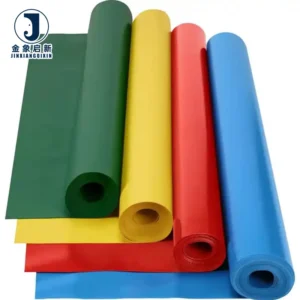
Provide your specific application and exposure conditions, including whether the fabric will face continuous UV, chemical splash, or mechanical abrasion. Confirm the target market and any fire safety or compliance requirements that apply. Specify the grade within the 500 to 800 g/m² range, required width and roll length, colour reference, and whether you need stock rolls or custom production. Let us know if sample rolls at your selected grade are needed before bulk commitment.
Frequently Asked Questions
Q: How is the actual GSM verified on each roll before it ships?
A: Every roll is weighed and measured as part of the 100% pre-shipment inspection. The material specification sheet accompanying your order states the measured GSM, base fabric denier, and coating weight for that specific roll, allowing you to cross-check on receipt against your purchase specification.
Q: What flame retardant grade and test standard supports the claim?
A: The fabric is stated as flame retardant with a ≤10 seconds result, but the specific test standard is not published in the source data. Confirm the standard required by your market — such as DIN 4102, NFPA 701, or a local building code — and request a matched test report with your sample.
Q: How does high-frequency welding compare to hot-air welding for seam integrity?
A: High-frequency welding creates a molecular bond between coating layers at the seam, producing a watertight join that flexes with the fabric. For this PVC coated polyester, high-frequency combined heat welding is specified to ensure seams do not crack or separate at flex points under load movement.
Q: Can I order sample rolls at a specific GSM to validate before bulk?
A: Yes. Samples are developed within days for your selected grade, colour, and width. This allows you to test coating adhesion, weld performance, and fabrication compatibility in your own workshop before confirming a production order.
Q: What documentation ships with each order for compliance purposes?
A: Each shipment includes a material specification sheet per roll, test reports for applicable treatments, ISO and CE certificates, a pre-shipment inspection record, a roll packing list, and a certificate of origin. Additional customs support documentation is available on request.