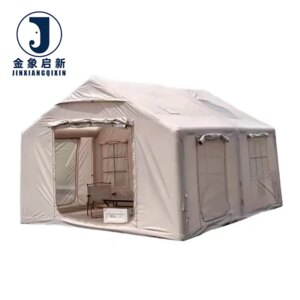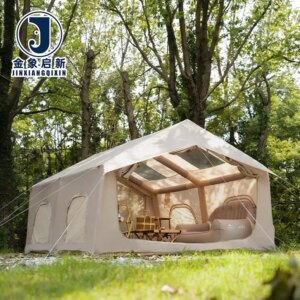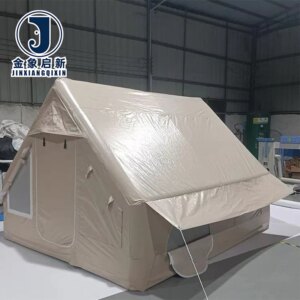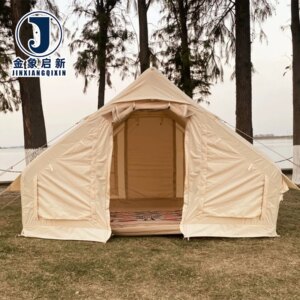
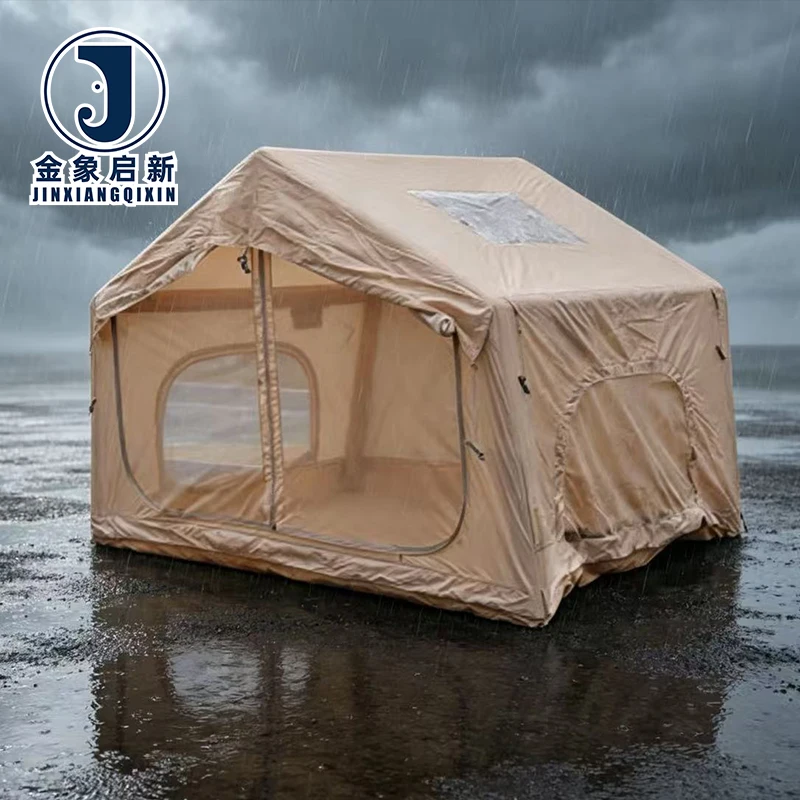
Batch-Consistent Rolls — Every roll of PVC inflatable tent fabric is inspected for GSM, coating weight, and colour uniformity against the order specification before dispatch, so your production line never stops for material variance.
Technical Specifications
| Parameter | Value |
|---|---|
| Product Type | Inflatable Tent Fabric |
| Core Material | PVC tarpaulin |
| Waterproof | Yes |
| UV Treatment | UV-resistant (test basis not stated in source — request report for your climate zone) |
| Flame Retardant | Fire-retardant (grade not stated in source — confirm the grade required for your market) |
| Anti-Static | Anti-static (surface resistance or standard not stated in source — specify target compliance) |
| Tear Resistance | Tear-resistant (test standard not stated in source — request test data per ISO 1421) |
| Production Lines | 3 full production lines |
| Processing Equipment | 36 sets of professional equipment |
| R&D Support | 10 technicians |
| Customization | OEM & ODM — sample customization, pattern printing, material selection, product design |
| Quality System | Full-process QA & QC with on-site dedicated staff |
| Standards | ISO 9001, ISO 14001, ISO 45001, CE |
Application Suitability
| Application | Exposure & Requirement |
|---|---|
| Commercial inflatable event tents | Repeated inflation/deflation cycles, UV exposure, crowd proximity requiring fire-retardant compliance |
| Construction site temporary shelters | Abrasive ground contact, wind-driven rain, dust ingress, on-site fire code enforcement |
| Agricultural mobile storage | Remote deployment, prolonged sun exposure, contact with fertiliser and organic matter |
| Membrane and inflatable structure manufacturing | Heat-weld seam integrity, airtight bladder construction, batch colour matching across panels |
| Mining and tunnelling shelters | Confined-space fire safety mandates, anti-static requirements, heavy handling and drag abrasion |
What Happens When Inflatable Tent Fabric Carries No Traceable Fire-Retardant Grade
A fire-retardant claim without a named standard is a compliance liability, not a safety feature.
Purchasing teams at inflatable structure OEMs frequently receive fabric labelled simply as "fire-retardant" on the quotation, only to discover at site inspection that the local fire authority requires a specific classification such as B1 per DIN 4102, M2 per NF P 92-501, or NFPA 701 pass criteria. The tent is erected, the inspector asks for the test report, and the roll number on the certificate does not match the material on the reel. [NEED_CITE: fire classification standards for temporary structures by jurisdiction]. Shutdowns follow, re-certification costs multiply, and the fabric supplier is already three time zones away.
Custom inflatable structure PVC fabric ordered from Jinxiang is supplied with fire-retardant treatment matched to the compliance framework you specify at inquiry stage. The test report cites the applicable standard, the test laboratory, and the batch number tied to your shipment. If your market demands a grade we have not yet tested, our 10-person R&D team runs a trial formulation and returns a result within the sampling window — not after the container has sailed.
Coating Adhesion and Airtight Bladder Performance
The air-holding bladder of an inflatable tent relies on two things: the PVC coating must bond to the base fabric with enough peel strength to survive repeated inflation cycles, and the heat-welded seam must outlast the panel field. When coating adhesion is marginal, the first sign of failure is a micro-delamination at the weld edge — invisible during factory QA but catastrophic after the third or fourth inflation on site. Our PVC inflatable tent fabric manufacturer process controls coating weight and adhesion at every production stage, verified through in-process peel testing before the roll is released. This is the reason inflatable tent fabric sourced here holds its airtight integrity through the flex-fatigue cycles that commercial event structures endure across seasons.
Base Fabric Construction and Tear Propagation Resistance
During inflation, the tube wall is under biaxial tension; any puncture or cut initiates a tear that propagates along the warp or weft depending on the density ratio of the base fabric. A high-denier yarn in a tight weave configuration resists tear initiation, but it is the balance between warp and weft density that controls whether a puncture stays local or runs. [NEED_CITE: tensile and tear test methods for coated fabrics per ISO 1421]. Our technical team evaluates denier and weave selection against the inflation pressure and tube diameter you specify, recommending a base fabric that keeps tear propagation contained within a repairable zone rather than compromising the entire bladder section.
Reading the Specification Sheet Beyond GSM
GSM tells you the total weight of base fabric plus coating per square metre, but it does not tell you how that weight is distributed. A 900 GSM fabric with a heavy coating over a light base may resist abrasion well yet tear easily; a lighter coating over a dense, high-denier base delivers superior tensile and tear values at the same or lower GSM. The coating method — whether knife-over-roll, calender, or laminated — determines peel strength, surface finish, and heat-weld compatibility. Knife-coated fabrics generally offer better adhesion for airtight seam construction, while calendered options may present a smoother surface for printed branding. Fire-retardant grades add chemical loading that can shift hand-feel and low-temperature flexibility; anti-static treatment alters surface resistivity. Understanding these trade-offs is where our R&D team adds value before you commit to a production order.
The Cost of a Specification Mismatch
When inflatable tent fabric is ordered on price and GSM alone, the consequences surface at the worst possible moment. A fire-retardant grade that does not map to the local building code halts the event permit. A coating formulation with insufficient low-temperature flexibility cracks during winter deployment. [NEED_CITE: common causes of inflatable structure field failures]. Rolls arriving with colour variance between batches force the manufacturer to either accept visible panel mismatch on the finished tent or scrap entire sections. Heat-weld parameters calibrated for one coating chemistry fail on another, producing seam leaks that pass the factory water test but open under real inflation pressure. Every one of these scenarios traces back to a single gap: the material specification was not locked to the performance requirement before the order was placed.
Why Procurement Teams Source Inflatable Fabric Here
Nearly 30 years of focused coated-fabric production means our process controls are built from decades of formula and line-adjustment data, not generic equipment manuals. Three full production lines and 36 sets of processing equipment give us the capacity to fulfil container-load orders of custom inflatable structure PVC fabric without splitting batches across different machines — the single biggest cause of roll-to-roll inconsistency. The 10-person R&D team handles material selection, custom formulation, and sample development in-house, so specification changes do not wait on an external compounder. Dedicated QA and QC staff inspect every production stage, and 100% pre-shipment inspection is standard, not optional. ISO 9001, ISO 14001, ISO 45001, and CE documentation ships with each order for your compliance file.
Documentation & Verification
- Material specification sheet stating GSM, base fabric denier, coating method, and colour reference per roll
- Fire-retardant and anti-static test reports tied to batch number and applicable standard
- UV-resistance test data available on request with exposure methodology stated
- ISO 9001, ISO 14001, ISO 45001, and CE certificates included for compliance submission
- Pre-shipment inspection record with roll-by-roll GSM and colour verification
- Certificate of origin and customs documentation for international shipment
Fabrication, Handling & Storage
- Heat-weld temperature and dwell time must match the specific PVC coating formulation — request weld parameters with your sample
- Store rolls upright on end-caps to prevent flat-spot creasing on the coating surface
- Allow cold-stored rolls to acclimatise to workshop temperature before unrolling to avoid coating micro-cracking
- Use compatible PVC-based repair adhesive matched to coating weight for on-site bladder patching
- Plan panel cutting layout to minimise off-cut waste, confirming available roll widths before nesting
- Clean with neutral pH detergent only; solvent-based cleaners may degrade fire-retardant chemical loading
Requesting a Specification Match
Tell us the target fire-retardant classification for your market, the inflation pressure range of your tube design, and the climate zone where the structure will operate. We need to know whether you require anti-static treatment and which surface resistivity standard applies. Specify roll width, colour references, and whether printed branding is part of the build. Our team will return a material recommendation with sample yardage for your weld and inflation-cycle testing before you commit to volume.
Frequently Asked Questions
Q: What fire-retardant certification does the inflatable tent fabric carry?
A: We supply fire-retardant grades matched to the standard you specify — such as B1, M2, or NFPA 701 — with a test report tied to your batch number. If your local authority requires a classification we have not yet tested, our R&D team runs a trial formulation during sampling and provides the result before production.
Q: Can the fabric be heat-welded for airtight inflatable tube construction?
A: Yes. Our PVC inflatable tent fabric is engineered for heat-weld seam construction. We supply recommended weld temperature, speed, and dwell-time parameters with each material formulation. We advise testing weld samples through multiple inflation cycles before releasing full-roll production.
Q: How do you ensure colour consistency across rolls in a single order?
A: Every roll is checked against the approved colour reference during pre-shipment inspection. Production is scheduled on a single line to avoid machine-to-machine coating variation. The inspection record documents colour verification per roll, so you can trace any panel back to its source.
Q: What documentation ships with each roll for compliance and quality records?
A: Each shipment includes a material specification sheet with GSM and coating details, fire-retardant or anti-static test reports linked to the batch, ISO and CE certificates, a pre-shipment inspection record, and standard export documentation including certificate of origin.
Q: Can you supply custom widths and printed branding for OEM tent manufacturers?
A: Custom widths, colours, and pattern printing are available through our OEM and ODM service. Provide your width requirement, Pantone or RAL references, and print artwork. We develop a sample roll for your approval before scheduling bulk production.