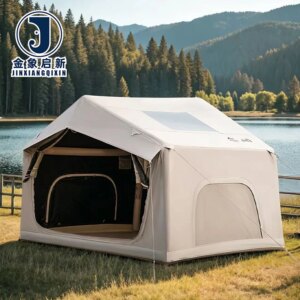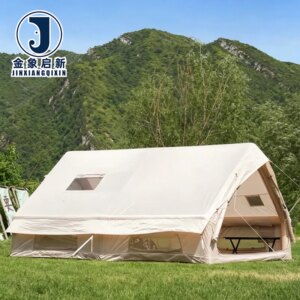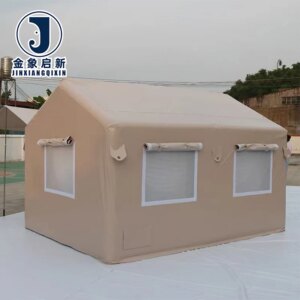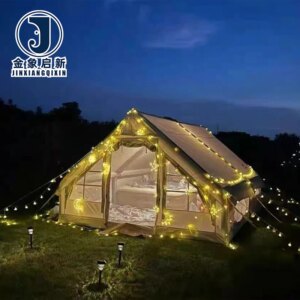
Coating Weight Control — Every roll of Inflatable Tent Fabric produced on our three full lines undergoes stage-by-stage QA with 100% pre-shipment inspection to verify stated coating adhesion and waterproof rating before dispatch.
Technical Specifications
| Parameter | Value |
|---|---|
| Product Type | Inflatable Tent Fabric |
| Core Material | Oxford Waterproof Fabric |
| Construction | Single Layer |
| Waterproof Rating | ≥10,000mm H2O |
| Waterproof Durability | 5000 cycles of water pressure testing |
| UV Treatment | UPF 50+ (test basis not stated) |
| Temperature Range | -30°C to 70°C |
| Tensile Strength | ≥300N/5cm (test basis not stated) |
| Tear Strength | ≥150N (test basis not stated) |
| Dimensional Tolerance | ±2cm |
| Material Thickness Tolerance | ±0.1mm |
| Key Features | Automatic Opening, Four-Season Design, Extended Type |
| Certifications | ISO9001, ISO14001, ISO45001, CE |
Application Suitability
| Application | Exposure & Requirement |
|---|---|
| Construction site temporary shelter | Continuous outdoor weathering, wind loading, abrasion from site activity, rapid deployment need |
| Mobile storage for logistics companies | Frequent inflation/deflation cycles, load protection from moisture, ground contact abrasion |
| Emergency preparedness and disaster relief | Extreme temperature variance, rapid assembly under pressure, reliable waterproof barrier |
| Outdoor industrial events | UV exposure over multi-day use, crowd proximity wear, aesthetic surface consistency |
| Temporary workspace enclosures | Wind and rain exposure, thermal comfort requirements, repeated relocation |
What "Waterproof" Means Without a Verified Test Cycle Behind It
A stated hydrostatic head value is only meaningful when backed by documented cycle testing under sustained pressure.
Technical buyers specifying inflatable structures frequently encounter fabric marketed as waterproof based on a single static column test, yet the coating delaminates or micro-cracks after repeated inflation cycles in field conditions. Inflatable Tent Fabric must withstand not just standing water but the cyclic stress of pressurised air chambers expanding and contracting across temperature swings. [NEED_CITE: hydrostatic head testing methods for coated fabrics per ISO 1421] When a specification sheet lists a waterproof figure without indicating how many pressure cycles the material endured, the buyer has no basis to predict field performance. The 5000-cycle water pressure durability figure on this fabric addresses that gap directly, providing a reference point for engineering evaluation rather than an untested claim.
Coating Adhesion and the Inflatable Chamber Challenge
The bond between the Oxford base fabric and its waterproof coating determines whether an inflatable air beam holds pressure through repeated use. Delamination at the coating-substrate interface is the primary failure mode in inflatable structures, typically appearing first at welded seams where cyclic flex concentrates stress. This Inflatable Tent Fabric undergoes controlled coating application with monitored adhesion parameters, ensuring the coating remains bonded under the internal pressure loads typical of four-season deployment. The ±0.1mm material thickness tolerance reflects the consistency maintained across the coating pass, which directly influences how uniformly pressure distributes across the air chamber walls.
Temperature Extremes and Material Behaviour
Operating across a -30°C to 70°C range means the coating formulation must resist brittle fracture in sub-zero conditions while preventing softening and creep at elevated temperatures. [NEED_CITE: low-temperature flex testing for PVC and Oxford coated fabrics] At the cold end, the plasticiser system in the coating must maintain flexibility so that inflation does not cause micro-cracking in the waterproof layer. At the upper boundary, the coating must retain sufficient rigidity that the air beam does not deform under its own internal pressure when exposed to direct solar gain. This temperature tolerance is validated during production QC rather than assumed from base material data sheets alone.
Reading the Specification Sheet as a Technical Buyer
Waterproof rating, tensile strength, and tear resistance interact as a system rather than independent figures. The ≥10,000mm H2O rating indicates the hydrostatic head the coating can sustain before water penetration, but this value depends on the integrity of the Oxford base fabric beneath it — a weak base will allow coating distortion under pressure, creating pathways for moisture ingress. The ≥300N/5cm tensile and ≥150N tear figures describe how the composite material resists the biaxial loads imposed by internal air pressure and external wind forces. [NEED_CITE: tensile and tear test methods for coated fabrics per ISO 1421] Single layer construction reduces weight for rapid deployment but demands that every parameter performs at the stated level, since there is no secondary barrier to compensate for a deficiency in any one property. The dimensional tolerance of ±2cm across the finished tent reflects the cutting and welding precision applied to this fabric grade.
The Cost of Specifying on Marketing Claims Alone
When a buyer accepts a waterproof rating without verifying the test cycle count, the inflatable structure may pass initial commissioning yet develop leaks within weeks of field deployment as the coating fatigues at flex points. Similarly, tensile and tear figures reported without a test standard leave no recourse when the fabric underperforms on site, because the supplier can argue a different test method was used. [NEED_CITE: common failure modes in inflatable structure fabric at welded seams] Batch-to-batch inconsistency in coating weight compounds these risks — a roll that is marginally underweight may still pass a spot check but fail under sustained pressurisation. The documented 5000-cycle durability figure and the ±0.1mm thickness tolerance on this Inflatable Tent Fabric exist to give technical buyers a verifiable baseline rather than a marketing assertion.
Why Technical Buyers Source This Fabric Here
Deep process control over coating weight and adhesion, developed across nearly 30 years of focused coated fabric production, ensures the waterproof and mechanical properties stated on the specification sheet match what arrives at the fabrication floor. Three full production lines and 36 sets of professional processing equipment provide the capacity to maintain batch consistency across multi-roll orders for large-scale inflatable structure manufacturing. A 10-person R&D team handles material selection, custom sizing, and sample development, enabling buyers to validate the fabric against their specific inflation pressures and environmental conditions before committing to production volume. Dedicated QA/QC at every production stage with 100% inspection before shipment means every roll shipped carries verified data rather than assumed compliance. ISO and CE certified production systems provide the documentation trail that procurement departments and compliance officers require for industrial and emergency deployment contracts.
Documentation & Verification
- Material specification sheet stating Oxford base fabric type, coating composition, and ≥10,000mm H2O waterproof rating
- UV treatment report with stated UPF 50+ value for outdoor deployment verification
- Pre-shipment inspection record with batch-specific tensile and tear strength data per roll
- ISO9001, ISO14001, ISO45001, and CE certificates for compliance documentation packages
- 5000-cycle water pressure durability test record for engineering lifecycle assessment
Fabrication, Handling & Storage
- Weld temperature and dwell time must be matched to the Oxford coating formulation to prevent seam delamination under inflation pressure
- Store rolls upright on padded racks to avoid compression marks on the coated surface that affect air chamber uniformity
- Allow fabric to acclimatise to ambient temperature before unrolling in cold conditions to prevent coating micro-fracture
- Use compatible adhesive systems for field repair patches, verified against the specific coating chemistry on this fabric grade
- Cut patterns to account for ±2cm dimensional tolerance, aligning panels to minimise waste across the available roll width
Inquiry Direction for Material Specification
Provide your intended deployment environment, including expected temperature extremes and wind loading, so the appropriate coating formulation and base fabric grade can be confirmed. Specify whether your fabrication process uses hot-air welding, high-frequency welding, or adhesive bonding, as this determines the coating compatibility requirements. Indicate your annual volume and required roll widths to confirm production scheduling and batch consistency parameters.
Frequently Asked Questions
Q: What test basis supports the UPF 50+ claim for outdoor deployment?
A: The UPF 50+ value is stated from production specification. For projects requiring third-party verified UV performance data tied to a specific test standard, request the UV test report with method reference when submitting your inquiry. This allows your engineering team to cross-check against the regulatory requirements of your target market and deployment environment.
Q: How is coating adhesion verified before shipment?
A: Coating adhesion is monitored through in-process quality control at each production stage, with final verification during 100% pre-shipment inspection. The inspection record documents the adhesion performance of each roll against the stated specification. For inflatable applications where weld integrity is critical, buyers can request peel strength data specific to their welding method.
Q: How do you verify GSM and coating weight on arrival?
A: Every roll undergoes coating weight and material thickness verification during the pre-shipment inspection, with results recorded on the inspection report. The ±0.1mm thickness tolerance provides a measurable parameter for incoming goods verification. Buyers conducting their own receiving inspection can reference the supplied test data to confirm the roll matches the ordered specification.
Q: What is the minimum order for custom dimensions or colour?
A: Minimum order quantities depend on the specific customisation required — whether it involves custom width, colour matching, or pattern printing on the Inflatable Tent Fabric. Submit your dimensional requirements and colour reference along with your projected annual usage, and the production team will confirm the minimum viable run size and lead time for your specification.
Q: How is batch-to-batch colour consistency controlled across rolls?
A: Colour consistency is managed through controlled pigment dosing during coating application, with visual and instrumental checks at each production stage. Rolls within a single order are produced in sequence to minimise variation. For projects where panels from different rolls will be visible side by side, request the batch colour reference data to verify consistency before fabrication begins.