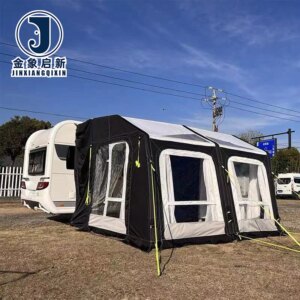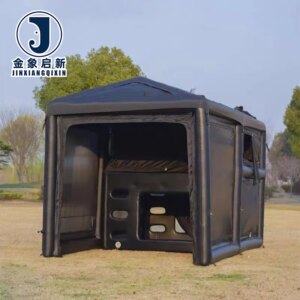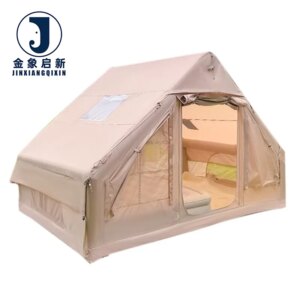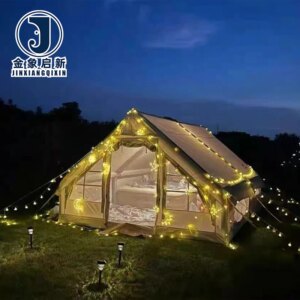
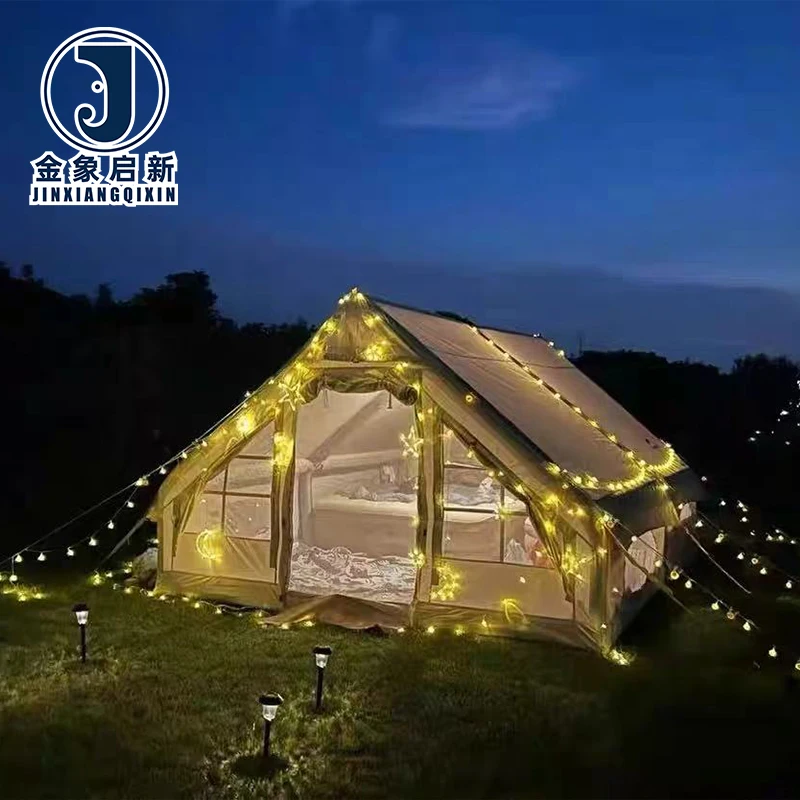
Process-controlled coating weight — Every roll of inflatable tent fabric we supply carries a documented GSM and base fabric spec verified at the coating head, not just on the quotation.
Technical Specifications
| Parameter | Value |
|---|---|
| Product Type | Inflatable Tent |
| Core Material | PVC Tarpaulin |
| Coating Method | Knife Coated |
| Key Performance | Waterproof, UV-resistant (test basis not stated), Tear-resistant |
| Layer Design | Single Layer |
| Opening Mechanism | Quick Automatic Opening |
| Capacity | 4-6 Person |
| Customization | OEM & ODM — sample customization, pattern printing |
| Standards | ISO9001, ISO14001, ISO45001, CE |
Application Suitability
| Application | Exposure & Requirement |
|---|---|
| Commercial outdoor gear product lines | Repeated inflation cycles, seam weld integrity, consumer-grade surface finish |
| Outdoor events management temporary workspace | Rapid deployment, wind load on membrane, UV exposure during multi-day events |
| Construction site equipment storage shelter | Abrasion from ground contact, puncture risk, weather exposure across seasons |
| Disaster relief mobile facility | Fast inflation under field conditions, waterproof integrity, transport and storage durability |
| Engineering firm temporary on-site structures | Structural membrane tension, temperature variation, repeated assembly and teardown |
Why Coating Adhesion Matters More Than GSM for Inflatable Tent Fabric
The weld line fails before the fabric does when coating adhesion is poorly controlled.
When an inflatable tent flexes under wind load or internal pressure changes, the stress concentrates at heat-welded seams. If the PVC coating does not bond fully to the base fabric, the peel strength at the weld drops and the seam separates — often while the fabric itself remains intact. This is one of the most common field failures in inflatable membrane structures [NEED_CITE: tensile and tear test methods for coated fabrics per ISO 1421]. Material buyers evaluating PVC tarpaulin for inflatable tent manufacturing should request peel strength data alongside GSM, because coating weight alone does not predict weld reliability.
How Knife Coating Builds a Reliable Membrane for Inflation
The knife coating process applies PVC paste directly onto the base fabric under controlled blade pressure, forcing the coating into the weave interstices. This produces a mechanical lock between coating and yarn that supports consistent heat welding across the membrane surface. For inflatable tent fabric material and coating specifications, knife coating delivers the uniform thickness needed for predictable hot-air weld behaviour during fabrication.
Coating Weight and Base Fabric Construction
A PVC tarpaulin specified for inflatable tent use must balance coating weight against base fabric denier and weave density. Heavier coating fills the weave completely and improves waterproof performance, but adds roll weight that affects shipping cost and handling on site. The base fabric construction determines how the material resists tear propagation when a puncture occurs under inflation pressure. Technical buyers should match both parameters to the expected stress conditions of the end application [NEED_CITE: coating weight and base fabric relationship in PVC tarpaulin performance].
Reading the Spec Sheet Beyond the Headline Number
GSM tells you the total mass per square metre but does not separate base fabric weight from coating weight. Two fabrics at the same GSM can behave very differently: one with a dense base and thin coating will tear differently than one with a light base and thick coating. Coating formulation also affects low-temperature flexibility — a PVC compound plasticised for cold climates stays supple where a standard formulation becomes brittle. For inflatable shelter applications deployed across seasons, confirming the plasticiser system and low-temperature flex rating prevents membrane cracking during winter inflation. Surface finish — glossy or matte — influences cleaning ease and print adhesion for branded event tents, and should be selected based on the end-use requirement rather than assumed from a general product description.
What Happens When Material Is Specified on Price Alone
Choosing inflatable tent fabric on cost per square metre without verifying coating adhesion and base fabric denier leads to predictable outcomes. Seams separate during the first strong wind event. The membrane surface cracks along fold lines after storage in cold conditions. Colour shifts between rolls become visible once multiple panels are welded into a single structure. These failures appear after fabrication is complete and the structure is deployed, making rework expensive and eroding confidence in the finished product line [NEED_CITE: common failure modes in PVC inflatable structures related to material inconsistency].
Why Fabrication Teams Source From This Line
Our coating lines maintain documented process control at every stage, from base fabric inspection through coating application to finished roll winding. The R&D team develops material samples within days when a fabricator needs a specific colour, width, or surface finish for a new inflatable product. Pre-shipment inspection covers every roll before it leaves the facility, checking coating adhesion, colour consistency, and surface quality against the agreed specification. We hold ISO9001, ISO14001, and ISO45001 certifications alongside CE marking, giving commercial buyers a documented quality framework for their procurement records. Custom width and pattern printing are handled on the same production lines as stock grades, so sample approval translates directly into production output.
Documentation & Verification
- Material specification sheet stating GSM, base fabric denier, and coating compound for each roll
- Test report for UV-resistant grades confirming exposure performance data
- Pre-shipment inspection record covering coating adhesion and surface consistency
- ISO9001, ISO14001, ISO45001, and CE certificates included with every dispatch
- Roll packing list with colour reference and batch traceability
Fabrication, Handling & Storage
- Hot-air welding temperature should be calibrated to the knife-coated PVC formulation before production runs begin
- Seam overlap width must account for inflation flex stress at panel junctions on this single-layer membrane
- Store rolls vertically on end caps to prevent permanent creasing across the coating surface
- Allow cold-stored rolls to reach ambient temperature before unrolling to avoid coating micro-cracking
- Use PVC-compatible cleaners only — solvent-based products can degrade the plasticiser system
What We Need to Specify Your Fabric
Provide the expected inflation pressure range and deployment climate so we can recommend the appropriate coating formulation and base fabric construction. Share your target market’s fire classification requirements if applicable, along with the roll widths your fabrication equipment handles. Confirm whether you need stock colour or a custom match, and whether finished samples are required before bulk production.
Frequently Asked Questions
Q: How do I verify the stated GSM matches what arrives?
A: Request a weight verification record per roll from the pre-shipment inspection. You can independently confirm by cutting a measured sample from the roll edge and weighing it on a calibrated scale. Discrepancies between quoted and actual GSM typically point to coating weight variation during production, which our process control is designed to prevent.
Q: What UV test data should I request before specifying this fabric outdoors?
A: Ask for the test standard and exposure duration behind any UV-resistant claim. Without a documented test basis, the UV treatment level cannot be compared across suppliers. We provide test reports for UV grades on request — confirm the exposure conditions relevant to your market before selecting a formulation.
Q: Which welding methods suit PVC tarpaulin for inflatable tent fabrication?
A: Hot-air welding and high-frequency welding both work with knife-coated PVC tarpaulin. The preferred method depends on seam geometry and production volume. Weld parameters must be calibrated to the specific coating formulation, as plasticiser content and coating thickness affect the temperature window for a reliable bond.
Q: Can batch-to-batch colour stay consistent across a large order?
A: Colour consistency depends on coating compound batching and inline quality checks during production. Our process includes colour reference verification at the coating stage, and pre-shipment inspection compares finished rolls against the approved sample. Specify your colour tolerance upfront so it is built into the production standard.
Q: How does the fabric behave at welded seams under inflation stress?
A: Welded seams on knife-coated PVC tarpaulin carry the inflation load at every panel junction. Coating adhesion to the base fabric determines whether the weld holds or peels under flex stress. Our material specification includes coating construction data so fabricators can set weld parameters with confidence.