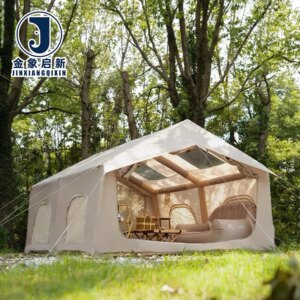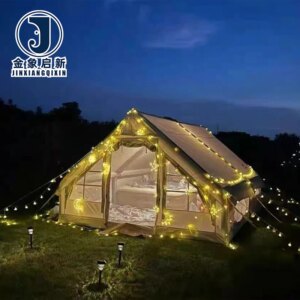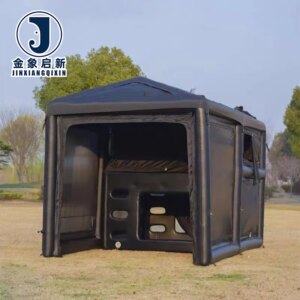
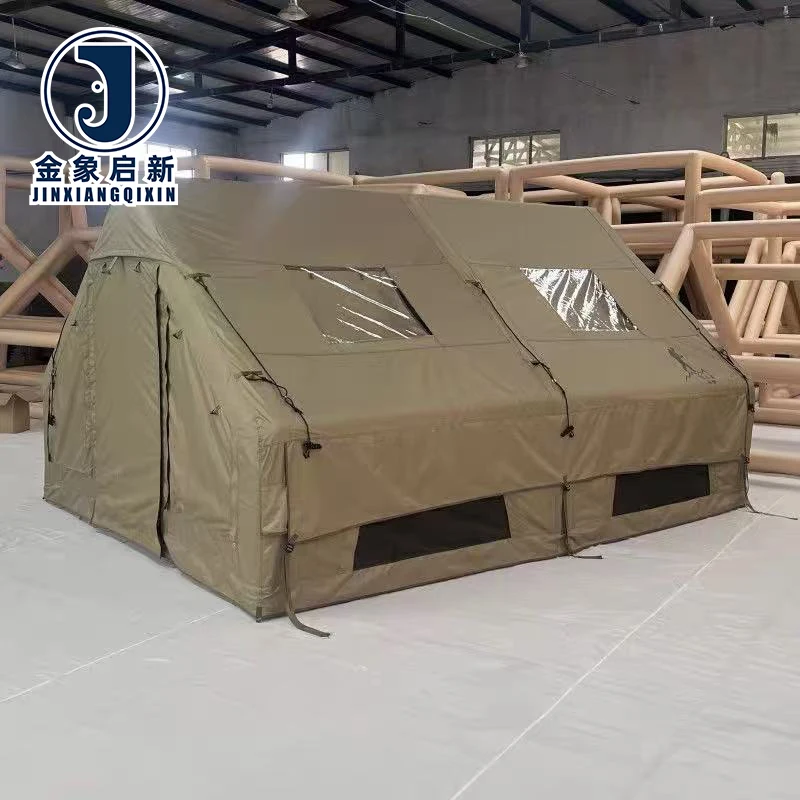
Coated Fabric Process Control — Nearly 30 years focused on PVC tarpaulin coating weight and adhesion, applied here to inflatable tent fabric where airtight seam integrity depends on consistent coating formulation and high-frequency weld compatibility.
Technical Specifications
| Parameter | Value |
|---|---|
| Product Type | Inflatable Tent Fabric |
| Core Material | PVC Tarpaulin |
| Product Forms | Inflatable structure with single layer construction |
| Key Performance | Waterproof, UV-Resistant (test basis not stated), Tear-Resistant, Quick Automatic Opening |
| Flame Retardant Grade | Grade not stated — confirm the grade required for your market |
| Anti-Static | Not confirmed — available upon specification |
| Customization Service | OEM & ODM including sample customization and pattern printing |
| Quality Control | Full-process inspection; 24-hour inflation test on every finished unit; pressure testing on airtight seams |
| Certifications | ISO9001, ISO14001, ISO45001, CE |
Application Suitability
| Application | Exposure & Requirement |
|---|---|
| Temporary site offices at remote construction projects | Prolonged UV exposure, wind load on inflatable frame, abrasion from repeated deployment and relocation |
| Equipment storage facilities in disaster recovery zones | Constant moisture contact, ground-level contamination, rapid inflation requirement under emergency timelines |
| Mobile command centers for infrastructure maintenance | Frequent transport and redeployment, thermal cycling across seasons, airtight integrity over extended occupation |
| Temporary warehousing during logistics operations | High-volume internal airflow, forklift proximity abrasion, sustained internal pressure over multi-week use |
Why Coating Adhesion Matters More Than Fabric Weight for Inflatable Structures
Airtight performance in inflatable tent fabric depends on coating-to-yarn bond strength, not GSM alone.
Many buyers specify inflatable structures by weight and discover after inflation that seams delaminate at the weld line before the base fabric shows any stress. The internal pressure of an airtight inflatable structure concentrates force at every welded joint, and if the PVC coating has not penetrated the base yarn bundle fully during the coating process, the weld captures coating film rather than fused yarn structure [NEED_CITE: high-frequency welding principles for PVC coated fabrics]. An Inflatable Tent Fabric manufacturer controlling the knife coating process can manage penetration depth and top-coat formulation specifically for thermal weld compatibility, rather than relying on laminated film that separates under sustained pressure.
Knife Coating and the Weld Integrity Chain
The knife coating process deposits liquid PVC plastisol directly onto the moving base fabric, forcing compound into the yarn interstices before gelling in the oven. For custom inflatable structure PVC tarpaulin, this penetration creates a monolithic cross-section where the weld fuses coating and yarn together rather than joining two separate film layers. Fabric produced by lamination carries an inherent peel plane between film and substrate, which becomes the failure point when internal air pressure pushes outward at seam junctions over sustained deployment periods.
Single Layer Construction and Pressure Distribution
Single layer inflatable construction eliminates the dead-air cavity found in double-wall designs, concentrating structural load onto one coated fabric membrane [NEED_CITE: structural analysis of single versus double wall inflatable shelters]. This means every square meter of the PVC tarpaulin must carry its share of internal pressure without localized stretch or coating micro-cracking. The base fabric denier and weave density work together with coating weight to distribute that load: a tighter weave with adequate coating penetration resists bias-direction stretching that causes inflatable tubes to deform under sustained inflation.
Reading the Specification Sheet Beyond GSM
Coating weight stated in GSM combines base fabric mass and PVC compound mass into one number, which obscures the ratio between structural yarn and protective coating. Two inflatable tent fabrics at the same GSM can behave completely differently if one uses a heavier base yarn with a thinner coat and the other uses a lighter base with a thicker coat. The heavier base offers higher tensile strength but may leave insufficient coating at the weld zone for reliable thermal fusion, while the thicker coat improves weld performance but adds dead weight without proportional strength gain. Buyers specifying material for custom inflatable structure PVC tarpaulin should request the base fabric denier and weave count alongside the total GSM to understand where the weight actually sits.
What Happens When Coating Formulation Does Not Match the Weld Process
When PVC compound plasticizer content is optimized for flexibility rather than weld compatibility, high-frequency welding produces joints that appear sealed during factory testing but develop micro-leaks after days of sustained inflation pressure in the field. The plasticizer migrates toward the weld zone under thermal cycling, softening the heat-affected area and reducing peel strength at the exact location where airtight integrity is most critical [NEED_CITE: plasticizer migration effects on PVC weld strength under thermal cycling]. This failure mode does not appear during short pre-shipment inflation checks, which is why a 24-hour continuous inflation test on every finished unit catches leaks that shorter verification protocols miss. Batch-specific weld sample testing, where sacrificial panels from the same production run are destructively peeled to measure joint strength, provides documentation that the coating formulation and weld parameters remained matched throughout the order.
Why Source Inflatable Tent Fabric from This Production Line
- Coating process control across three full production lines allows batch-to-batch consistency in PVC formulation, so repeat orders of inflatable tent fabric maintain the same weld behavior and coating adhesion without requalification.
- 36 sets of professional processing equipment include the high-frequency welders and inflation test rigs needed to verify airtight performance on every finished inflatable structure, not just sample units.
- 10-person R&D team develops pre-production samples for buyer evaluation of inflation behavior, seam integrity, and packing dimensions before bulk commitment locks in the specification.
- Dedicated QA and QC staff on site at every stage means coating weight verification, base fabric incoming inspection, and finished unit pressure testing each have assigned personnel rather than shared responsibilities.
- Full OEM and ODM capability with pattern printing supports branding and color requirements for commercial emergency shelters without outsourcing print to a separate facility that may not control coating compatibility with ink adhesion.
Documentation & Verification
- Material specification sheet confirming PVC tarpaulin base fabric denier, weave count, and total GSM per roll
- UV-resistance test report included where applicable, stating test method and exposure duration
- Batch-specific weld peel strength data from sacrificial panels produced alongside the order
- 24-hour inflation test record for every finished unit, traceable by order and unit number
- ISO9001, ISO14001, ISO45001, and CE certificates shipped with documentation package
- Pre-shipment inspection report covering dimensional checks, seam continuity, and surface quality
Fabrication, Handling & Storage
- High-frequency welding parameters must be calibrated to the specific PVC coating formulation of this inflatable tent fabric to prevent under-weld or burn-through at seam junctions
- Store PVC tarpaulin rolls vertically on padded racks to prevent flat-spot deformation that causes creasing when the inflatable structure is first deployed
- Avoid folding finished inflatable units along welded seam lines during packing, as repeated crease stress at the weld reduces long-term airtight performance
- Clean deployed inflatable tent surfaces with mild pH-neutral detergent only, as solvent-based cleaners can extract plasticizer from the single layer PVC coating
- Field repair of minor punctures requires PVC-compatible adhesive patch kits matched to the coating formulation, not generic vinyl repair compounds
How to Specify Your Inflatable Tent Fabric Requirement
Provide the intended deployment environment including typical wind load, temperature range, and expected duration of continuous inflation so we can recommend the appropriate base fabric weight and coating formulation. Specify your target market fire classification requirements, as flame retardant grades vary by region and must be confirmed before production begins. Confirm whether you need finished inflatable units with welded seams and 24-hour inflation testing, or roll stock of custom inflatable structure PVC tarpaulin for fabrication at your own facility.
Frequently Asked Questions
Q: How do we verify PVC tarpaulin GSM on arrival against the quotation for inflatable tent orders?
A: Request a batch-specific weight verification report with your shipment showing measured GSM per roll. On arrival, cut a measured sample from the roll edge and weigh it on a calibrated scale to confirm the figure matches. Significant deviation should be reported before fabrication begins, as cutting voids any GSM dispute.
Q: What test basis supports the UV-resistance claim for extended outdoor inflatable shelter deployment?
A: UV-resistance treatment is applied to the PVC coating formulation, but the specific test method and exposure duration must be confirmed for your climate zone and deployment timeline. Request the test report stating the standard used and hours of exposure completed before committing to a bulk order for long-term outdoor installation.
Q: How is high-frequency weld quality controlled for airtight inflatable structures?
A: Every finished inflatable unit undergoes a 24-hour continuous inflation test with dedicated QA staff monitoring pressure retention. Additionally, sacrificial weld panels from each production batch are destructively peel-tested to verify that joint strength meets specification before the main production run proceeds through final assembly.
Q: What custom sizing and MOQ applies to OEM and ODM inflatable tent fabric orders?
A: Minimum order quantity depends on whether you require roll stock in custom widths or finished inflatable units with welded construction and pattern printing. The R&D team develops pre-production samples for your approval before bulk manufacturing begins, allowing performance evaluation of inflation behavior and seam integrity at your own facility.
Q: What field maintenance and repair procedures apply to PVC inflatable shelters in industrial use?
A: Inspect welded seams and valve connections before each inflation cycle for signs of coating delamination or micro-leakage. Minor punctures in the single layer PVC tarpaulin membrane can be repaired with PVC-compatible adhesive patches matched to the coating formulation. Avoid solvent-based cleaners that extract plasticizer and accelerate embrittlement.