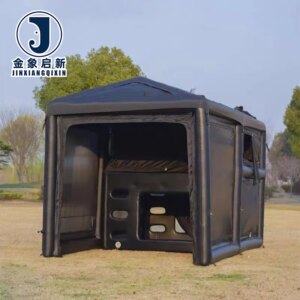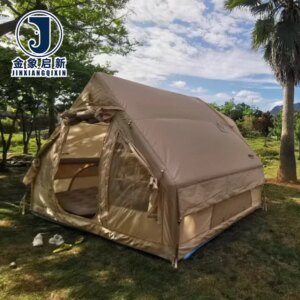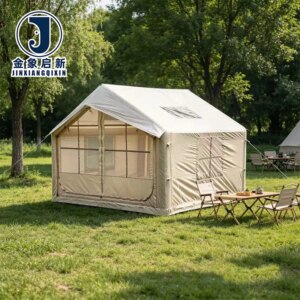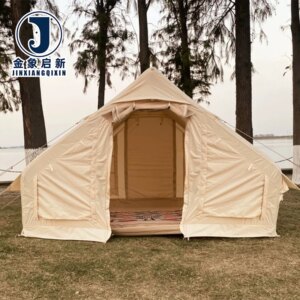
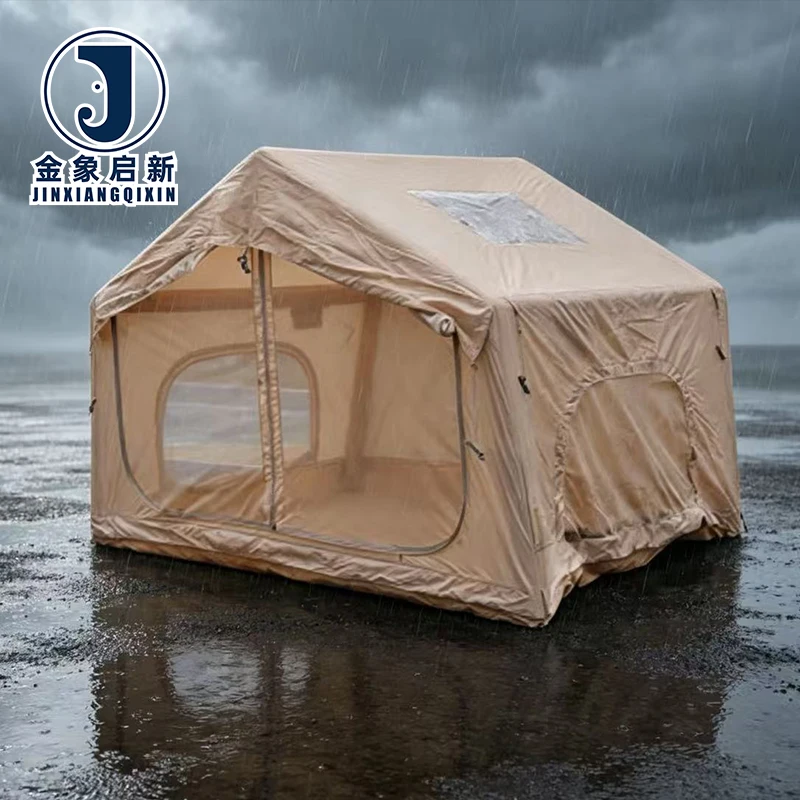
Process-Controlled PVC Coating — three dedicated production lines maintain uniform coating weight and adhesion on every roll of inflatable tent fabric leaving the facility.
Technical Specifications
| Parameter | Value |
|---|---|
| Product Type | Inflatable Tent |
| Core Material | UV-Resistant PVC |
| Waterproof Rating | Hydrostatic head exceeding 5000 mm |
| UV Resistance | Tested to withstand 5000+ hours of sunlight exposure (test basis not stated in source) |
| Tensile Strength Retention | Maintains 85% tensile strength after 2 years of outdoor exposure (test basis not stated in source) |
| Deployment Mechanism | Quick automatic opening, under 60 seconds |
| Temperature Tolerance | -30 °C to 70 °C |
| Construction | Single-layer |
| Customization Options | Size adjustments, color customization, logo printing, structural design modifications |
| Production Lead Time | 15–20 working days after sample approval |
| Quality Inspection | 12 inspection points including 24-hour pressure retention testing and ultrasonic seam integrity checks |
| Certifications | ISO 9001, ISO 14001, ISO 45001, CE |
Application Suitability
| Application | Exposure & Requirement |
|---|---|
| Construction site temporary storage shelters | Prolonged rain and wind, abrasive dust, daily deployment and stowage |
| Mobile equipment enclosures for logistics operations | Frequent transport, UV exposure on open yards, rapid setup under time pressure |
| Outdoor event weather-protected workspaces | Guest-visible appearance, sustained inflation under variable wind loads |
| Emergency relief shelters | Immediate deployment in extreme temperatures, material compliance documentation required on site |
| Field equipment maintenance areas | Chemical splash from lubricants and solvents, ground contact abrasion |
Why Material Datasheets Matter More Than Stated Weight for Inflatable Tent PVC
The performance of an inflatable shelter depends on the coating compound and base fabric interaction, not on a single GSM figure printed on the label.
Procurement teams evaluating Inflatable Tent PVC fabric aftermarket supplier options frequently receive quotations that quote a target weight without disclosing the base fabric denier, weave density, or coating method. When the roll arrives lighter than agreed or the coating delaminates under inflation pressure, the entire shelter structure becomes unreliable [NEED_CITE: tensile and tear test methods for coated fabrics per ISO 1421]. Batch-to-batch inconsistency compounds the problem — a field crew may find one panel holds pressure while an adjacent panel sags within hours, forcing unplanned downtime and replacement costs that far exceed any initial savings.
Coating Formulation and Pressure Retention
The inflatable structure relies entirely on air pressure to maintain its shape, which places continuous stress on every welded seam and valve interface. The UV-resistant PVC compound used in this Inflatable Tent PVC is formulated to retain flexibility across the -30 °C to 70 °C operating range, preventing the brittle cracking that compromises airtightness in cold-weather deployments. Consistent coating adhesion between the PVC layer and the base fabric ensures that inflation pressure is distributed evenly across the panel rather than concentrating at weak points.
Waterproof Integrity Under Sustained Inflation
A hydrostatic head rating exceeding 5000 mm indicates that the PVC coating maintains a continuous barrier against moisture ingress even when the fabric is under tension from internal air pressure. Unlike static covers where water simply runs off the surface, inflatable tent panels experience multidirectional stress that can open micro-gaps in poorly coated fabrics. The single-layer construction eliminates the interlayer moisture trapping that can occur in laminated structures, simplifying both maintenance and field repair procedures.
How Base Fabric Construction Determines Long-Term Airworthiness
The tensile strength retention figure of 85% after extended outdoor exposure reflects the combined contribution of the base fabric weave and the PVC coating bond. Heavier denier yarns resist the progressive elongation that causes inflated panels to bulge and distort over repeated inflation cycles. The weave density determines how effectively tearing forces are arrested before they propagate across a panel — a critical property when a puncture or cut occurs during field handling [NEED_CITE: tear propagation resistance testing for coated technical textiles]. Coating weight must be balanced against base fabric porosity; insufficient coating penetration leaves unsealed yarn intersections that become leakage paths under sustained pressure.
The Hidden Cost of Skipping Pre-Shipment Pressure Testing
Inflatable shelters that pass visual inspection but fail pressure retention tests create cascading operational failures. A shelter that slowly deflates over several hours forces field crews to run compressors continuously, consuming fuel and generator capacity needed for other equipment. Worse, a partial collapse during high winds or heavy rain exposes stored equipment and personnel to conditions the shelter was specified to prevent [NEED_CITE: field performance validation of inflatable temporary structures]. When the failure traces back to inconsistent weld quality or coating defects, the procurement team bears the cost of emergency replacement shipments and project delays.
What This Supply Chain Delivers for Inflatable Shelter Projects
The 10-person R&D team develops custom inflatable tent structures from initial material selection through pattern design and sample validation, ensuring the PVC fabric specification matches the inflation geometry. Three full production lines and 36 sets of processing equipment support volume commitments without splitting an order across different coating lines that may produce shade or weight variation. Every roll undergoes inspection at 12 defined checkpoints including 24-hour pressure retention testing and ultrasonic seam integrity verification before release. Sample development within days allows buyers to validate material behaviour with their own inflation equipment before committing to a production run. ISO 9001, ISO 14001, ISO 45001, and CE certifications provide the documentation trail required by project specifications and regulatory compliance reviews.
Documentation & Verification
- Material specification sheet detailing PVC compound formulation, base fabric denier, and coating weight per roll
- Hydrostatic head and UV exposure test reports matched to the production batch number
- 24-hour pressure retention test certificate for each inflatable panel produced
- ISO 9001, ISO 14001, ISO 45001, and CE certificate copies included in the shipment file
- Ultrasonic seam inspection record identifying every weld line and pass/fail result
- Certificate of origin and customs documentation prepared for the destination country
Fabrication, Handling & Storage
- Hot-air welding temperature and speed settings calibrated to the specific PVC coating compound used on this inflatable tent fabric
- Valve mounting flanges reinforced with additional PVC layers to prevent leakage at the inflation point
- Rolls stored vertically on pallets to prevent permanent creasing that weakens the coating at fold lines
- Low-temperature transport below -30 °C avoided to prevent coating embrittlement before deployment
- Mild detergent cleaning recommended; solvent-based cleaners degrade the UV-stabilized PVC surface over time
- Field puncture repairs executed with compatible PVC patching compound and heat-activated bonding
Requesting a Specification Match for Your Project
Provide the intended deployment environment including expected temperature extremes, wind load conditions, and average inflation duration per cycle. Share any compliance requirements your end market imposes on temporary shelter materials, such as fire classification or material safety documentation. Confirm whether you need rolls of Inflatable Tent PVC for your own fabrication line or finished inflatable panels assembled to your structural drawings, and indicate your target order volume so lead time and sampling can be planned accordingly.
Frequently Asked Questions
Q: What customization options are available for inflatable tent dimensions and branding?
A: Size adjustments, color customization, logo printing, and structural design modifications are all supported through the OEM and ODM capability. The R&D team develops a sample reflecting your exact specifications — including inflation geometry and panel layout — so you can validate fit and performance before approving bulk production.
Q: Does the inflatable tent carry international certifications for commercial deployment?
A: The product is manufactured under ISO 9001, ISO 14001, ISO 45001 quality and environmental management systems and carries CE marking. These certifications are documented in the shipment file and can be referenced in project tenders or regulatory submissions where certified shelter materials are specified.
Q: Can samples be produced before placing a bulk order?
A: Yes, samples are developed within days to reflect your custom requirements including size, color, and structural modifications. This allows you to test inflation behaviour, pressure retention, and material handling on your own equipment before committing to the full production run.
Q: What is the typical production lead time for custom inflatable tent orders?
A: Production lead time is 15–20 working days after sample approval. Factors that may extend this timeline include non-standard color matching, structural design modifications requiring additional prototyping, and high seasonal demand across the three production lines.
Q: How is batch-to-batch consistency ensured across multiple production runs?
A: Every roll passes through 12 defined inspection points including 24-hour pressure retention testing and ultrasonic seam integrity checks. The single-layer PVC coating process is controlled for compound formulation and coating weight, and inspection records are retained to verify consistency between orders.