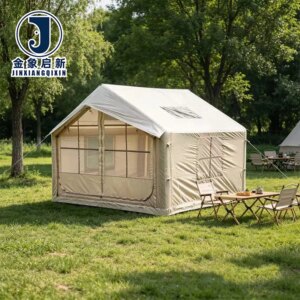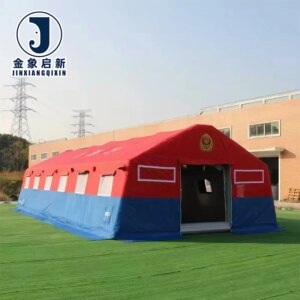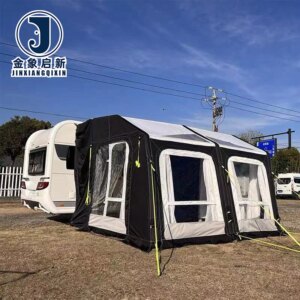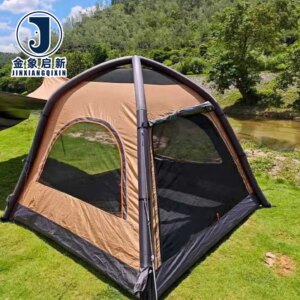
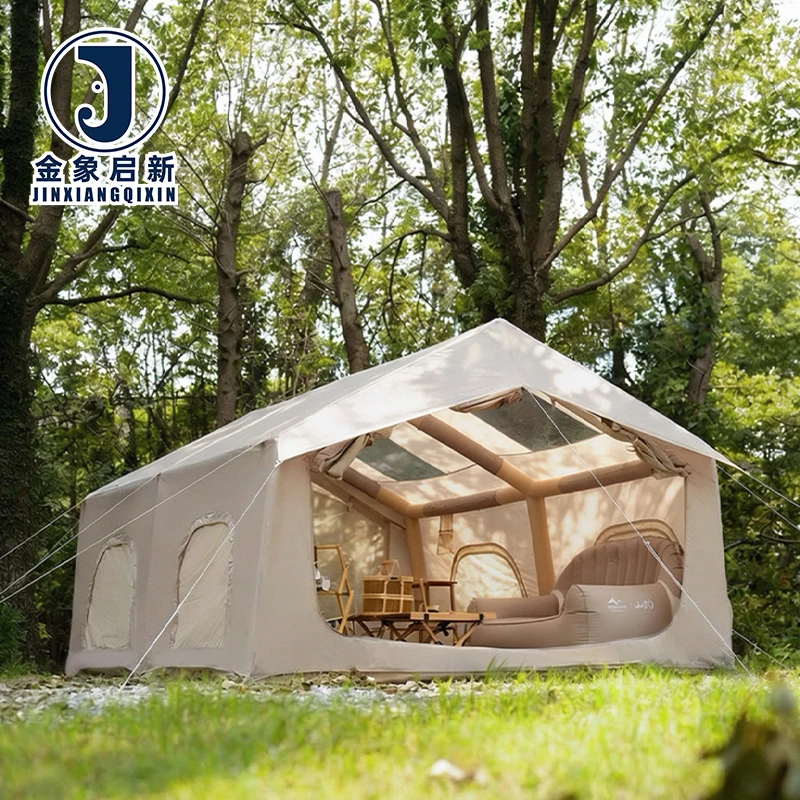
Deep Process Control Over Coating Weight and Adhesion — Nearly 30 years of coated fabric manufacturing expertise channeled into PVC tarpaulin specifically engineered for inflatable structures, ensuring batch-to-batch coating consistency that maintains air retention and structural stability in emergency deployment shelters.
Technical Specifications
| Parameter | Value |
|---|---|
| Product Type | Inflatable Tent |
| Core Material | PVC Tarpaulin |
| Product Forms | Single Layer Inflatable Tent |
| Waterproof Performance | Fully waterproof coated construction |
| UV Resistance | UV-resistant (test basis not stated in source) |
| Tear Resistance | Tear-resistant |
| Fire-retardant Treatment | Fire-retardant (grade not stated in source) |
| Anti-static Treatment | Anti-static (standard not stated in source) |
| Customization Service | Sample customization, pattern printing, OEM & ODM |
| Production Facility | 9,180 m² with 3 full production lines |
| Processing Equipment | 36 sets of professional equipment |
| R&D Team | 10 technicians |
| Quality Control | Full-process QA & QC with dedicated on-site staff |
| Certifications | ISO9001, ISO14001, ISO45001, CE |
Application Suitability
| Application | Exposure & Requirement |
|---|---|
| Emergency response command centers | Rapid inflation and deployment under time pressure, repeated setup and teardown cycles, outdoor weathering |
| Disaster relief temporary storage | Continuous outdoor exposure, precipitation contact, UV radiation, wind loading on inflated structure |
| Remote equipment maintenance shelters | Isolated deployment without permanent foundations, dust and particulate exposure, temperature fluctuation |
| Infrastructure inspection field stations | Transport over rough terrain, frequent packing and unpacking, exposure to site-specific contaminants |
| Inflatable structure and membrane tent manufacturers | Roll-to-roll batch consistency, fire-retardant compliance per target market, reliable supply for production planning |
What "Flame Retardant" Means Without a Grade Behind It
Inflatable tent fabric must carry a verifiable fire classification that matches your local building or temporary structure code — a generic claim is not enough for procurement sign-off.
When emergency shelters are deployed on construction sites or near public gathering areas, the fire-retardant grade directly determines whether the structure passes the site safety audit. Buyers regularly receive quotations listing "fire-retardant treated" on the spec sheet, only to discover during compliance review that no test report accompanies the batch [NEED_CITE: DIN 4102 fire classification for building materials]. For the PVC Inflatable Tent aftermarket supplier relationship to function, the manufacturer must provide the specific classification — and the underlying test data — before production begins, not after the goods arrive. Sourcing an Inflatable Tent Fabric manufacturer custom capable of aligning material treatment with regional safety standards eliminates the re-order cycle that delays shelter deployment.
Coating Integrity and Air Retention in Inflatable Shelters
Single-layer inflatable tents depend entirely on the PVC tarpaulin coating to hold internal air pressure across the full membrane surface. Any variation in coating weight between panels creates differential flex behaviour, causing the structure to inflate unevenly or develop stress concentrations at panel seams. Our 3 full production lines maintain tight coating control so that every roll of Inflatable Tent Fabric manufacturer custom output meets the specification stated on the material sheet — verified through in-process QA before the roll reaches the cutting table.
Custom Sizing and Pattern Printing for OEM Projects
Inflatable tent manufacturers building branded emergency shelters or commercial event structures need fabric that accepts pattern printing without compromising the coating bond. Our 10-person R&D team develops print-ready surfaces and custom panel dimensions that align with your structural design, reducing material waste during fabrication. Sample customization runs allow you to confirm colour registration, print adhesion, and panel fit before committing to a full production order [NEED_CITE: tensile and tear test methods for coated fabrics per ISO 1421].
Reading the Specification Sheet Beyond Surface Claims
GSM alone tells you how much material is present per square metre but says nothing about how that weight is distributed between the base fabric and the PVC coating layers. A heavier base fabric with a thinner coating may deliver higher tensile strength but lower air retention — a critical trade-off for inflatable structures where membrane integrity under internal pressure is the primary design requirement. Fire-retardant treatment adds chemical compounds to the coating matrix that can influence surface flexibility and low-temperature behaviour, making it essential to confirm the grade and its interaction with the coating formulation for your specific deployment climate. Available in fire-retardant grades — confirm the grade required for your market before placing your order. Anti-static treatment is offered as an option, with surface resistance documentation provided upon request to support site safety compliance.
The Hidden Cost of Unverified Performance Claims
When a batch of inflatable tent fabric arrives without the fire-retardant test report that the site safety officer requires, the entire shipment sits in quarantine until documentation is produced — or the structure is rejected at inspection [NEED_CITE: temporary structure fire safety compliance on construction sites]. Similarly, colour variation between rolls intended for the same shelter project creates visible panel mismatches once the tent is inflated on-site, forcing the buyer to either accept a non-uniform appearance or scrap the affected panels. These failures do not show up on a quotation comparison; they surface only when the material is put under real procurement and deployment pressure. Sourcing from an Inflatable Tent Fabric manufacturer custom that ties every performance claim to a traceable batch record prevents these costly delays.
Why Source Inflatable Tent Fabric Here
Deep process control over coating weight and adhesion, developed across nearly 30 years of focused PVC coated fabric production, ensures that the material you specify is the material you receive. Three full production lines and 36 sets of professional processing equipment provide the capacity to fulfil bulk roll orders with reliable on-time delivery, so your shelter production schedule stays on track. A dedicated 10-person R&D team handles material selection, custom sizing, pattern printing and sample development in-house, eliminating the back-and-forth with external consultants. Full-process QA and QC inspection at every production stage, with 100% pre-shipment verification, catches coating inconsistencies before they leave the factory floor. ISO9001, ISO14001, ISO45001 and CE certifications provide the procurement documentation your compliance team needs to approve the purchase order without delay.
Documentation & Verification
- Material specification sheet stating base fabric type, coating weight, colour reference and treatment options per roll
- Batch-specific test reports for fire-retardant and anti-static grades where applicable to your target market
- Pre-shipment inspection record with weight verification against stated GSM before dispatch
- ISO9001, ISO14001, ISO45001 and CE certificates supporting procurement compliance audits
- Certificate of origin and customs documentation package for international shipment clearance
Fabrication, Handling & Storage
- Heat-weld seams using temperature settings matched to the PVC coating formulation to prevent bond failure at inflation stress points
- Store rolls horizontally on padded racks to avoid surface creasing that compromises the waterproof coating layer
- Use PVC-compatible cleaners on finished inflatable panels to preserve anti-static and fire-retardant treatment surfaces
- Allow cold-stored rolls to acclimate to workshop temperature before unrolling to prevent coating micro-cracking
- Plan panel cutting layout to minimise off-cuts and reduce the number of welded seams in the inflated structure
Starting Your Inflatable Tent Fabric Enquiry
Provide the deployment environment and expected exposure conditions — including temperature range, UV intensity and any site-specific fire safety codes — so we can recommend the appropriate treatment grade. Confirm whether you require rolls for your own fabrication line or finished cut-to-size panels with pattern printing. Share your target order volume and required lead window so we can align production scheduling to your project timeline.
Frequently Asked Questions
Q: What fire-retardant grades are available for inflatable tent fabric, and how do I match my local code?
A: Fire-retardant treatment is available in grades that can be matched to your target market’s safety standards. Specify the classification your site requires — such as DIN 4102 or NFPA 701 — and we will confirm the applicable grade with supporting test documentation before production begins.
Q: How is anti-static performance verified and documented for each batch?
A: Anti-static treatment is applied during the coating process, and surface resistance measurements are recorded for the batch. We provide documentation stating the measured resistance values so your site safety team can verify compliance against their requirements.
Q: What is the sample development process before a full production run?
A: Our R&D team produces sample panels reflecting your specified coating weight, colour and treatment options. You evaluate these for air retention, print quality and dimensional accuracy before approving the specification for bulk manufacturing.
Q: How is colour consistency controlled across multiple rolls for a single project?
A: Each production batch is monitored through in-process QA checks against the approved colour reference. Pre-shipment inspection verifies that all rolls in your order match within the defined tolerance, preventing visible panel mismatches when the tent is assembled.
Q: Can custom dimensions and pattern printing be included for OEM inflatable tent projects?
A: Yes. We handle custom sizing, pattern printing and full OEM and ODM configurations through our in-house R&D and production facilities. Provide your structural drawings and branding files, and we will develop samples for your approval before production.