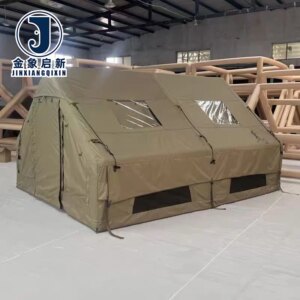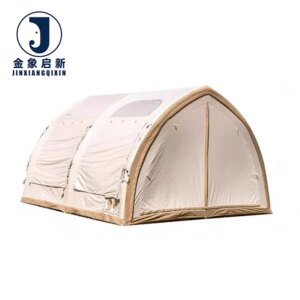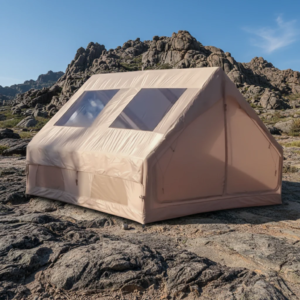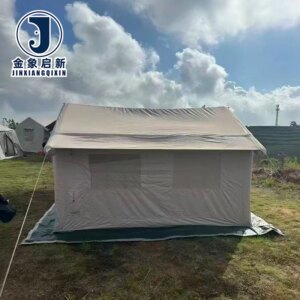
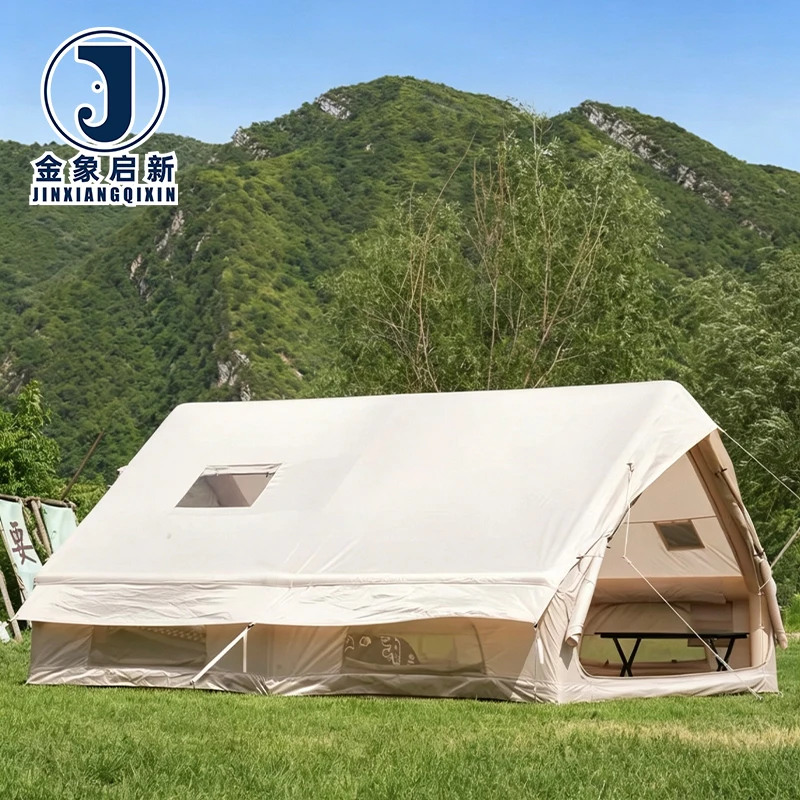
Deep Process Control Over Coating Weight — every roll of inflatable tent fabric is verified against stated GSM before dispatch, backed by nearly 30 years of PVC coated fabric expertise applied to air-holding membrane structures.
Technical Specifications
| Parameter | Value |
|---|---|
| Product Type | Inflatable Tent |
| Core Material | PVC tarpaulin |
| Coating Material | PVC |
| Key Performance | Waterproof, UV-resistant (test basis available on request), tear-resistant |
| Season Rating | Four-Season |
| Capacity | 2-3 Person |
| Opening Mechanism | Quick Automatic Opening (Air Inflation) |
| Design | Single layer |
| Customization | OEM & ODM, sample customization, pattern printing |
| Standards | ISO9001, ISO14001, ISO45001, CE |
Application Suitability
| Application | Exposure & Requirement |
|---|---|
| Commercial camping ground facilities | Sustained internal air pressure, four-season temperature shifts, repeated inflation cycles |
| Outdoor event management shelters | Rapid deployment, wind loading on air beams, UV exposure during multi-day events |
| Construction site auxiliary shelters | Abrasion from site debris, dust ingress prevention, temporary accommodation compliance |
| Mobile field operations | Quick setup and breakdown, transport flexibility, weather resistance in remote locations |
| Outdoor exhibition booths | Visual consistency across panels, pattern printing adhesion, public access safety |
| Equipment storage facilities | Waterproof integrity under sustained inflation, puncture resistance from stored items |
Why Inflatable Tents Fail at the Welded Seams First
The coating bond to the base fabric determines whether an inflatable tent holds pressure through repeated setup cycles or deflates under load.
Inflatable structures concentrate stress at every welded joint where air beams meet flat panels. When PVC inflatable tent material arrives with coating adhesion below what the base fabric demands, the seam separates before the fabric itself shows any sign of wear. Fleet operators and tent manufacturers who have dealt with mid-event deflations know that the failure point is almost always a heat-welded junction that could not withstand repeated inflation and deflation flexing. [NEED_CITE: tensile and peel strength test methods for coated fabrics per ISO 1421]
Coating Adhesion and Air-Beam Structural Integrity
The base fabric denier and weave density in our PVC inflatable tent fabric are selected to handle the internal pressure loads that air beams generate during inflation. A higher-denier yarn in the warp direction resists the longitudinal stretch that pressurised tubes demand, while the weft density controls circumferential expansion. This directional engineering matters because inflatable tent PVC material must hold its shape across temperature variations without the coating cracking in cold conditions or softening in heat.
Welded Seam Performance Under Repeated Inflation Cycles
Every inflation cycle flexes the welded joints where air beams connect to the tent body. Our PVC inflatable tent material supplier process controls coating weight and adhesion so that heat-welded seams reach strength levels that match the base fabric tear resistance. When tent manufacturers run inflation cycle testing on samples, the weld line must survive hundreds of pressurisation events without delamination. [NEED_CITE: peel adhesion testing for PVC coated polyester fabrics]
Base Fabric and Coating Construction Explained
The PVC tarpaulin core uses a woven polyester base fabric that provides dimensional stability under the sustained internal pressure inflatable tents require. The PVC coating is applied to achieve waterproof integrity and tear-resistant performance across four-season temperature ranges. Coating weight and base fabric density work together — a heavier coating on a low-density weave will crack at flex points, while a light coating on a dense weave may not seal adequately against water penetration. The balance between these two variables is what separates material that survives a season of commercial camping use from material that fails during its first inflation cycle.
What Happens When Material Specifications Are Wrong for Inflation
Tent manufacturers who source PVC inflatable tent fabric without verifying coating adhesion against air-beam pressure requirements face deflation failures that damage their reputation with end users. A material that performs well in flat-panel applications may not hold welded seams under the cyclic flexing that inflatable structures demand. When the coating weight is lighter than what the air-beam design requires, seams peel apart during temperature-driven pressure changes — exactly when the shelter is needed most. [NEED_CITE: field failure analysis of inflatable membrane structures]
Why Procure Inflatable Tent PVC From Jinxiang
Nearly 30 years of PVC coated fabric production gives us process control over coating weight and base fabric adhesion that directly affects inflatable tent seam performance. Three full production lines with 36 sets of professional processing equipment support bulk roll supply with consistent coating thickness across every batch. A 10-person R&D team handles material selection, sample development for inflation cycle testing, and pattern printing specifications for branded tent structures. Dedicated QA and QC staff inspect every production stage, with 100% pre-shipment inspection verifying that coating adhesion, waterproof performance, and colour consistency meet stated specifications before rolls leave the facility.
Documentation & Verification
- Material specification sheet confirming GSM, base fabric construction, and coating type for each roll
- UV resistance test reports available on request for outdoor exposure validation
- Pre-shipment inspection record covering coating adhesion and waterproof performance checks
- ISO9001, ISO14001, ISO45001 and CE certification documentation for target market compliance
- Roll packing list with colour reference and batch traceability for multi-roll orders
Fabrication, Handling & Storage
- Heat welding temperature must match PVC coating thickness to achieve full seam adhesion on air beams
- Store rolls upright on pallets to prevent flat-spot deformation of the PVC tarpaulin coating surface
- Allow cold-transported rolls to reach ambient temperature before unrolling to avoid coating micro-cracking
- Use PVC-compatible cleaners only — solvent-based products degrade the coating layer on inflatable tent fabric
- Pattern printing requires surface preparation matching the PVC coating finish for durable ink adhesion
- Cut panels with sealed edges to prevent base fabric wicking moisture into the woven structure
Request a Material Specification for Your Inflatable Tent Project
Provide your intended application, expected inflation pressure range, and the temperature conditions the structure will face. If your target market requires flame-retardant compliance, specify the grade needed so we can confirm availability with supporting test documentation. Tell us whether you need fabric by the roll for your own fabrication line, or whether finished panel cutting and pattern printing are part of the requirement.
Frequently Asked Questions
Q: What UV resistance test basis supports the outdoor exposure claims on inflatable tent fabric?
A: UV-resistant treatment is applied during the coating process to extend outdoor service life. The specific test method and exposure duration data are available on request — confirm which UV standard your target market or end-use application requires so we can supply matching documentation.
Q: What are the custom dimension and MOQ options for inflatable tent PVC fabric?
A: OEM and ODM services cover custom width, length, pattern printing, and colour requirements. Minimum order quantities depend on whether you need standard stock grades or custom-produced rolls. Provide your annual volume and panel dimensions so we can recommend the most efficient roll width.
Q: How should heat welding parameters be set for inflatable tent air-beam seams?
A: Welding temperature, pressure, and dwell time must match the specific PVC coating weight and base fabric construction. We provide recommended heat welding parameters with sample rolls so your fabrication team can validate seam strength through inflation cycle testing before committing to bulk production.
Q: How do you control colour consistency across multiple rolls in one order?
A: Dedicated QA and QC staff verify colour against the stated reference at every production stage. Pre-shipment inspection includes side-by-side roll comparison so that visible colour variation is caught before dispatch — addressing a common pain point where colour differences appear only after installation.
Q: Are flame-retardant grades available for inflatable tent fabric with valid test reports?
A: Flame-retardant treatment options are available for inflatable tent PVC material. Specify the fire classification required in your target market — such as B1 per DIN 4102 or NFPA 701 — and we will confirm the matching grade with supporting test documentation for your compliance submission.