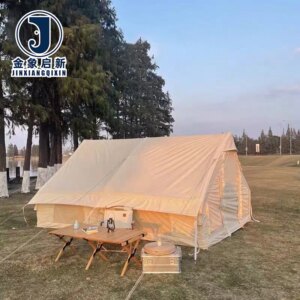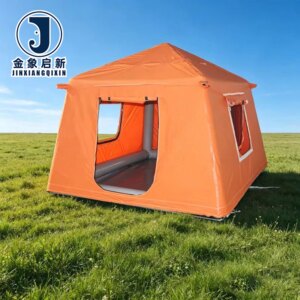
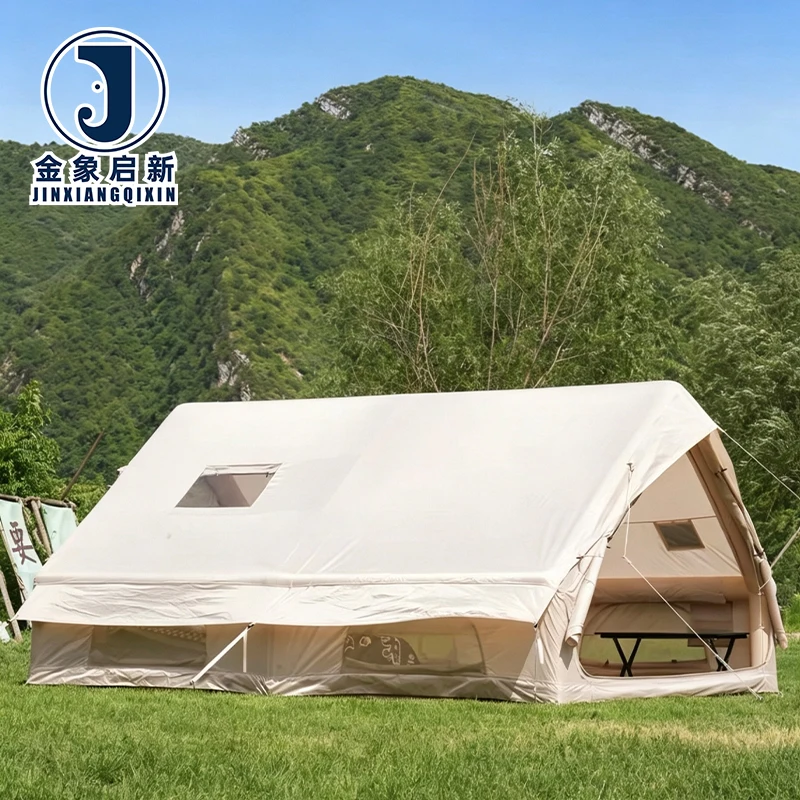
Coating weight discipline — Every roll of inflatable tent fabric we produce is checked against a ±2% thickness tolerance, ensuring heat-sealed seams hold under sustained inflation pressure without weak spots across the production batch.
Technical Specifications
| Parameter | Value |
|---|---|
| Product Type | Inflatable Tent |
| Core Material | PVC Tarpaulin |
| Raw Material Standard | GB/T 5761-2006 (virgin PVC resin) |
| Waterproof Rating | 3000mm water column |
| Fire-Retardant Standard | EN 13501-1 |
| UV Treatment | UV-resistant (test basis not stated) |
| Anti-Static | Anti-static (surface resistance not confirmed) |
| Thickness Tolerance | ±2% across production batches |
| Season Rating | Four-Season |
| Deployment | Quick Automatic Opening |
| Capacity | 8–10 Person |
| Customization | OEM & ODM, size adjustments, Pantone color matching, logo printing, custom door/window configurations |
| Pre-Shipment Test | 24-hour inflation testing for airtightness and structural stability |
Application Suitability
| Application | Exposure & Requirement |
|---|---|
| Remote-site workforce housing | Sustained inflation, fire-retardant compliance for occupied shelters, temperature swings |
| Commercial adventure tourism base camps | All-weather exposure, UV degradation, repeated inflation/deflation cycles |
| Event management multi-unit deployments | Batch color consistency across structures, quick setup, public-use fire certification |
| Field research stations | Anti-static performance near sensitive instruments, wind load on inflated membrane |
| Expedition outfitter inventory | Four-season fabric integrity, abrasion from ground contact, transport packing stress |
Why Inflatable Tent Fabric Fails at the Weld Before the Fabric Does
Seam failure in inflatable structures almost always traces back to inconsistent coating adhesion across the roll.
When PVC tarpaulin fabric for inflatable structures carries uneven coating weight, the heat-sealed seams become the weakest point. During inflation testing, air pressure concentrates stress at weld lines. If the coating thickness varies beyond acceptable tolerance, the weld peels apart while the base fabric remains intact. This is not a material strength problem — it is a coating process control problem that surfaces only after the tent is inflated and loaded. [NEED_CITE: weld integrity requirements for inflatable membrane structures]
How Virgin Resin Translates to Weld Consistency
Inflatable Tent Fabric material properties depend heavily on the purity of the PVC compound. Virgin PVC resin meeting GB/T 5761-2006 provides a predictable melting point and viscosity profile during heat welding. Recycled content introduces variable plasticiser ratios, causing some weld zones to melt faster than adjacent areas. For tent tubes holding continuous air pressure, even a small inconsistency in weld penetration can develop into a slow leak that worsens over repeated inflation cycles.
What Anti-Static Treatment Means for Field Deployments
Static charge buildup on inflated PVC surfaces is more than a nuisance — it attracts dust that abrades the coating over time and can interfere with electronic instruments housed inside research or medical shelters. The anti-static formulation in this Inflatable Tent Fabric material properties range addresses surface charge, though the specific surface resistance value and test standard should be confirmed for your deployment environment before committing to bulk production.
Reading the Specs That Actually Govern Inflatable Structure Performance
The base fabric denier and weave pattern determine how tear forces propagate once a puncture occurs — a tighter weave arrests tear spread more effectively than a loose construction, independent of the PVC coating weight above it. Knife coating, as opposed to laminating, forces PVC compound into the weave interstices, creating mechanical adhesion that resists delamination under the flexing stress of inflation and deflation. The ±2% thickness tolerance maintained here matters because inflatable tube walls experience hoop stress; a section that is thinner than adjacent material will stretch more, concentrating load until the coating cracks or the weld gives way. EN 13501-1 fire classification addresses reaction to fire for construction and temporary structure materials — verify the specific grade within this standard that your local authority requires for occupied inflatable shelters. [NEED_CITE: EN 13501-1 classification system for temporary membrane structures]
The Cost of Specifying Inflatable Fabric Without Verifying Batch Data
When inflatable tent fabric arrives with GSM that matches the quotation but thickness that drifts outside tolerance, the consequences show up during fabrication. Heat-weld parameters calibrated for the expected coating thickness will either under-penetrate or burn through. Manufacturers then face rework — stripping failed seams, re-welding, and repeating 24-hour inflation tests. For event companies deploying multiple identical tents side by side, color variation between rolls becomes immediately visible once structures are inflated in a row, forcing selective panel replacement or accepting a visually inconsistent installation. [NEED_CITE: batch consistency requirements for PVC coated fabric in membrane applications]
Why Source Inflatable Structure Fabric Through This Process
Three full production lines and 36 sets of professional equipment provide the capacity to run dedicated batches for a single inflatable tent order, reducing the cross-contamination risk that arises when lines switch between incompatible coating formulations. A 10-technician R&D team handles Pantone color matching and custom door or window configurations, developing samples within days so weld parameters can be locked in before bulk commitment. Full-process quality inspection with dedicated QA and QC staff means every roll is checked for thickness tolerance, and 24-hour inflation testing on finished structures verifies airtightness before dispatch — not after arrival at your facility.
Documentation & Verification
- Material specification sheet confirming GSM, base fabric denier, and coating type per roll
- EN 13501-1 fire-retardant test report matching the shipped batch
- Thickness and coating weight inspection records within ±2% tolerance
- 24-hour inflation test documentation for each completed structure
- UV-resistance test data available upon request — confirm test basis for your market
- Roll packing list with batch traceability codes
Fabrication, Handling & Storage
- Heat-weld temperature profiles should be validated against sample rolls before bulk fabrication to account for coating thickness within the ±2% tolerance band
- Store rolls vertically on padded racks to prevent flat-spot deformation that causes uneven inflation in finished tubes
- Use PVC-compatible solvent cleaners only — aggressive solvents can soften the knife-coated surface and reduce waterproof integrity
- Allow cold-stored rolls to reach ambient temperature before unrolling to prevent coating micro-cracking at fold lines
- For custom door and window cutouts, reinforce perimeter welds to distribute inflation stress around the opening
Before You Request a Quote
Specify the deployment environment — occupied workforce housing, event structures, or expedition base camps — as this determines which fire-retardant grade and anti-static level your authority requires. Confirm whether you need fabric by the roll for your own fabrication line or finished inflatable structures with 24-hour inflation testing completed before shipment. Provide target dimensions, annual volume, and any Pantone color references so sample development can begin immediately.
Frequently Asked Questions
Q: What fire-retardant standard does the inflatable tent fabric meet, and is the test report included with shipment?
A: The fabric carries EN 13501-1 fire-retardant classification. A batch-specific test report ships with every order. Confirm the exact grade within this standard that your local fire authority requires for occupied inflatable structures, as requirements differ between public event venues and industrial workforce camps.
Q: How is PVC coating weight verified, and what thickness tolerance is maintained across production batches?
A: Coating weight and thickness are measured at multiple points across each roll during production. The maintained tolerance is ±2% across the batch. This consistency supports repeatable heat-weld parameters during fabrication, preventing seam failures that arise when coating thickness varies beyond the welder’s calibrated range.
Q: Does the inflatable fabric carry anti-static certification suitable for sensitive equipment environments?
A: Anti-static treatment is applied to the PVC coating formulation. However, the specific surface resistance value and the test standard it meets should be confirmed for your application. Request the anti-static test data before final approval if your deployment involves proximity to sensitive electronic or medical instruments.
Q: What heat-sealing process is used, and how is seam airtightness validated before dispatch?
A: Heat-sealed seams are used for inflatable tube and panel construction. Every completed structure undergoes a 24-hour inflation test verifying airtightness and structural stability. This test identifies slow leaks at weld lines before the tent leaves the facility, eliminating on-site failures during deployment.