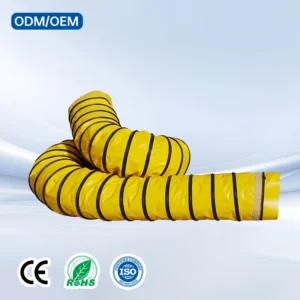
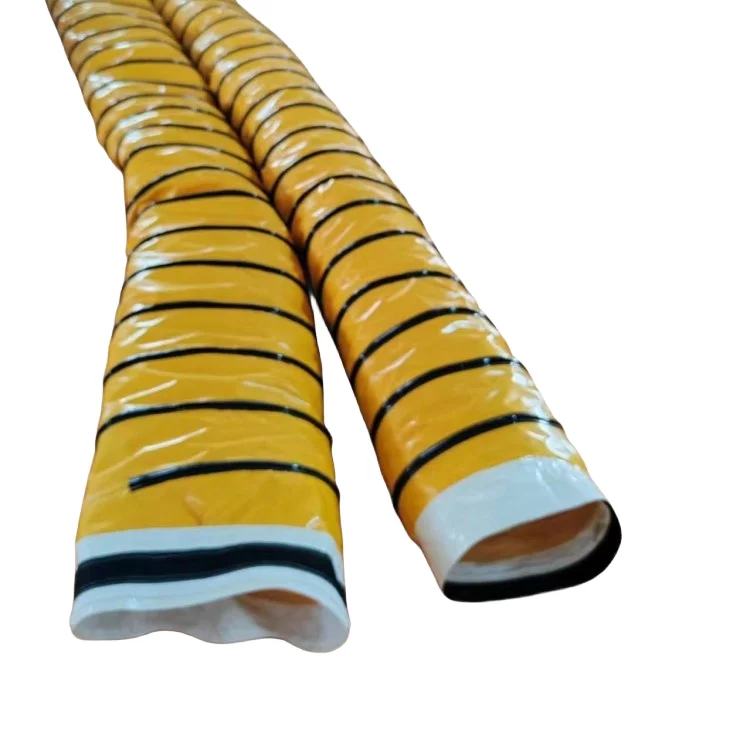
Deep Coating Expertise — Nearly 30 years of PVC coating process control applied to every 12-inch PCA duct we produce, verified by 100% pre-shipment inspection before it leaves our facility.
Technical Specifications
| Parameter | Value |
|---|---|
| Product Type | Aircraft PCA Air Duct |
| Diameter | 12 Inch |
| Coating Material | PVC |
| Base Fabric | Fabric-reinforced layer |
| Insulation Layer | Aluminum foil bubble film |
| Temperature Range | -30°C to 150°C |
| Outer Layer Color | Yellow-black alternating (high visibility) |
| Connection Method | Zipper, Velcro |
| Mildew Resistance | Yes |
| Flame Retardant | Available in flame retardant grades — confirm the grade required for your airport authority (grade not stated in source) |
| Anti-Static | Available upon specification — confirm anti-static certification requirements for your apron environment (not confirmed in source) |
| Standards | ISO, CE (specific product standard numbers available on request) |
Application Suitability
| Application | Exposure & Requirement |
|---|---|
| Airport apron PCA unit to aircraft cabin connection | Continuous cold/hot airflow, rapid deployment cycles, UV and fuel-proximate environment |
| Aircraft cabin pre-conditioning during turnaround | High-volume air transfer under pressure, frequent connect/disconnect via zipper joints |
| Military and remote charter ground support | Operation without fixed jet-bridge infrastructure, exposure to dust and weather extremes |
| Maintenance hangar temporary climate control | Extended deployment in semi-enclosed spaces, mechanical handling by maintenance crews |
What "Fire Retardant Certified" Actually Means on the Apron
An Aircraft PCA Air Duct fire retardant certified to a named standard is the only kind that passes airport authority inspection.
Every ground support equipment supplier claims fire resistance, but without a documented grade tied to a test method, that claim holds no weight when the fire marshal audits your apron operations. I have seen ducts pulled from service mid-contract because the supplier provided a generic material safety sheet instead of a fire classification report matching the airport’s specific requirement. The gap between "we can make it flame retardant" and "here is the test certificate" is where operations stall [NEED_CITE: airport authority fire safety standards for ground support equipment].
How the Insulation Layer Sustains Thermal Performance
The aluminum foil bubble film insulation bonded within the duct wall is what separates a PCA duct from a standard ventilation hose. This layer traps thermal energy as pre-conditioned air travels from the ground unit to the aircraft cabin door, maintaining the delivered temperature across the full -30°C to 150°C operating range. Without this insulation, cold air loses its cooling effect before reaching the cabin in summer, and heated air arrives lukewarm in winter. The Aircraft PCA Air Duct fire retardant certified construction wraps this insulation inside a PVC-coated fabric shell that protects it from mechanical damage during daily apron handling.
PVC Coated Fabric as the Structural Backbone
The fabric-reinforced base layer beneath the PVC coating carries the mechanical load. Every time a ground crew drags the duct across concrete or connects it under pressure, the tensile strength of that base fabric determines whether the wall holds or stretches out of round. The PVC coating seals the weave against moisture ingress and fuel splash contamination, while the yellow-black alternating outer coloring keeps the duct visible to vehicle operators in active ground support zones. This combination addresses the constant abrasion and impact that defines apron life [NEED_CITE: tensile and tear test methods for coated fabrics per ISO 1421].
Reading the Specifications That Matter Most
Temperature range defines the boundary conditions: -30°C to 150°C means the insulation and coating must remain flexible at sub-zero winter starts and stable when PCA units push heated air during cold-soak procedures. The 12-inch diameter must match the PCA unit outlet flange and the aircraft cabin air conditioning interface — any mismatch creates pressure drop and connection failure. The zipper and Velcro connection system enables tool-free deployment and teardown between aircraft turns, but the seam construction around those fasteners must resist air leakage under full operating pressure. Outer layer visibility coloring is not cosmetic; it is a safety requirement in zones where baggage tugs and fuel trucks operate in close proximity.
The Cost of Specifying on Price Alone
When a duct is sourced without verifying insulation layer composition or seam construction method, the failure rarely shows up on day one. It appears weeks later as thermal drop-off — the cabin never reaches set temperature because the insulation was substituted with a lighter alternative. Or the zipper joint starts leaking air under pressure because the seam allowance was reduced to save material cost. I have seen entire ground support fleets grounded while replacement ducts were expedited at premium cost, all because the original specification lacked a requirement for insulation test documentation [NEED_CITE: common causes of ground support equipment failure during peak season].
Why Procurement Teams Source This Duct Here
Our coating process control extends to the insulation lamination step — each duct’s aluminum foil bubble film layer is verified for adhesion and coverage before the PVC outer shell is applied. The 10-person R&D team develops connection configurations matched to specific PCA unit flange sizes and aircraft interface standards, producing samples within days rather than weeks. Three full production lines with 36 sets of professional equipment support volume orders without compromising the 100% pre-shipment inspection that checks seam integrity, zipper function, and dimensional accuracy on every Aircraft PCA Air Duct fire retardant certified unit before dispatch.
Documentation & Verification
- Material specification sheet stating PVC coating weight, base fabric denier, and insulation layer composition per production batch
- Fire retardant and anti-static test reports matched to your airport authority’s referenced standard
- Pre-shipment inspection record confirming 12-inch diameter, zipper function, and seam air-tightness
- Certificate of origin and full customs documentation package for international airport procurement
Fabrication, Handling & Storage
- Heat-weld seams at manufacturer-recommended temperature settings to maintain PVC coating adhesion at joint lines
- Deploy zipper connections fully before pressurization to distribute load evenly across the 12-inch circumference
- Store rolled ducts in dry, shaded conditions to prevent UV degradation of the yellow-black outer PVC layer
- Avoid compressing stacked ducts beyond two-high to protect the aluminum foil bubble film insulation structure
- Clean exterior with mild detergent only — solvents can compromise PVC coating plasticizer balance
What to Include in Your Inquiry
Specify the PCA unit make and model you are connecting from, the aircraft types served, and the airport authority’s fire-retardant or anti-static standard reference. Confirm whether you need standard 12-inch diameter or a custom size matched to a specific flange configuration. Indicate annual volume and whether logo or outer packaging customization is required — minimum order quantities apply for branded configurations.
Frequently Asked Questions
Q: What fire-retardant grade does the PCA duct meet, and which airport authority standards does it satisfy?
A: Fire-retardant grades are produced to match the specific standard referenced by your airport authority or IATA ground equipment guidelines. We supply the test report with the grade designation documented. Confirm your local requirement during inquiry so the correct grade is specified before production begins.
Q: How is the anti-static property verified for use in fuel-proximate apron environments?
A: Anti-static treatment is available upon specification and verified through surface resistivity testing per the standard your airport mandates. The test report accompanies shipment documentation. Request this at inquiry stage, as anti-static certification requires specific material formulation and dedicated testing before dispatch.
Q: Can the duct diameter and length be customized to match specific PCA unit and aircraft interface configurations?
A: Yes. Our R&D team develops custom diameter and length configurations based on your PCA unit flange dimensions and aircraft connection interface specifications. Samples are produced within days for dimensional verification. Provide equipment model numbers and interface drawings for accurate sample development.
Q: How are zipper and Velcro joints tested for air-tightness under full PCA unit operating pressure?
A: Every zipper and Velcro joint undergoes inspection during our pre-shipment quality control process, where connection integrity and seam construction are checked against air leakage under pressure. The inspection record is included in your shipment documentation, confirming each joint passes before the duct is cleared for dispatch.
Q: What is the expected service life under continuous apron UV exposure and mechanical handling?
A: Service life depends on deployment frequency, handling practices, and UV exposure intensity at your location. The PVC-coated fabric and yellow-black outer layer are formulated for extended outdoor apron use. Request a material specification sheet detailing coating weight and base fabric denier to assess durability against your specific operational cycle.