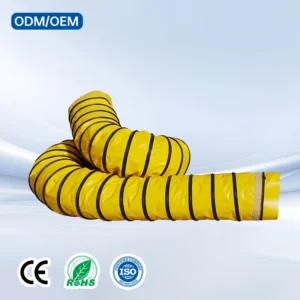
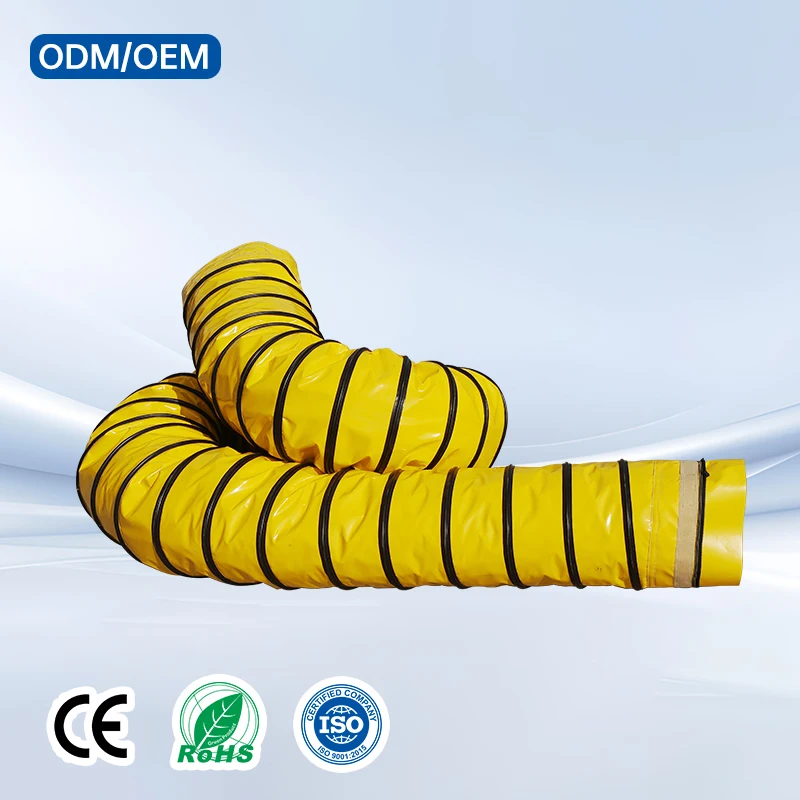
Precision Thermal Transfer — Our aviation ducts undergo 100% pre-shipment inspection to verify insulation layer integrity, ensuring every Aircraft PCA Hose aviation air duct manufacturer order meets apron compliance documentation standards.
Technical Specifications
| Parameter | Value |
|---|---|
| Product Type | Aviation Air Duct |
| Coating Material | PVC + fabric-reinforced layer / aluminum foil |
| Insulation Layer | Built-in aluminum foil bubble film |
| Temperature Range | -30°C to 150°C |
| Outer Layer Color | Yellow-black alternating (high visibility) |
| Connection Method | Zipper, Velcro |
| Flame Retardant Grade | Available in flame retardant grades — confirm the grade required for your airport authority |
| Anti-Static | Available in anti-static versions — confirm the standard required for your apron compliance |
| Characteristics | Mildew resistance, water resistance, high strength, strong tension |
| Logo Customization | Supported, MOQ 100 |
| Pattern Customization | Supported, MOQ 100 |
| Standards | ISO, CE |
Application Suitability
| Application | Exposure & Requirement |
|---|---|
| Airport apron PCA-to-aircraft air supply | Jet blast debris, fuel vapor exposure, ground vehicle traffic, extreme ambient temperature swings |
| Aircraft cabin air conditioning interface beneath cabin door | Repeated coupling and decoupling, tight bend radius around fuselage, thermal shock from cold air transmission |
| Aviation MRO hangar ventilation | Suspended duct runs, sustained warm air flow, chemical vapor from maintenance processes |
| Airport infrastructure contractor apron-side distribution | Long continuous runs, UV exposure during extended ground operations, compliance documentation for authority approval |
Why Certification Gaps Ground Your Duct Before It Ever Reaches the Apron
Compliance paperwork matters as much as the duct itself on an active airport apron.
When an aviation air duct aftermarket supplier ships product without the fire-retardant or anti-static certification your airport authority mandates, the entire ground support equipment setup fails inspection. We have seen operators lose full shifts of aircraft turnaround because documentation was missing or the test standard cited did not match local aviation regulations [NEED_CITE: airport apron fire safety compliance standards for ground support equipment]. The duct material may perform adequately, but without the correct certification trail, procurement teams face rejection at the site acceptance stage.
Thermal Insulation Architecture for Pre-Conditioned Air Transfer
The Aircraft PCA Hose aviation air duct manufacturer design integrates a built-in aluminum foil bubble film insulation layer between the PVC-coated fabric reinforcement and the inner air passage. This multi-layer construction addresses the core challenge of pre-conditioned air transmission: maintaining the temperature differential between the PCA unit output and the aircraft cabin interface across extended duct runs on the apron. The aluminum foil layer reflects radiant heat gain from tarmac surfaces while the bubble film structure traps still air to reduce convective losses.
Rapid Deployment Connections for Turnaround Efficiency
Zipper and Velcro connection systems allow ground crews to couple and decouple duct segments without tools, directly supporting aircraft turnaround time targets. Each connection point is reinforced to handle the repeated stress of daily apron operations, where ducts are dragged, repositioned, and stored multiple times per shift. The yellow-black alternating outer coloring provides high-visibility safety marking that aligns with ground operations protocols, reducing trip and vehicle strike hazards in low-light or high-traffic apron conditions [NEED_CITE: ground support equipment visibility standards for airport ramp operations].
Decoding the Material Specification for Aviation Duct Selection
The temperature range of -30°C to 150°C defines the operational envelope for both cold air transmission from PCA cooling units and warm air supply during cold-weather aircraft preconditioning. At the lower boundary, the PVC coating must resist embrittlement and cracking when flexed at sub-zero temperatures, while at the upper boundary, the fabric-reinforced layer must maintain structural integrity without softening or delamination. The aluminum foil insulation layer performance is directly tied to its continuity — any compression or puncture that collapses the bubble film structure reduces thermal resistance at that point. PVC-coated fabric construction provides the water resistance and mildew resistance necessary for ducts that are frequently exposed to rain, de-icing fluid overspray, and humid conditions on the apron before being rolled and stored.
The Hidden Cost of Undocumented Material Properties
When flame retardant grade or anti-static performance is claimed on a quotation but no test report accompanies shipment, the buyer assumes liability for any compliance failure at the airport authority inspection. We have observed batches rejected at customs because the certificate of origin and material documentation did not align with the importing country’s aviation ground equipment regulations [NEED_CITE: international aviation ground support equipment import documentation requirements]. Ducts that fail color consistency between production batches create visible mismatches when segments are connected in series, undermining the high-visibility safety function of the yellow-black alternating pattern.
Why Procurement Teams Source Aviation Ducts Here
Three full production lines with 36 sets of professional equipment support batch volumes for airport infrastructure projects without sacrificing the dimensional accuracy each duct segment requires. The 10-person R&D team develops custom diameter, length, and connection fitting configurations against specific aircraft model interfaces, with samples produced within days rather than weeks. Dedicated QA/QC at every production stage includes insulation layer continuity checks and connection hardware integrity verification before packing. Material specification sheets state the base fabric construction, coating type, and insulation layer details — not generic product family descriptions. Pre-shipment inspection records document dimensional accuracy and visual consistency across the full order quantity.
Documentation & Verification
- Material specification sheet stating PVC coating weight, fabric reinforcement denier, and aluminum foil insulation construction
- Flame retardant and anti-static test reports matching the specific grade required by your airport authority
- Pre-shipment inspection record confirming duct diameter, length, and zipper-Velcro connection integrity
- ISO and CE certificates with certificate of origin for international airport project customs clearance
- Roll-by-roll color consistency record for the yellow-black high-visibility outer layer
Fabrication, Handling & Storage
- Heat-weld seams at zipper connection points using temperature settings validated for the PVC-coated fabric reinforcement layer
- Store rolled ducts upright in climate-controlled conditions to prevent aluminum foil bubble film compression damage
- Avoid dragging duct segments across abrasive tarmac surfaces to protect the outer PVC coating and high-visibility coloring
- Clean with mild detergent solutions only; solvent-based cleaners may degrade the PVC coating and aluminum foil adhesion
- Inspect Velcro connection surfaces for debris accumulation after each apron deployment cycle before re-storage
What We Need to Quote Your Aviation Duct Requirement
Provide the aircraft models your ground support equipment serves, along with the required duct diameter and segment length for each PCA-to-cabin interface configuration. Specify the flame retardant grade and anti-static standard mandated by your airport authority so we can align test documentation accordingly. Indicate whether you need the standard yellow-black alternating outer color or a custom pattern, and confirm your annual volume to determine customization feasibility.
Frequently Asked Questions
Q: What fire-retardant and anti-static certifications are available for airport apron compliance?
A: Our aviation ducts are available in flame retardant and anti-static versions. The specific grade and test standard must match your airport authority’s requirements, which vary by jurisdiction. Share your local compliance specification during inquiry so we can align the test report and material documentation to the exact standard your site inspection demands.
Q: How is the temperature range verified from -30°C to 150°C in actual operating conditions?
A: The -30°C to 150°C range reflects the material system’s tested operational envelope covering both PCA cold air transmission and warm air preconditioning. Verification includes low-temperature flex testing to confirm PVC coating resistance to embrittlement and elevated-temperature stability checks on the fabric-reinforced layer and aluminum foil insulation adhesion.
Q: Can the duct diameter, length and connection fittings be customized to specific aircraft models?
A: Yes. Our R&D team develops custom configurations against specific aircraft cabin interface dimensions and PCA unit output connections. Samples are produced within days for dimensional verification before batch production proceeds. Zipper and Velcro connection positions can be adjusted to match your ground crew’s deployment sequence.
Q: How do you ensure batch-to-batch color consistency for the yellow-black high-visibility outer layer?
A: Color consistency is controlled through standardized pigment formulation and verified at the pre-shipment inspection stage. Each production batch is checked against the approved color reference to prevent visible mismatches when duct segments from different orders are connected in series on the apron.
Q: What documentation is provided for airport authority approval and customs clearance?
A: Each shipment includes a material specification sheet, applicable flame retardant and anti-static test reports, pre-shipment inspection records, ISO and CE certificates, certificate of origin, and a detailed packing list. Documentation format can be adjusted to match your airport authority’s submission requirements and importing country customs protocols.