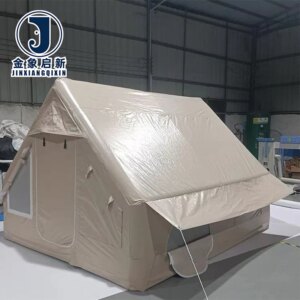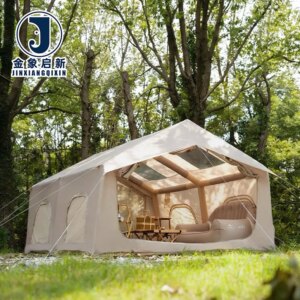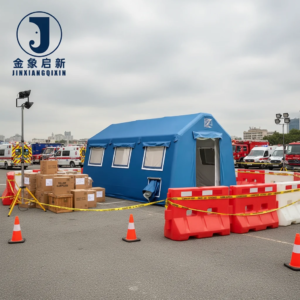
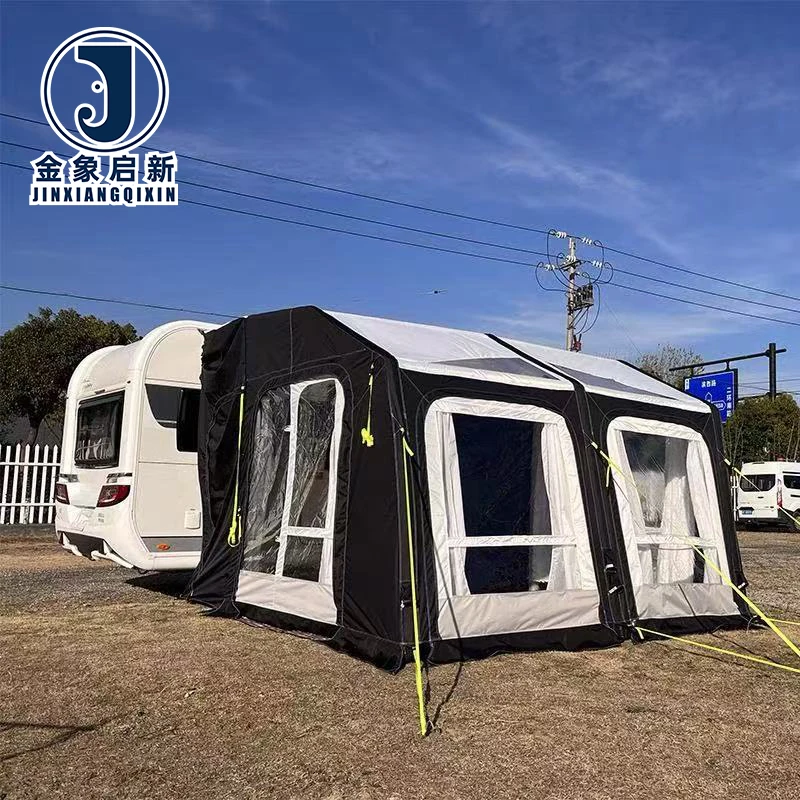
Coating Weight Control — Every roll of PVC inflatable tent fabric is verified against the stated GSM before dispatch, ensuring structural integrity at air-beam weld points.
Technical Specifications
| Parameter | Value |
|---|---|
| Product Type | Inflatable Tent |
| Core Material | PVC Tarpaulin |
| Construction | Single Layer, Extended Type |
| Waterproof Performance | Fully waterproof coated construction |
| UV Resistance | UV-resistant treatment applied (test basis not stated) |
| Tear Resistance | Tear-resistant PVC coated fabric |
| Customization | OEM & ODM, sample customization, pattern printing |
| Sample Lead Time | 7-10 business days |
| Quality System | Full-process QA/QC inspection |
| Certifications | ISO9001, ISO14001, ISO45001, CE |
Application Suitability
| Application | Exposure & Requirement |
|---|---|
| Emergency response centers | Rapid deployment, repeated inflation cycles, all-weather shelter |
| Disaster recovery temporary storage | Prolonged outdoor exposure, moisture ingress prevention, wind load |
| Mobile command posts for engineering projects | Frequent transport, setup and teardown, UV and abrasion exposure |
| Auxiliary workspace at outdoor industrial operations | Year-round deployment, temperature fluctuation, chemical dust |
| Remote industrial installations | Isolated site logistics, limited repair capability, four-season weather |
Why Coating Adhesion Matters More Than Fabric Weight in Inflatable Structures
When an inflatable beam flexes under wind load or internal pressure changes, the welded seam experiences cyclic stress that can delaminate poorly bonded coatings from the base fabric. A PVC inflatable tent fabric manufacturer must control both coating weight and the adhesion interface — because field failures in inflatable shelters almost always originate at the heat-welded joints, not in the body of the fabric. [NEED_CITE: tensile and tear test methods for coated fabrics per ISO 1421]
Coating Formulation and Heat-Weld Compatibility
The base PVC tarpaulin used for inflatable shelter structures requires a coating formulation that responds predictably to high-frequency or hot-air welding. When the coating softens at the weld zone, it must fuse with the opposing layer without degrading the base fabric’s yarn structure. This PVC inflatable tent fabric is produced on lines where coating weight is monitored continuously, giving fabricators a consistent thermal response across the entire roll length.
Single Layer Construction for Rapid Field Deployment
Inflatable emergency shelters demand a balance between structural rigidity when pressurised and manageable pack weight for transport to disaster zones. The single layer extended-type construction keeps overall mass within limits suitable for manual handling while maintaining the tear resistance needed for repeated inflation and deflation cycles. Manufacturers sourcing custom inflatable shelter material for disaster relief programs can request thickness adjustments through the OEM and ODM service. [NEED_CITE: ISO 1421 tensile testing for coated fabrics used in temporary structures]
Interpreting the Material Specification for Inflatable Beam Design
The waterproof PVC tarpaulin core provides the air-holding barrier, but the base fabric’s denier and weave density determine how the material behaves when the beam bends. Higher denier yarns resist tear propagation if the surface is punctured by debris at a disaster site. The coating weight — stated on the material specification sheet — works together with base fabric density: a heavier coating on a loosely woven base will not outperform a moderate coating on a tightly woven substrate. Specifiers should review both values in combination rather than relying on GSM alone. UV-resistant treatment is available for prolonged outdoor exposure; confirm the test basis and grade required for your project’s expected deployment duration.
The Cost of Material Inconsistency in Emergency Shelter Programs
Large-scale disaster preparedness procurement often involves multiple production batches delivered over months. If coating weight drifts between batches, the heat-weld parameters that worked on the first shipment may produce weak joints on the second — leading to beam failures during deployment exercises or, worse, in actual emergency conditions. Colour variation across rolls also creates visible differences when multiple shelters are erected side by side at a response site, undermining the professional appearance that government and NGO procurement officers require. [NEED_CITE: batch consistency requirements for coated fabrics in emergency shelter specifications]
Manufacturing Capability Behind This Inflatable Tent Fabric
Three full production lines with 36 sets of professional equipment provide the volume capacity needed for large preparedness tenders without extended lead times. The 10-technician R&D team develops samples within 7-10 business days, allowing OEM partners to validate weld parameters and seam geometry before committing to production volumes. Dedicated QA and QC staff inspect every production stage, with 100% pre-shipment inspection ensuring that coating adhesion, waterproof integrity and dimensional accuracy meet the batch specification. ISO9001, ISO14001, ISO45001 and CE certifications support compliance documentation for international procurement programs.
Documentation & Verification
- Material specification sheet stating base fabric denier, coating type and GSM for each roll
- UV-resistant test report provided where applicable — confirm grade required for your market
- Batch-specific pre-shipment inspection record covering coating weight and adhesion checks
- ISO9001, ISO14001, ISO45001 and CE certificates included with shipment documentation
- Roll packing list with individual roll identifiers for traceability
Fabrication, Handling & Storage
- Heat-weld parameters must be validated on each batch; coating thickness variation affects optimal temperature and dwell time
- Store rolls horizontally on padded racking to prevent permanent creasing in the PVC tarpaulin coating layer
- Allow cold-stored rolls to acclimatise before unrolling to avoid coating cracking at low temperatures
- Clean surfaces with mild detergent only; solvent-based cleaners may degrade the UV-resistant treatment
- Repair minor punctures with compatible PVC adhesive patches matching the coating formulation
- Plan cutting layout to minimise transverse welds across the inflatable beam’s primary flex zones
Specify Your Inflatable Shelter Fabric Requirements
Provide the intended deployment environment, expected wind and snow loads, and the compliance standards your target market requires. Indicate whether you need roll stock for your own fabrication line or finished panels with pattern printing. Share your annual volume estimate and preferred roll width to receive a production schedule aligned with your procurement cycle.
Frequently Asked Questions
Q: How does coating adhesion affect heat-weld performance at inflatable beam joints?
A: The coating must soften and fuse uniformly under high-frequency or hot-air welding without separating from the base fabric. Our PVC inflatable tent fabric is produced with controlled coating adhesion across each roll. We recommend requesting a sample to validate your specific weld parameters before bulk production.
Q: What UV resistance documentation is available for outdoor deployment?
A: UV-resistant treatment is applied during production. A test report can be provided where applicable — we recommend confirming the specific grade and exposure duration required by your project’s engineering specification before ordering.
Q: How does base fabric denier influence tear strength in single-layer inflatable construction?
A: Higher denier yarns in the base fabric resist tear propagation if the shelter surface is punctured during deployment. The material specification sheet lists the base fabric denier alongside coating weight so you can assess combined performance for your application.
Q: What is the sample development process for OEM and ODM orders?
A: Samples are developed within 7-10 business days, covering custom sizing, material thickness adjustments and pattern printing. This allows fabricators to test weld compatibility and structural behaviour before committing to full production volumes.
Q: What quality documentation accompanies each shipment?
A: Every shipment includes a batch-specific pre-shipment inspection record, material specification sheet, roll packing list, and applicable ISO and CE certificates. These documents support compliance verification for government and NGO procurement programs.