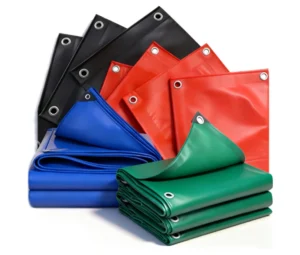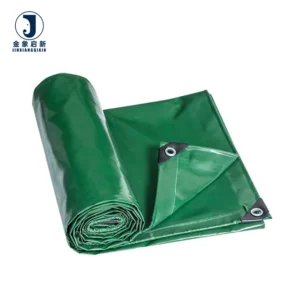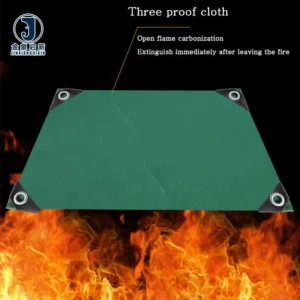
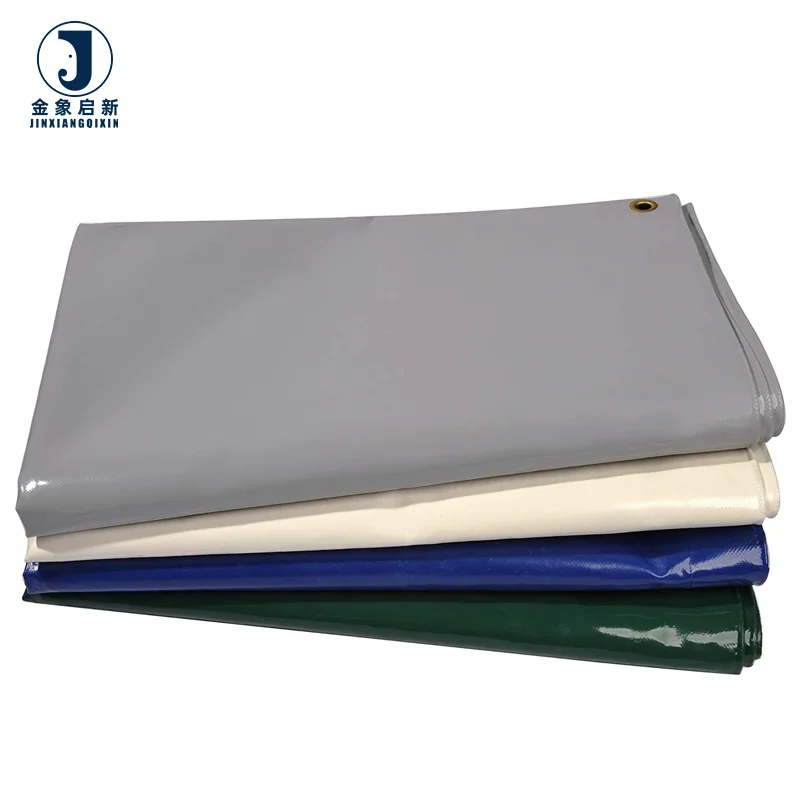
Deep process control over coating weight — verified GSM across every roll from lightweight 420g/㎡ awning grades to heavy-duty 1000g/㎡ truck cover fabrics, backed by stage-by-stage QA and 100% pre-shipment inspection.
Technical Specifications
| Parameter | Value |
|---|---|
| Product Type | PVC Coated Tarpaulin |
| Base Fabric Material | Polyester |
| Yarn Count Options | 500D×840D, 500D×1000D, 1000D×1000D, 1000D×1300D, 1300D×1300D, 1000D×2000D |
| Weight Range | 420g/㎡ – 1000g/㎡ |
| Thickness Range | 0.29 mm – 0.65 mm |
| Mesh Density Options | 20×20, 30×15, 30×19 |
| Tensile Strength (Warp) | 1650 N – 3900 N |
| Tensile Strength (Weft) | 1600 N – 3500 N |
| Coating Material | PVC (double-sided) |
| Key Features | Water resistant, waterproof, available in flame retardant grades — confirm the grade required for your market, available in anti-UV treatment — confirm the test basis for your application |
| Edge Construction | High temperature heat sealed seamless edge wrapping, 5 mm thick rope without splicing |
| Eyelet Options | 3 cm enlarged aluminum alloy buttonhole, reinforced corners |
| Density Parameter | 1.15 – 2.00 g/cm³ |
| Brittle Temperature | ≤ -50 °C to -60 °C |
| Softening Temperature | ≥ 80 °C |
| Melting Point | 212 °C |
| Surface Finish | Smooth with leather-like texture |
| Standards | ISO, CE |
Application Suitability
| Application | Exposure & Requirement |
|---|---|
| Truck and trailer side curtains | Constant flexing at load points, road debris abrasion, prolonged UV exposure, high tensile demand during transit |
| Awning and pergola canopies | Long-term sun exposure, wind uplift tension, water pooling on low slopes, periodic folding and storage |
| Tent and inflatable membrane structures | High-frequency hot-air welding at seams, sustained wind load, rapid deployment tension, fire code compliance for public assembly |
| Outdoor machinery and equipment covers | Abrasion from vibration, chemical splash, dust ingress, repeated fitting and removal cycles |
| Balcony and window rainproof enclosures | Wind-driven rain, UV degradation on vertical surfaces, requirement for visual clarity or opacity depending on specification |
Why a Quoted GSM Does Not Guarantee Tensile Performance
Tensile strength comes from the base fabric denier and weave density, not from coating weight alone.
I have seen technical buyers specify a heavy GSM expecting higher strength, only to receive a thick-coated but loosely woven fabric that tears easily at the weld line. PVC coated tarpaulin material properties depend on the interaction between yarn count and mesh density [NEED_CITE: tensile and tear test methods for coated fabrics per ISO 1421]. A 650g/㎡ fabric woven from 1000D×1000D yarn at 30×19 density will behave completely differently under load than a 650g/㎡ fabric woven from 500D×840D yarn at 20×20 density — even though the scale reads the same. Coating weight adds mass and weather protection, but the skeleton of the fabric is the polyester base. When the material specification sheet omits denier and density, the buyer is essentially purchasing on faith.
Base Fabric Denier as the Structural Foundation
The yarn count range from 500D×840D to 1000D×2000D defines the load-bearing capacity of every PVC coated tarpaulin grade in this family. Higher denier yarns resist tensile failure and slow tear propagation, which matters when a truck cover flexes under wind load or a membrane structure sustains uplift pressure. Selecting the correct denier is a function of the mechanical demand at the seam, not just the overall weight target.
Coating Weight, Thickness, and Abrasion Resistance
Thickness from 0.29 mm to 0.65 mm correlates directly with the volume of PVC applied to each side of the base fabric [NEED_CITE: relationship between coating thickness and abrasion resistance in technical textiles]. Heavier coating protects the yarn from mechanical wear, chemical splash, and moisture penetration at flex points. However, excessive coating without a proportional increase in yarn denier produces a stiff fabric that cracks at the fold line in cold conditions, which is why the brittle temperature rating of ≤ -50 °C to -60 °C must be considered alongside thickness selection.
Reading the Specification Sheet Beyond GSM
A proper material specification sheet for PVC coated tarpaulin should state GSM, base fabric denier, mesh density, total thickness, and coating method as a complete set. GSM alone is a one-dimensional metric. When a fabricator evaluates weld parameters, seam peel strength, and long-term weathering behavior, the coating composition, density parameter (1.15–2.00 g/cm³), and thermal thresholds (softening ≥ 80 °C, melting at 212 °C) all enter the calculation. Buyers who request only GSM on their inquiry are leaving five or six critical variables to the supplier’s discretion [NEED_CITE: DIN 53354 test methods for coated fabric peel strength].
The Cost of Specifying on Weight Alone
When a buyer specifies GSM without denier or density, the supplier may meet the weight target by adding coating to a lighter base fabric. The roll arrives on scale, but the tensile and tear values fall short of what the application demands. I have seen weld seams fail at the exact point where the load flexes most, not because the fabric was weak, but because the base fabric density was too low to hold the coating under cyclic stress [NEED_CITE: weld seam failure modes in PVC coated polyester fabrics]. Batch-to-batch colour variation is another consequence of loose specification — when the supplier switches base fabric mills to hit a price target, the PVC absorption changes and the colour shifts between rolls in the same order.
Verification Infrastructure Behind Every Roll
This PVC coated tarpaulin range is produced on three full production lines with 36 sets of professional equipment, allowing the mill to control coating weight at each stage rather than relying on end-of-line spot checks. The 10-person R&D team handles material selection and sample development for custom denier and density combinations. Every roll undergoes dedicated QA/QC at each production stage, with 100% inspection before shipment against the stated material specification sheet — GSM, thickness, and visual consistency are all verified before the packing list is issued.
Documentation & Verification
- Weight verification per roll against the stated GSM on the material specification sheet before dispatch
- Base fabric denier and mesh density recorded on the specification sheet for each production batch
- Test reports for flame retardant and anti-UV grades supplied where applicable to the specified treatment
- Pre-shipment inspection record documenting thickness, colour consistency, and visual defects
- Certificate of origin and customs documentation prepared for export shipments
Fabrication, Handling & Storage
- Hot-air welding temperature should reference the 212 °C melting point and ≥ 80 °C softening threshold to avoid base fabric damage
- Heat sealed seamless edge wrapping eliminates glue cracking at hem lines during repeated flex cycles
- Store rolls vertically on end to prevent flat-spot compression marks on the PVC coating surface
- Allow cold-stored rolls to acclimatise before unrolling to avoid creasing below the brittle temperature threshold
- Repair field damage with compatible PVC hot-air welding using matching thickness material from off-cuts
What to Include in Your Inquiry
Specify the end-use application, expected mechanical loads, and environmental exposure so the correct denier and density combination can be recommended. State your target market’s fire classification requirements if flame retardant treatment is needed, along with the specific test standard your project references. Confirm required roll widths, annual volume, and whether you need the material supplied as roll stock or as finished fabricated covers with eyelets and reinforced hems.
Frequently Asked Questions
Q: How does the relationship between denier and mesh count affect tensile and tear strength?
A: Denier determines individual yarn strength while mesh count defines how many yarns share the load per unit area. A 1000D×1000D yarn at 30×19 density delivers higher warp tensile strength than a 500D×1000D at 20×20, even at similar GSM. Tear resistance depends on both factors working together, which is why our specification sheets list denier and density as a pair rather than GSM alone.
Q: How do you guarantee the GSM matches the material specification sheet upon arrival?
A: Every roll is weighed and measured during 100% pre-shipment inspection. The actual GSM and thickness values are recorded on the inspection report and compared against the quoted specification. Rolls that fall outside the agreed tolerance are held before dispatch, so the buyer receives documentation confirming the weight they paid for is the weight that ships.
Q: What are the thermal properties relevant to high-temperature welding?
A: The coating softens at ≥ 80 °C and the PVC component melts at 212 °C, which defines the working window for hot-air and wedge welding. Fabricators should set equipment temperature to achieve coating fusion without damaging the polyester base fabric. The heat sealed seamless edge wrapping used on finished products is processed within this same thermal range to ensure adhesion without base fabric degradation.
Q: Do you supply custom widths and roll lengths?
A: Yes, the production lines accommodate custom width and roll length specifications beyond standard stock sizes. Minimum order quantities and lead times vary by the degree of customisation required. Provide your target width, roll length, and annual volume in your inquiry so we can confirm feasibility and production scheduling for your specific PVC coated tarpaulin grade.