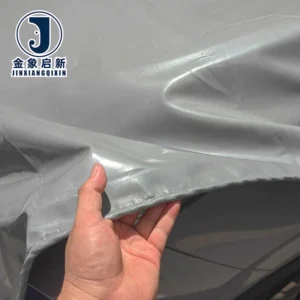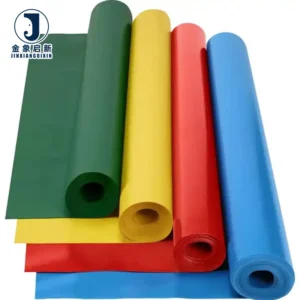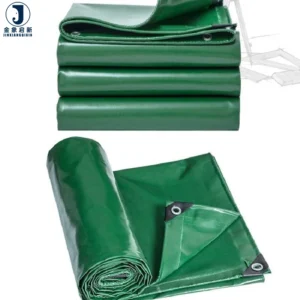
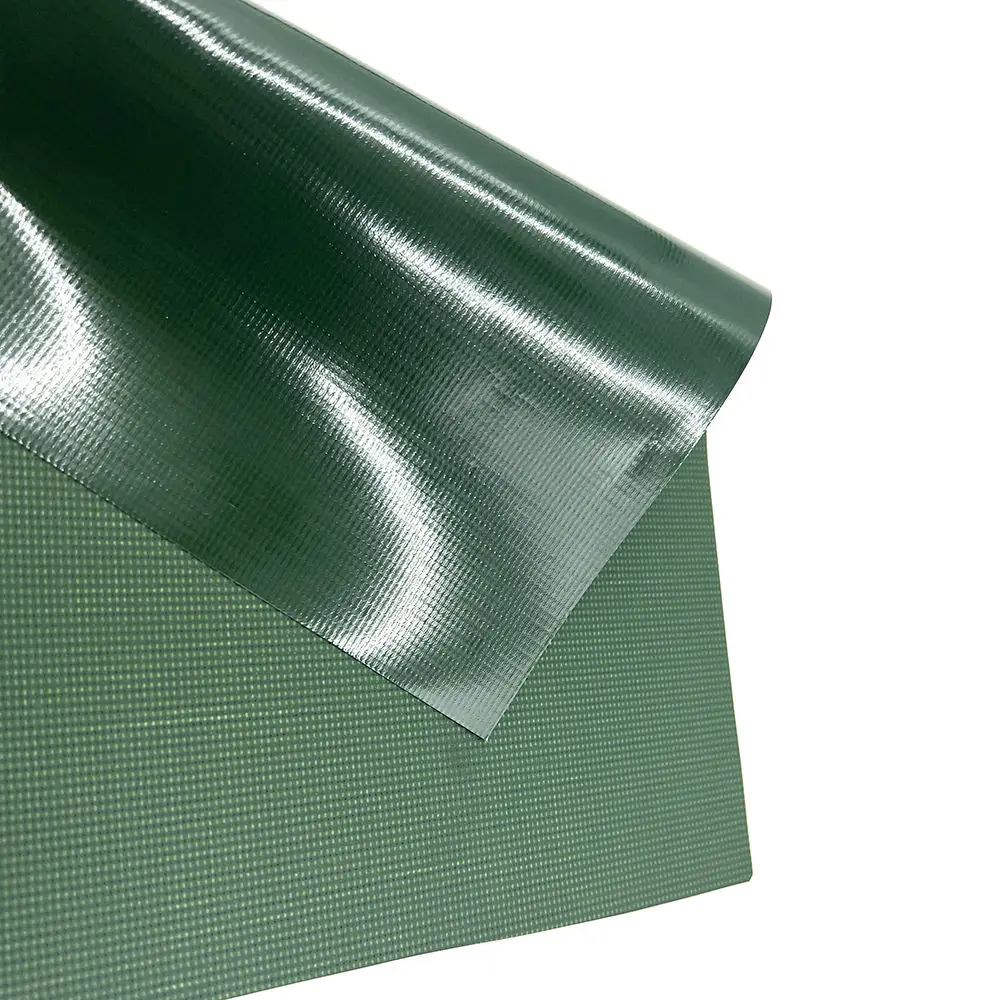
Coating Weight Control — Knife coating process verified at every production stage to ensure GSM matches the specification sheet, not just the quotation.
Technical Specifications
| Parameter | Value |
|---|---|
| Product Type | PVC Coated Tarpaulin Fabric |
| Material Construction | PVC knife coated fabric |
| Coating Method | Knife Coated |
| Color | Green |
| UV Treatment | Available with UV resistance treatment (test basis not stated in source) |
| Flame Retardant | Available in fire retardant grades (grade not stated in source) |
| Antibacterial & Mildew Proof | Yes |
| Oil & Stain Resistance | Yes |
| Acid & Alkali Resistance | Yes |
| Temperature Resistance | High temperature and cold resistant |
| Weather & Oxidation Resistance | Yes |
| Flexibility | Highly flexible, resistant to cracking |
| Self-Cleaning Surface | Yes |
| Welding Compatibility | HF welding, hot air welding, sewing |
| Certification | ISO 9001, CE |
Application Suitability
| Application | Exposure & Requirement |
|---|---|
| Tensile and membrane architectural structures | Sustained tensile load, UV cycling, wind-driven rain, long-term weathering |
| Airport hangar and stadium fabric roofing | Fire code compliance, large-span tension, UV and thermal cycling |
| Portable storage and shade systems | UV exposure, temperature fluctuation, repeated assembly and disassembly |
| Truck and trailer side curtain fabric | Road abrasion at flex points, weather exposure, tie-down tension |
| Large format technical textiles | Fabrication into complex shapes, multiple seam methods, surface durability |
Why Claimed Treatments Fail Verification When the Fabric Arrives
Flame retardant and anti-UV claims mean nothing on a job site without a test report tied to a specific standard.
Buyers specify PVC coated tarpaulin for structural or transport use based on a quotation that says "fire retardant" or "UV resistant." The material arrives, passes visual inspection, and gets fabricated. Then the site inspector asks for the test certificate and the supplier cannot produce one — or produces a generic report that does not match the batch delivered [NEED_CITE: DIN 4102 fire classification for building materials]. The entire installation is held until documentation catches up, or worse, the fabric is rejected and the project schedule slips. This happens because the treatment was stated as a feature rather than verified against a named standard with a batch-specific report.
Knife Coating Process and Coating Adhesion Mechanics
The knife coating method applies PVC compound directly onto the base fabric under controlled blade gap and tension. This produces a uniform coating layer with strong mechanical bonding to the yarn structure, which is critical for PVC knife coated tarpaulin fabric coating technology performance in tensioned applications. Unlike lamination, knife coating allows the PVC to penetrate the weave, creating a bond that resists delamination under repeated flexing and thermal cycling.
Welding Compatibility Across Fabrication Methods
This green PVC coated fabric supports high-frequency welding, hot air welding, and traditional sewing. HF welding produces a molecular bond at the seam, suitable for tensile structures where the weld must carry structural load. Hot air welding offers flexibility for on-site repairs and field fabrication. Sewing remains viable for applications where mechanical fastening is preferred or where the seam will be reinforced with tape [NEED_CITE: tensile and tear test methods for coated fabrics per ISO 1421].
Reading the Specification Sheet Beyond GSM
GSM alone does not define how the fabric will perform under load. The base fabric denier and weave density determine how tensile and tear forces distribute across the material. A high GSM achieved through heavy coating on a low-density base may resist abrasion but remain vulnerable to tear propagation. Knife coating ensures the PVC penetrates and locks into the weave rather than sitting on top as a thick layer, balancing surface durability with structural integrity. The self-cleaning surface treatment reduces dirt accumulation on installed shade and tensile structures, cutting maintenance frequency without adding a separate topcoat that could affect welding behaviour.
What Happens When Colour Varies Between Rolls in the Same Order
Roll-to-roll colour inconsistency is not visible in sample swatches or single-roll inspections. It becomes apparent only when two rolls are unrolled and installed side by side on a tensile canopy or a fleet of truck curtains. The green shade shifts from one panel to the next, and the client rejects the entire installation [NEED_CITE: colour consistency standards for coated technical textiles]. This failure traces back to pigment dosing variation or coating temperature drift during production — issues that only consistent in-process QA checks can catch before the rolls leave the factory.
Why Fabricators Choose This Material Source
Coating weight and adhesion are controlled through dedicated process parameters on three full production lines, ensuring each roll of this PVC coated fabric meets the stated specification. A ten-person R&D team handles custom width, colour, and treatment requirements with sample turnaround in days rather than weeks. Every roll undergoes inspection before dispatch, with actual GSM checked against the order specification. ISO and CE certifications are maintained across the product range, and documentation packages are assembled per shipment. Custom development does not require high minimums, making trial orders practical for new fabrication projects.
Documentation & Verification
- Material specification sheet stating exact GSM, base fabric denier, and coating weight per roll
- Third-party test reports for UV resistance and flame retardant grade matched to order batch
- Pre-shipment inspection record confirming coating adhesion and colour consistency roll by roll
- ISO 9001 and CE certificates current and applicable to this PVC coated fabric product line
- Roll packing list with individual roll weights and dimensions for receiving verification
Fabrication, Handling & Storage
- HF welding parameters should be calibrated to the knife coated PVC layer thickness for consistent seam strength
- Hot air welding temperature and speed must account for the green pigment’s heat absorption characteristics
- Sewn seams on this PVC coated fabric should use UV-stable thread matching the material’s weather resistance
- Store rolls upright on pallets to prevent flat spots that create permanent creases in the coated surface
- Avoid dragging the self-cleaning surface across abrasive ground during site deployment to preserve the finish
- Clean with mild detergent only; solvent-based cleaners may degrade the PVC coating and antibacterial treatment
What We Need to Move Your Inquiry Forward
Provide the application type and the environmental conditions the fabric will face — sustained UV, fire code requirements, or temperature extremes. Confirm whether you need rolls in standard width or a custom width to reduce fabrication waste. Let us know if you require finished panels cut to size or roll stock for your own workshop, and whether a sample is needed to verify colour and weld compatibility before bulk commitment.
Frequently Asked Questions
Q: How is actual GSM verified against the quoted specification before shipment?
A: Every roll is weighed and measured during pre-shipment inspection. The actual GSM is recorded and compared to the specification sheet value. Rolls that fall outside the agreed tolerance are flagged and replaced before dispatch, ensuring the PVC knife coated tarpaulin you receive matches what was quoted.
Q: What test reports are provided for UV and flame-retardant treatment claims?
A: Test reports are supplied based on the grade specified at the inquiry stage. For flame retardant, reports reference the applicable standard such as DIN 4102 or NFPA 701. For UV resistance, reports document the test method and exposure duration. Confirm the standard required by your market when requesting a quotation.
Q: Can custom width, colour, or print be produced without high minimums?
A: Custom widths and colours are available with practical minimum quantities suited to project-based purchasing. The R&D team develops samples within days so you can verify colour match, coating weight, and welding behaviour before committing to bulk production of the PVC coated fabric.
Q: How is roll-to-roll colour consistency controlled across a bulk order?
A: Pigment dosing is controlled at the mixing stage, and coating temperature is monitored throughout production. During pre-shipment inspection, rolls are compared side by side under standardised lighting. Any visible variation is identified and corrected before the order is packed and dispatched.
Q: What welding methods are compatible with this knife coated PVC fabric?
A: The fabric supports high-frequency welding for structural seams, hot air welding for field fabrication and repairs, and sewing for applications requiring mechanical fastening. Welding parameters should be tested on a sample piece to confirm optimal temperature, speed, and pressure for your specific equipment.