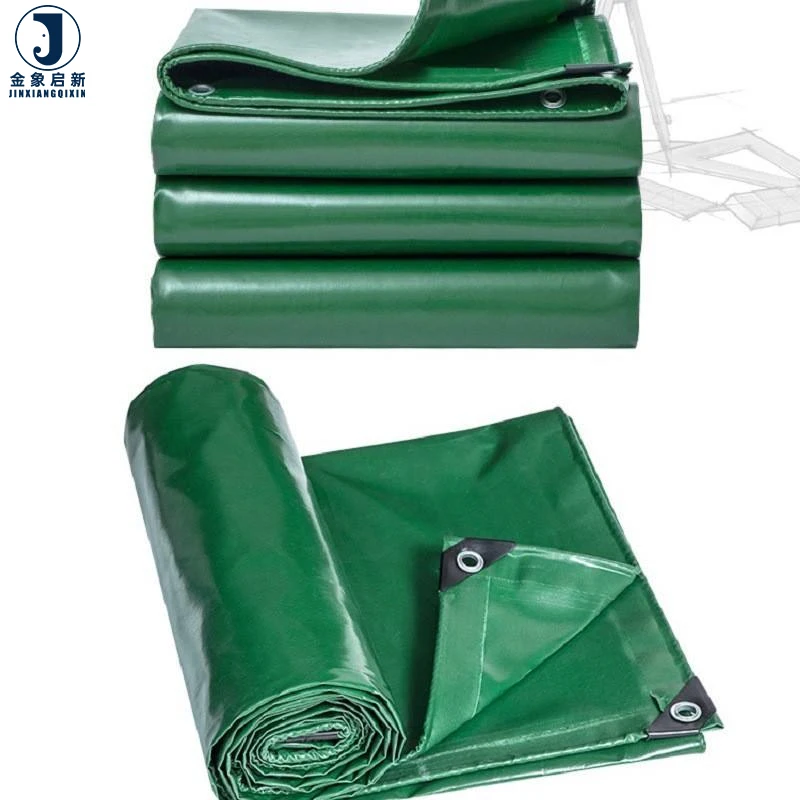
Material consistency across rolls — Every production run of this PVC coated tarpaulin roll is checked against coating weight and thickness tolerances before leaving the facility, giving technical buyers confidence that the GSM stated on the material specification sheet matches what arrives at the warehouse.
Technical Specifications
| Parameter | Value |
|---|---|
| Product Type | PVC Coated Tarpaulin Roll |
| Base Fabric | High-strength polyester mesh fabric |
| Coating Technology | Laminated technology & Hot-melt coating technology |
| Weight (GSM) | 350gsm / 420gsm / 500gsm / 550gsm / 600gsm / 750gsm (multiple grades available — confirm the grade for your project) |
| Total Thickness | 0.32mm / 0.35mm / 0.4mm / 0.45mm / 0.5mm / 0.65mm |
| Roll Width | 2m / 2.1m |
| Roll Length | 75m (for 2m width) / 50m (for 2.1m width) |
| Surface Finish | Glossy surface or matt surface (available as options) |
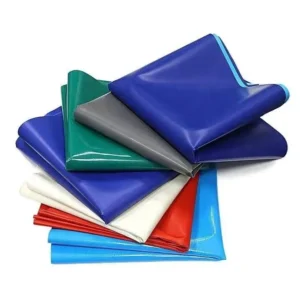
| Colour Options | Blue, Red, Yellow, Light Blue, Grey (custom colours available on request) |
| Waterproof Performance | Double-sided 100% waterproof coated construction |
| Key Features | Cold crack resistance, anti-mildew treatment, anti-static treatment, sunproof formulation |
| Flame Retardant | Available in flame retardant grades — confirm the grade required for your market |
| UV Treatment | Sunproof formulation applied (test basis available on request) |
| Tensile Strength | High tension strength (test standard available on request) |
| Tear Strength | High tear strength (test standard available on request) |
| Certifications | ISO, CE |
Application Suitability
| Application | Exposure & Requirement |
|---|---|
| Tent and awning covers | Prolonged sun exposure, wind load on seams, repeated folding and unfolding at fold lines |
| Truck awning and cargo covers | Road abrasion at flex points, tie-down tension, constant UV and weather cycling |
| Pond and reservoir liners | Permanent water immersion, soil chemistry contact, puncture risk from substrate |
| Inflatable and membrane structures | Continuous air pressure loading, weld seam integrity, UV degradation over extended service periods |
| Fish tank and pool lining | Constant water contact, chemical treatment exposure, requirement for continuous waterproof integrity |
Why GSM Alone Does Not Tell You How Strong This PVC Coated Tarpaulin Roll Actually Is
Coating weight tells you mass per square metre — base fabric denier, weave density, and coating adhesion together determine whether the fabric performs under load.
Technical buyers reviewing quotations often compare GSM figures across suppliers, assuming a higher number means a stronger material. In practice, a PVC coated tarpaulin roll with a lighter base fabric and heavier coating can tear more easily than one with a denser polyester mesh and balanced coating weight. The adhesion between the PVC layers and the mesh determines whether the coating delaminates under stress or holds together at flex points [NEED_CITE: tensile and tear test methods for coated fabrics per ISO 1421]. Without seeing the base fabric construction alongside the stated GSM, the number on the quotation remains an incomplete specification.
How Laminated and Hot-Melt Coating Affect Fabric Performance
The two coating technologies available for this PVC coated tarpaulin roll serve different fabrication requirements. Laminated technology bonds pre-formed PVC films to the polyester mesh under heat and pressure, producing a uniform coating layer with consistent thickness. Hot-melt coating applies molten PVC directly to the base fabric, allowing the coating to penetrate the mesh weave for mechanical interlocking. Each method affects how the material behaves during welding — laminated grades typically offer predictable melt behaviour at the seam, while hot-melt grades may require adjusted heat settings depending on coating penetration depth. Fabricators should request weld samples to confirm seam behaviour before committing to a production run.
The Relationship Between Base Fabric, Coating Weight, and Mechanical Behaviour
The structural backbone of any PVC coated tarpaulin roll is the polyester mesh beneath the coating layers. High-tenacity polyester yarns provide the tensile strength that resists stretching under load, while the weave density determines how the material resists tear propagation once a cut initiates. The PVC coating adds waterproof integrity, UV protection, and surface durability, but it does not substitute for base fabric strength. When the mesh denier and weave count are balanced with the coating weight, the resulting fabric distributes stress evenly across warp and weft directions rather than concentrating force at individual yarn intersections [NEED_CITE: relationship between base fabric denier and tear propagation in coated polyester textiles].
Reading GSM and Thickness as a Paired Specification
The six weight grades in this range — 350gsm through 420gsm, 500gsm, 550gsm, 600gsm, and 750gsm — each correspond to a specific total thickness from 0.32mm to 0.65mm. This paired data matters because GSM alone does not reveal how that weight is distributed between coating and base fabric. A 550gsm roll at 0.45mm thickness has a different coating-to-mesh ratio than a 550gsm roll at a different thickness, which changes how the material handles bending, folding, and heat welding. Technical specifiers should request both values together and cross-reference them against the application’s mechanical demands. Glossy and matt surface finish options further influence how the coating behaves during digital printing or screen printing, with matt surfaces generally accepting ink adhesion differently than glossy ones.
What Happens When the Roll Specification Does Not Match the Fabrication Method
Selecting a PVC coated tarpaulin roll without considering the downstream fabrication process leads to failures that appear after installation rather than at the cutting table. Welded seams on a laminated grade may perform differently than on a hot-melt grade, and if the heat settings are not matched to the coating technology, the seam fails before the fabric body does. Colour variation between rolls in the same order becomes visible once panels are installed side by side on a large tent or awning, forcing costly replacement or rework [NEED_CITE: colour consistency standards for coated fabric roll stock]. Cold crack resistance and anti-mildew treatments stated on the quotation provide no benefit if the material grade selected is too light for the actual exposure conditions the finished product will face.
What Supports Reliable Specification for This Coated Fabric Range
Three full production lines and 36 sets of professional equipment allow this facility to maintain coating weight consistency across large-volume roll orders, reducing batch-to-batch variation that affects fabricators working with multiple rolls on a single project. A 10-person R&D team handles material selection and sample development, meaning custom GSM grades, widths, and surface finishes can be sampled before bulk production begins. Dedicated QA and QC inspection runs at every production stage, with 100% pre-shipment inspection verifying that coating weight, colour reference, and roll dimensions match the approved specification. Nearly 30 years of focused coated fabric production has built process control over coating adhesion that newer operations cannot replicate. ISO and CE certifications are held at the facility level, supporting documentation requirements for export markets across North America, Europe, and Asia.
Documentation & Verification
- Material specification sheet stating exact GSM, base fabric denier, coating method, and thickness for the ordered grade
- UV and flame retardant test reports provided with stated standard references where applicable to the grade selected
- ISO and CE certificates available to support import compliance and site acceptance requirements
- Pre-shipment inspection record confirming roll dimensions, colour consistency, and coating weight before dispatch
- Roll packing list with individual roll weights and dimensions for warehouse receiving verification
- Certificate of origin and customs documentation supporting international freight clearance
Fabrication, Handling & Storage
- Hot-melt coated grades require weld temperature testing on sample offcuts before production welding begins
- Laminated grades produce consistent seam melt behaviour, suitable for high-frequency and hot-air welding on awning panels
- Glossy surface rolls should be stored upright on cores to prevent surface marking and pressure creases
- Matt surface finishes accept ink adhesion for printed branding — confirm ink compatibility with sample prints first
- Rolls in 2m × 75m format yield fewer cross-seams on long tent and awning panels than shorter roll lengths
- Cold crack resistant formulations should still be unrolled above freezing to avoid coating micro-cracking during handling
Requesting the Right Specification for Your Project
To match the correct PVC coated tarpaulin roll grade to your application, provide the end-use exposure conditions including UV intensity, mechanical loading at seams, and any fire safety requirements for the installation market. Specify whether the material will be welded, sewn, or both, so the coating technology recommendation aligns with your fabrication method. Confirm whether rolls are required in stock widths and standard colours, or whether custom colour references and non-standard widths are needed for your production line. Sample rolls can be developed for weld testing and print trials before full order quantities are committed.
Frequently Asked Questions
Q: How can I verify the actual GSM of the PVC coated tarpaulin roll when it arrives?
A: Request a material specification sheet that states coating weight separately from base fabric weight for your ordered grade. On arrival, cut sample swatches of known area and weigh them to confirm total GSM. Cross-check results against the pre-shipment inspection record provided with the shipment to identify any discrepancies before the rolls enter your production line.
Q: What test basis supports the sunproof and cold crack resistance claims on this PVC coated tarpaulin roll?
A: The sunproof formulation and cold crack resistance treatments are applied during coating. Specific test standards and exposure duration data are available on request for your grade. Before placing a bulk order, ask for the test report referencing the standard used so you can confirm suitability for your installation climate and expected service exposure.
Q: How do I obtain flame retardant certification with a stated grade for my market?
A: Flame retardant grades are available across the GSM range, but the specific grade and test standard must be confirmed against your local fire safety regulations. State your market and the required classification when inquiring. The manufacturer can then supply the corresponding test report and ensure the correct formulation is applied during production of your PVC coated tarpaulin roll order.
Q: What is the difference in weld behaviour between laminated and hot-melt coated grades?
A: Laminated technology produces a uniform coating film that melts predictably under high-frequency and hot-air welding. Hot-melt coating penetrates the mesh weave, which can affect how the coating flows at the seam junction. Request sample offcuts of both types to run weld tests at your standard machine settings before selecting the coating method for your PVC coated tarpaulin roll production.
Q: How is colour consistency controlled across multiple rolls in a single order?
A: Each order is produced with a confirmed colour reference, and rolls are inspected for batch-to-batch uniformity during the 100% pre-shipment check. For projects where panels are installed side by side, specify that all rolls must come from the same production batch and request the inspection record showing colour consistency verification before the shipment is dispatched.