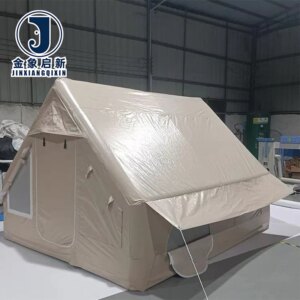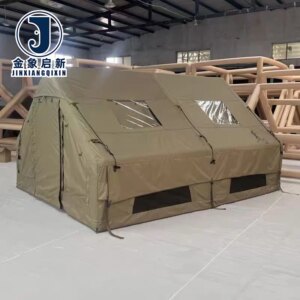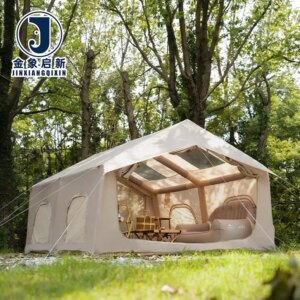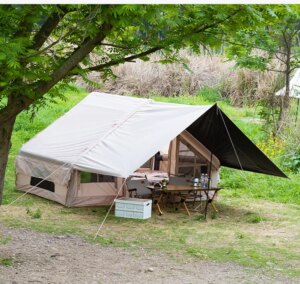
Coating Weight Integrity — Verified GSM and adhesion control per roll for inflatable tube structures, eliminating the gap between quoted spec and delivered material.
Technical Specifications
| Parameter | Value |
|---|---|
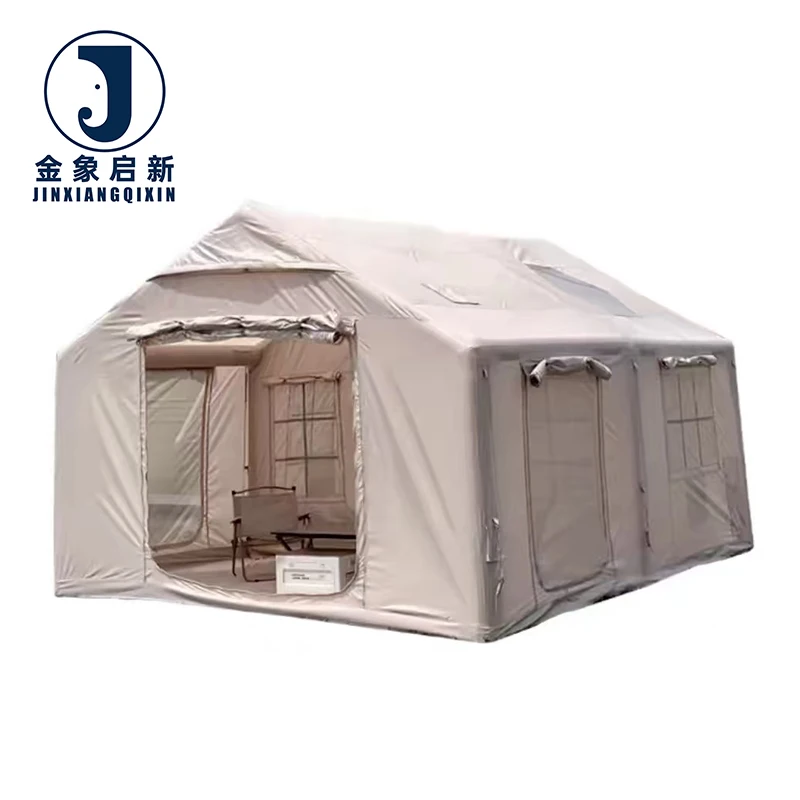
| Product Type | Inflatable Tent Fabric / Emergency Relief Tent |
| Core Material | PVC knife-coated fabric |
| Fabric Construction | Knife coating over woven polyester base |
| Capacity | 3-5 person |
| Design Configuration | Four-season use, single layer construction, extended type |
| UV Resistance | UV-resistant treatment (test basis not stated) |
| Waterproofing | Fully waterproof coated construction |
| Tear Performance | Tear-resistant woven substrate |
| Customization | OEM & ODM: size, thickness, and color variations |
| Certifications | ISO 9001, ISO 14001, ISO 45001, CE |
Application Suitability
| Application | Exposure & Requirement |
|---|---|
| Temporary site offices during infrastructure recovery | Wind loading on inflatable tubes, continuous UV exposure, rapid deployment |
| Equipment storage shelters in post-disaster operations | Water ingress prevention, abrasion from stored machinery, extended weathering |
| Emergency command centers for large industrial facilities | Frequent inflation/deflation cycles, structural tube integrity, multi-season use |
| Material staging and operational coordination shelters | Puncture risk from equipment handling, ground moisture, thermal fluctuation |
Why Unverified Coating Claims Undermine Inflatable Structure Safety
Every roll ships with a specification sheet confirming GSM, base fabric construction, and coating weight before it leaves the facility.
When sourcing PVC inflatable tent fabric for emergency deployment, buyers frequently encounter materials where anti-UV or flame-retardant treatment is stated on the quotation but never backed by a test result. For inflatable disaster relief tents, the air-holding tube structure depends entirely on the coating adhesion and tensile integrity of the fabric — a failure at the weld seam or a UV-degraded tube wall in the field is not a warranty claim, it is an operational crisis. We address this by providing batch-specific documentation and test reports that confirm the treatment claimed is the treatment delivered. [NEED_CITE: tensile and tear test methods for coated fabrics per ISO 1421]
Coating Adhesion and Inflatable Tube Integrity
The PVC inflatable tent fabric produced here uses knife-coating technology, where liquid PVC is applied directly onto the woven polyester base under controlled tension.* compared to laminated alternatives, producing stronger inter-layer adhesion. For inflatable tube structures that endure repeated inflation cycles, this adhesion prevents delamination at the stress points where tubes flex during deployment and collapse.
UV Treatment Verification for Field-Deployed Shelters
Outdoor inflatable emergency tents face sustained solar exposure across seasonal rotations. The UV-resistant treatment applied to this PVC inflatable tent fabric is documented with test references so that technical buyers can confirm suitability for their specific climate zone. Available in flame retardant grades — confirm the grade required for your market before specifying, as regulatory requirements differ between mining, aviation, and construction sites.
Understanding the Material Construction Behind the Specification
Knife-coated PVC fabric starts with a woven polyester base whose denier and thread density set the foundation for tensile and tear strength. The coating weight applied on top determines surface waterproofing, abrasion resistance, and the quality of thermal welds during fabrication. A heavier coating does not automatically mean a stronger fabric — a high-GSM material built on a loosely woven base will underperform against a moderate-GSM material with a tightly constructed substrate. This is why material specification sheets listing both base fabric density and coating weight are essential for evaluating true structural capability. Single-layer construction in these tents reduces overall weight for transport while relying on the knife-coated membrane to provide the full weather barrier. [NEED_CITE: relationship between base fabric density and tear propagation in coated technical textiles]
The Hidden Cost of Specifying on GSM Alone
Procurement teams that select inflatable tent material based on quoted GSM without verifying base fabric construction often receive rolls that meet the weight target through excess coating rather than structural weave. The result is a fabric that welds poorly because the coating-to-yarn ratio is off, and tears propagate faster under wind load because the underlying scrim lacks density. For emergency shelters deployed in high-wind post-disaster zones, a tube failure caused by inadequate base fabric is discovered only when the structure is under full operational stress. Batch-to-batch inconsistency compounds this when multiple tents for the same project arrive with varying hand-feel and mechanical performance. [NEED_CITE: field failure analysis of coated fabrics in temporary shelter applications]
Why Technical Buyers Source This PVC Inflatable Tent Fabric Here
Deep process control over knife-coating parameters — coating weight and adhesion are monitored at every stage, not sampled at the end. Three full production lines and 36 sets of professional equipment deliver bulk capacity with on-time scheduling for emergency stockpiling programs. A 10-person R&D team handles custom material thickness, dimension adjustments, and color matching with samples developed within days. Dedicated QA/QC staff conduct 100% pre-shipment inspection including inflation testing on fabricated samples. Nearly 30 years of continuous coated-fabric production means the process variables that cause delamination and weld failure are controlled by experience, not just instrumentation.
Documentation & Verification
- Material specification sheet stating GSM, base fabric denier, and coating weight per production batch
- UV treatment test report available on request with order reference number
- Pre-shipment inspection record covering coating adhesion and surface integrity
- ISO 9001, ISO 14001, ISO 45001, and CE certificates included with shipment documentation
- Certificate of origin and customs documentation for cross-border delivery
Fabrication, Handling & Storage
- Thermal welding parameters should be calibrated to the knife-coated PVC thickness for consistent tube seam strength
- Store rolls vertically in climate-controlled conditions to prevent permanent creasing of the coated surface
- Avoid dragging single-layer fabric over abrasive ground during field deployment to protect the coating membrane
- Use compatible PVC-based repair adhesives for field patching of punctures on the knife-coated surface
- Allow cold-stored rolls to reach ambient temperature before unrolling to prevent coating crack at low temperatures
What to Include When Requesting a Quotation
Specify the deployment environment including expected wind loads, temperature range, and UV exposure duration so the correct base fabric and coating weight can be recommended. Indicate whether you require roll stock for in-house fabrication or finished tent units with welded tube assemblies. If your market mandates a specific fire classification, state the required grade and standard so compliant material is allocated from the appropriate production batch. Confirm color requirements and whether you need samples for approval before bulk commitment.
Frequently Asked Questions
Q: How do I verify PVC coating weight and GSM on arrival against the quotation?
A: Each shipment includes a material specification sheet stating the GSM, base fabric details, and coating weight for that production batch. You can cross-reference this against the original quotation. For independent verification, we support third-party lab testing arranged before dispatch or upon receipt.
Q: What test basis supports the UV-resistant claim for outdoor inflatable structures?
A: The UV-resistant treatment applied to this fabric is documented with test references included in the shipment documentation. If your project requires compliance with a specific UV exposure standard for your regional climate, state this at inquiry stage so the appropriate treatment grade is selected and tested.
Q: How does knife-coated PVC perform at thermal welds for inflatable tube joints?
A: Knife coating produces strong inter-layer adhesion because the PVC penetrates the woven base during application. This gives thermal welds a consistent melt profile across the seam. We recommend calibrating weld temperature and dwell time to the specific material thickness for optimal joint integrity.
Q: What customization options are available for thickness, color, and dimensions?
A: OEM and ODM services cover material thickness adjustments, custom color matching, and dimension variations. Samples are developed within days for approval before production proceeds. Specify your target thickness, color reference, and width requirements when submitting your inquiry.
Q: Is batch-to-batch color consistency maintained when ordering multiple tents?
A: Production runs are controlled to maintain color consistency within a single order. For multi-batch orders placed over time, we retain color reference records from previous shipments. State your tolerance requirements at inquiry so matching protocols are applied during coating preparation.