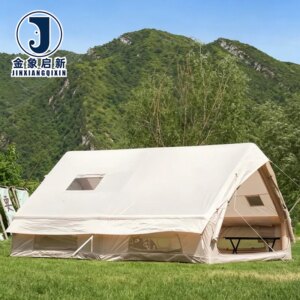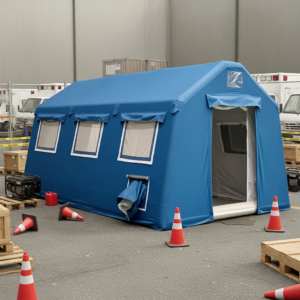
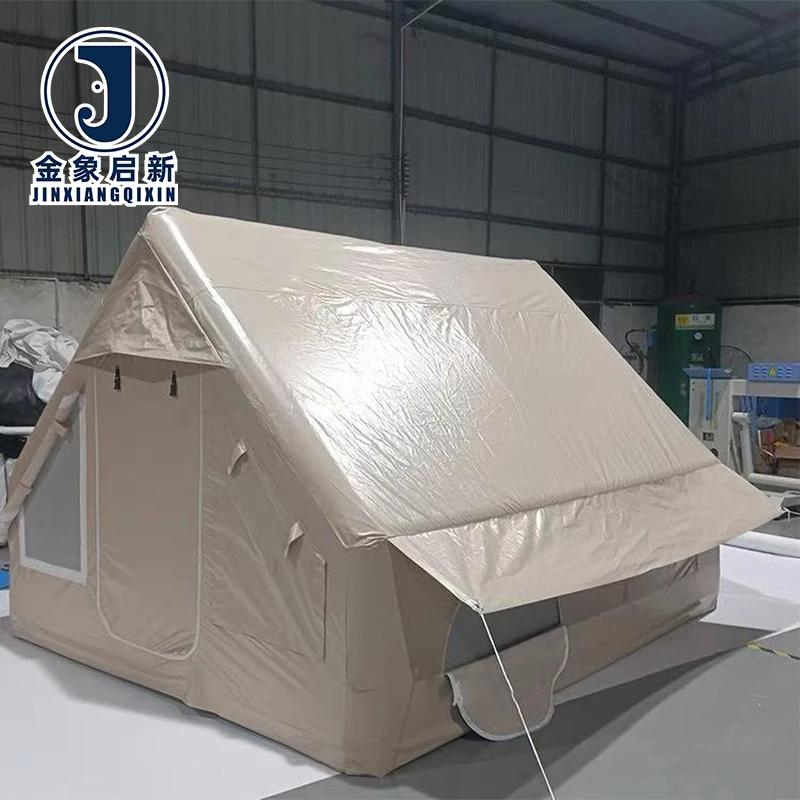
Deep Process Control Over Coating Weight — three full production lines with 36 sets of professional equipment ensure consistent PVC coating adhesion and uniform GSM across every roll of inflatable tent fabric, verified at each stage before dispatch.
Technical Specifications
| Parameter | Value |
|---|---|
| Product Type | Inflatable Tent |
| Core Material | PVC tarpaulin |
| Coating Method | Knife coated |
| Capacity | 5-8 Person |
| Opening Mechanism | Quick automatic opening |
| Season Rating | All-season |
| Waterproof | Confirmed |
| UV Treatment | UV-resistant (test basis not stated) |
| Tear Resistance | Tear-resistant (test standard not stated) |
| Flame Retardant | Fire-retardant (grade not stated) |
| Anti-Static | Anti-static (standard not stated) |
| Customization | OEM & ODM, sample customization, pattern printing |
| Standards | ISO9001, ISO14001, ISO45001, CE |
Application Suitability
| Application | Exposure & Requirement |
|---|---|
| Mining and tunnelling temporary shelters | Fire-retardant compliance near ventilation zones, rapid deployment in confined underground environments |
| Construction site crew accommodation | Harsh weather exposure, wind load on inflated panels, repeated inflation cycles |
| Emergency response field shelters | All-season deployment, rapid inflation under time-critical conditions, transport abrasion |
| Large-scale event management structures | High foot traffic proximity, UV exposure during extended outdoor use, public safety compliance |
| Resource exploration base camps | Remote logistics, extreme temperature variation, prolonged UV and moisture exposure |
Why "Fire-Retardant" Means Nothing Without a Grade Behind It
PVC inflatable tent fabric must carry a verified flame-retardant classification matched to your market’s regulatory framework — a generic claim does not pass site inspection.
When an inflatable shelter is deployed on a mining site or inside a tunnel ventilation zone, the safety officer asks for the test certificate, not the brochure. Inflatable structures concentrate stress at welded seams, and a fire-retardant coating that degrades at the heat-weld line leaves the structure vulnerable precisely where it inflates under pressure. Buyers who specify "fire-retardant PVC" without naming the standard frequently face rejection at the pre-commissioning audit [NEED_CITE: fire classification standards for temporary industrial structures]. Our PVC inflatable tent fabric is available in fire-retardant grades — confirm the grade required for your market before placing the production order.
Coating Formulation and Airtight Seam Integrity
The PVC coating on inflatable tent panels must bond to the base fabric with enough adhesion strength to survive repeated inflation and deflation cycles without delamination. Knife coating applies a controlled layer of PVC compound directly onto the woven base, producing a uniform film that supports consistent heat-weld performance across the entire panel surface. When the PVC inflatable tent fabric is fabricated into inflatable bladders, the weld line is only as strong as the coating-to-substrate bond — any inconsistency in coating weight shows up immediately as a weak seam under pressure.
Fire-Retardant and Anti-Static Treatment for Enclosed Structures
Inflatable shelters used in mining, tunnelling, or industrial disaster zones operate in environments where electrostatic discharge and ignition sources are constant concerns. The anti-static formulation reduces surface charge accumulation on the PVC film, while fire-retardant additives are compounded into the coating layer during production. For enclosed temporary structures housing personnel, these treatments are not optional — they define whether the shelter passes the site safety induction [NEED_CITE: anti-static and flame-retardant requirements for underground and industrial temporary enclosures]. Request the specific test reports for both properties before approving the material specification.
How Base Fabric and Coating Weight Interact to Define Panel Strength
The tear resistance of an inflatable tent panel is governed by the interplay between base fabric denier, weave density, and the PVC coating weight applied during knife coating. A heavier coating does not automatically deliver higher tear strength — if the base fabric is underspecified, the coating adds weight without contributing structural integrity. Conversely, a tightly woven high-denier base with insufficient coating adhesion will delaminate at the weld before the yarns reach their breaking point. Specifying PVC inflatable tent fabric requires reviewing the base fabric denier and weave alongside the coating GSM to confirm that tensile and tear performance meet the inflation pressure and wind load requirements of the deployment site.
The Hidden Cost of Unverified Material Claims
Inflatable tent fabric that arrives lighter than the quoted GSM inflates to shape but fails prematurely at the seam when wind load flexes the panels. Fire-retardant treatment claimed without a supporting test report leads to failed site inspections and work stoppages that cost far more than the material itself. Batch-to-batch colour variation across rolls becomes visible the moment panels are joined side by side on a large event structure, triggering rejection and replacement under deadline pressure [NEED_CITE: common causes of coated fabric rejection at pre-commissioning inspection]. These failures are preventable when the buyer demands documentation at the quotation stage rather than at delivery.
Why Technical Buyers Source PVC Inflatable Tent Fabric Here
Our coating lines maintain tight control over PVC compound application weight, verified by in-process measurement rather than post-production sampling alone. The 10-person R&D team develops sample panels matched to your inflation pressure and weld method before the production order is confirmed. Every roll undergoes dedicated QA/QC inspection at each production stage, with 100% pre-shipment verification against the stated material specification. Custom widths, colours, and pattern printing are produced on the same lines as stock grades, eliminating the quality gap that often separates sample approval from bulk delivery. ISO9001, ISO14001, ISO45001, and CE certifications are held current and available for audit.
Documentation & Verification
- Material specification sheet confirming GSM, base fabric denier, weave structure, and coating type for each roll
- Fire-retardant and UV test reports citing the applicable standard — request before order confirmation
- Pre-shipment inspection record with coating weight verification against quoted specification
- ISO and CE certificates available with batch traceability linked to the purchase order number
- Roll packing list detailing gross weight, net weight, and dimensions for container loading planning
Fabrication, Handling & Storage
- Set heat-weld temperature and dwell time based on the specific PVC coating weight before running production seams
- Store rolls horizontally on pallets to prevent permanent creasing across the knife-coated PVC surface
- Avoid dragging rolls on abrasive surfaces that can score the PVC film before fabrication begins
- Allow cold-stored rolls to reach ambient temperature before unrolling to prevent coating micro-cracking
- Use PVC-compatible cleaners only — solvent-based products can degrade the coating surface and compromise weld adhesion
- Plan panel cutting layout to minimize waste and reduce the number of field-welded joints on the inflatable structure
What We Need to Quote Accurately
Provide the deployment environment and the regulatory framework your site operates under, including any fire-retardant or anti-static classification required by the project specification. Confirm the panel dimensions, inflation pressure range, and whether you require roll stock or fabricated panels with welded seams. Specify the colour reference and whether pattern printing or branding is needed on the outer surface. State your target order volume and required lead time so we can schedule production on the appropriate line and prepare matched samples for your approval.
Frequently Asked Questions
Q: What base fabric denier and coating weight are used for inflatable tent panels?
A: The base fabric denier and coating weight are selected based on the inflation pressure and structural load requirements of your specific tent design. We provide a material specification sheet stating the exact GSM, base fabric denier, weave density, and coating method for your review. Request matched samples with full documentation before confirming the production order.
Q: Which fire-retardant standard does the PVC coating meet for industrial shelter use?
A: Fire-retardant grades are available to meet various market requirements, but the specific standard depends on your deployment jurisdiction and site safety regulations. Confirm the classification required — such as the applicable national or project-specific standard — and we will supply the corresponding test report with the material documentation package.
Q: How is anti-static performance verified and tested?
A: Anti-static treatment is incorporated into the PVC coating compound during production. Verification testing is conducted according to the applicable standard for your operational environment. Request the test method reference and result documentation before approving the material for use in sensitive locations such as mining or fuel-adjacent facilities.
Q: What welding and seam methods are compatible with this PVC-coated inflatable fabric?
A: Hot-air welding and high-frequency welding are both compatible with our knife-coated PVC inflatable tent fabric. The coating formulation is designed to produce consistent weld strength across the panel surface. We recommend running test welds on sample material to establish the optimal temperature, speed, and pressure settings for your fabrication equipment.
Q: How is batch-to-batch colour and coating consistency controlled across roll stock?
A: Each production run is monitored for coating weight and colour consistency through in-process QA checks at every stage. Rolls within the same order are produced consecutively to minimize variation. The pre-shipment inspection record documents the verification results, and batch traceability is maintained through the order number for future reference.