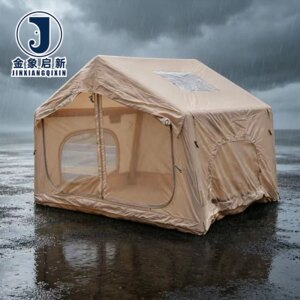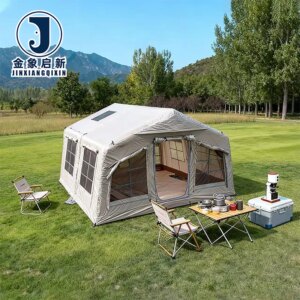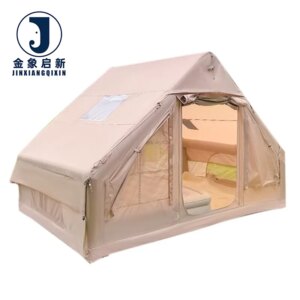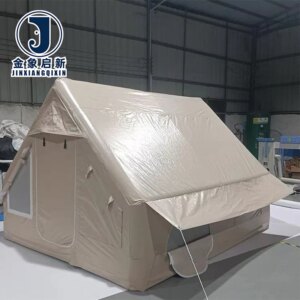
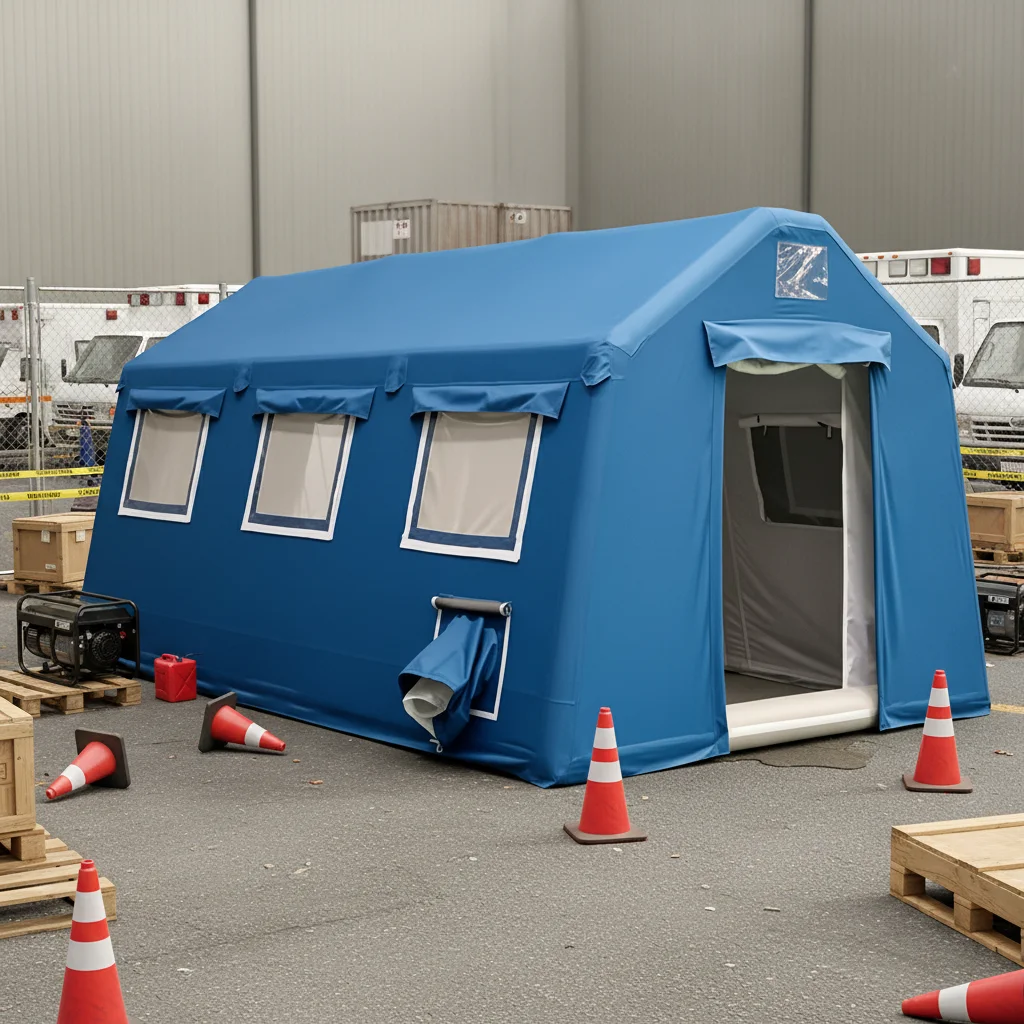
Material Process Control — Nearly three decades of knife-coated fabric production with coating weight verified at every stage, ensuring batch-to-batch adhesion consistency for inflatable structures.
Technical Specifications
| Parameter | Value |
|---|---|
| Product Type | Inflatable Tent |
| Core Material | PVC knife-coated tarpaulin |
| Coating Method | Knife coated |
| Waterproof Construction | Yes, waterproof seam technology |
| UV Treatment | UV-resistant coating (test basis not stated in source) |
| Flame Retardant | Fire-retardant properties (grade not stated in source) |
| Tear Resistance | High tensile and tear resistance (test standard not stated in source) |
| Product Forms | Quick automatic opening, single layer, extended type |
| Air Pressure Retention Test | Minimum 24-hour inflation integrity verification |
| Customization | OEM & ODM, size adjustments, color options, pattern printing |
| Quality System | ISO9001, ISO14001, ISO45001, CE certified |
| R&D Support | 10 technicians |
| Production Lines | 3 full production lines |
| Processing Equipment | 36 sets |
Application Suitability
| Application | Exposure & Requirement |
|---|---|
| Emergency response command centers | Rapid deployment, repeated inflation cycles, wind load stress, all-weather exposure |
| Disaster recovery temporary storage | Continuous inflation over days, rain and moisture contact, ground abrasion |
| Mobile field operations bases | Four-season climate variation, UV exposure, setup and teardown frequency |
| Infrastructure maintenance shelters | Outdoor industrial environments, chemical and dust exposure, structural rigidity under load |
| Inflatable structure manufacturing | Roll consistency for fabrication, weld compatibility, specification conformance per batch |
What Separates a Claimed Fire Rating from a Verified One in Inflatable Shelter Fabric
A fire-retardant claim without a documented grade leaves the buyer carrying all the compliance risk.
Inflatable tents deployed at construction sites, mining operations, or disaster relief zones must meet the fire safety codes of the jurisdiction where they are erected. Procurement teams frequently receive fabric described as "fire retardant" on the quotation, only to discover at site inspection that no test certificate accompanies the shipment. The inflatable structure then fails the safety audit, delaying the entire project timeline and forcing a costly replacement order. When a PVC inflatable tent aftermarket supplier cannot produce a grade-specific test report for the batch delivered, the buyer has no evidence to present to the site safety officer or the local authority having jurisdiction [NEED_CITE: fire classification standards for temporary structures and membrane buildings].
How Knife Coating Determines Structural Behaviour Under Inflation Pressure
The knife-coated construction method applies PVC paste directly onto the base fabric under controlled tension, forcing the coating into the weave interstices. This produces a bond between coating and yarn that resists delamination when the inflatable air beams flex under wind load. For a PVC inflatable tent aftermarket supplier, maintaining consistent paste viscosity and knife gap across the production run is what prevents the soft spots that lead to localized bulging. The 10-person R&D team develops the coating formulation for each order based on the end-use inflation pressure and expected temperature range, rather than running a single stock recipe.
Seam Integrity Where Air Beams Meet the Base Panel
The junction where the inflatable beam connects to the ground sheet or wall panel concentrates stress during both inflation and deflation. Waterproof seam technology addresses this by heat-welding the panels rather than stitching, eliminating needle holes that become leak paths. When the structure is pressurised, the weld line must carry the same load as the parent fabric. If the heat input during welding is too low, the bond is superficial and peels apart under cyclic loading. If it is too high, the PVC scorches and becomes brittle. Every production run undergoes a minimum 24-hour air pressure retention test to confirm that the assembled inflation system holds without measurable loss before dispatch.
Reading the Specification Sheet Beyond the Headline Numbers
Coating weight and base fabric denier work together to determine how the inflatable tube behaves when pressurised. A heavier base fabric with a lighter coating may show good tensile figures on a strip test but poor air-holding performance because the coating has not fully encapsulated the yarns. Conversely, a heavy coating on a loosely woven base adds weight without proportional strength gain, making the structure harder to fold and transport. The knife-coated process addresses this by driving PVC into the weave, so the effective bond area is the full yarn surface rather than just the fabric face. Flame retardancy, when specified, is achieved through additive chemistry in the PVC compound; the grade achieved depends on the formulation and must be verified by batch testing against the standard required in the destination market. UV-resistant treatment similarly depends on the stabiliser package and its concentration — buyers should confirm the test basis that matches their regional climate classification [NEED_CITE: ISO 1421 tensile and tear test methods for coated fabrics]. Colour consistency across rolls in the same order requires pigment dosing controlled to a defined tolerance, and any variation becomes visible once adjacent panels are welded together on the production floor.
The Cost of Accepting Coated Fabric Without Batch-Level Verification
When an inflatable tent manufacturer receives rolls where the actual coating weight falls below the quoted specification, the air beams inflate to shape but lack the rigidity to resist wind-induced deformation. The structure sways, the weld lines fatigue, and failure occurs weeks rather than seasons into service. Colour drift between rolls in the same shipment forces the fabricator to cull panels and reorder, pushing delivery dates past the event or contract deadline. Flame-retardant grades that are not backed by a test report for the specific batch create liability exposure: if a fire incident occurs and the material is found non-compliant, the procurement trail points back to the buyer who accepted undocumented claims. These are not theoretical risks; they recur across the industry wherever specification verification stops at the quotation stage [NEED_CITE: common failure modes in coated fabric structures under cyclic inflation loading].
Why Sourcing This Material Here Reduces Specification Risk
Coating weight is measured at the head of each production line and cross-checked at the wind-up station, so the GSM on the certificate matches the roll the buyer receives. The 36 sets of processing equipment include dedicated welding and testing stations, meaning inflation integrity is verified in-house rather than outsourced to a third-party fabricator. A dedicated QA and QC team inspects every production stage, not just final output, catching adhesion defects and colour drift before they compound into full-roll losses. The 10-technician R&D team develops custom formulations and sample panels within days, allowing the buyer to validate material behaviour under their specific inflation pressure and ambient conditions before committing to a production order. Three full production lines provide the capacity to deliver container-quantity orders on schedule without splitting the batch across machines with different wear profiles, which is a common source of roll-to-roll inconsistency.
Documentation & Verification
- Material specification sheet listing base fabric denier, coating method, and weight for each roll
- Batch inspection report with 24-hour air pressure retention test results per production lot
- Fire-retardant and UV test reports issued against the specific batch when grades are specified
- ISO9001, ISO14001, ISO45001, and CE certificates included with every shipment
- Pre-shipment inspection record documenting seam strength and surface quality checks
- Roll packing list with individual roll weight and dimensions for customs clearance
Fabrication, Handling & Storage
- Heat-weld seams using temperature and dwell settings validated on the specific knife-coated PVC formulation supplied
- Store rolls horizontally on racking to prevent permanent creasing in the coated surface layer
- Allow cold-stored rolls to reach ambient temperature before unrolling to avoid coating micro-cracking
- Use PVC-compatible solvent cleaners only; aggressive solvents attack the knife-coated surface bond
- Plan panel nesting layout to minimise offcut waste given the supplied roll width and order length
- Repair minor field punctures with compatible PVC patch material heat-welded to the parent fabric
Before You Send the Inquiry
Provide the inflation pressure your structure operates at, the ambient temperature range at the deployment site, and the fire safety classification required by the local authority. Specify whether you need rolls for your own fabrication line or pre-cut panels with welded seams, and indicate the target colour reference or pattern print file. If your project timeline allows, request a sample panel produced to your specification so that weld compatibility and inflation behaviour can be evaluated on your equipment before the production order is placed.
Frequently Asked Questions
Q: What customization options are available for inflatable tent fabric?
A: Size, color, and pattern printing can all be specified per order. The R&D team develops a custom coating formulation based on your inflation pressure and deployment climate. Access configurations such as doors, windows, and pass-throughs are cut and welded to your drawings. Sample panels are produced for approval before the full production run begins.
Q: How is air retention integrity verified before shipment?
A: Every production batch undergoes a minimum 24-hour inflation system integrity test. The assembled air structure is pressurised to operating level and monitored for pressure loss over the full period. Test results are documented in the batch inspection report that accompanies the shipment, giving you verified evidence of air-holding performance.
Q: What certifications and compliance documentation come with each batch?
A: Each shipment includes ISO9001, ISO14001, ISO45001, and CE certificates along with the material specification sheet and pre-shipment inspection record. Where fire-retardant or UV-resistant grades are specified, the corresponding test reports for that specific batch are provided. All documentation supports customs clearance and site compliance audits.
Q: How does the sample development and approval process work?
A: After you submit your specification requirements, the 10-person R&D team formulates the coating and produces sample panels within days. You evaluate these samples on your own welding equipment and under your target inflation conditions. Once approved, the formulation and process parameters are locked for your production order to ensure consistency.
Q: How does OEM and ODM ordering work from specification to delivery?
A: The process starts with your application requirements, including deployment environment, inflation pressure, and regulatory compliance needs. A specification recommendation and sample are developed, followed by a quotation with lead time. After sample approval, production proceeds with in-process QA at every stage, 100% pre-shipment inspection, and dispatch with full documentation.