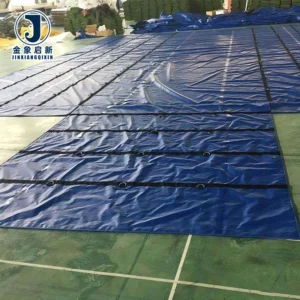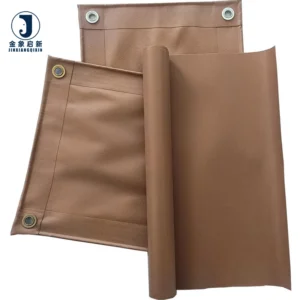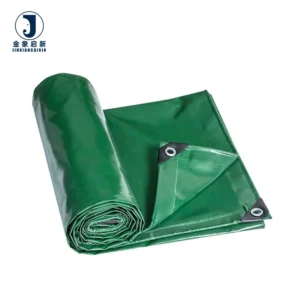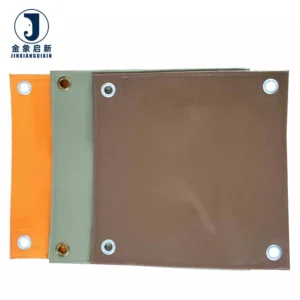
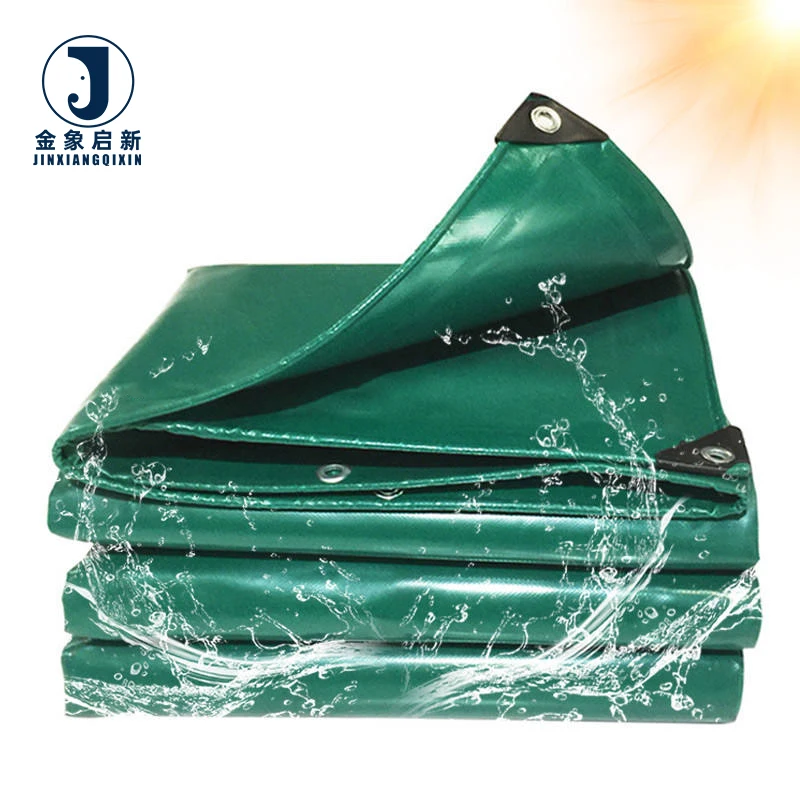
Precision Coating Control — Every roll of PVC coated tarpaulin is backed by a material specification sheet stating exact GSM, base fabric denier and measured tensile strength before it leaves the line.
Technical Specifications
| Parameter | Value |
|---|---|
| Product Type | PVC Coated Tarpaulin Roll |
| Weight Range | 350gsm, 400gsm, 420gsm, 500gsm, 600gsm, 650gsm, 750gsm, 900gsm |
| Base Fabric Denier | 500D×840D (350/400/420), 500D×1000D (500), 1000D×1000D (600), 1000D×1300D (650), 1300D×1300D (750), 1000D×2000D (900) |
| Mesh Count | 30×19 (350/400/420/500), 20×20 (600/650/750), 30×15 (900) |
| Total Thickness | 0.29mm (400), 0.32mm (420), 0.38mm (500), 0.44mm (600), 0.46mm (650), 0.55mm (750), 0.65mm (900) |
| Tensile Strength (Warp) | 1650N (350), 1800N (400), 1850N (420), 2050N (500), 2500N (600), 2550N (650), 2750N (750), 3900N (900) ¹ |
| Tensile Strength (Weft) | 1600N (350), 1700N (400), 1750N (420), 1900N (500), 2200N (600), 2250N (650), 2850N (750), 3500N (900) ¹ |
| Coating Method | High frequency hot melt, Hot air welding, Sewing |
| Flame Retardant | Available in flame retardant grades — confirm the grade required for your market |
| UV Treatment | Anti UV (test basis available on request) |
| Temperature Envelope | Brittle ≤ -50~-60°C, Softening ≥ 80°C, Melting 212°C |
| Key Features | Waterproof, Anti-Mildew, Printable, Custom Colour |
¹ Test standard not stated in source — request method documentation for your QA protocol.
Application Suitability
| Application | Exposure & Requirement |
|---|---|
| Truck Side Curtains | Constant flexing, road debris abrasion, UV exposure, tie-down point stress |
| Trailer Top Roofs | Standing water, wind load tension, thermal cycling, weld integrity |
| Outdoor Event Tents (Block-Out) | UV saturation, flame retardant compliance for public assembly, wind shear |
| Awnings & Terrace Pergolas | Direct sunlight, water pooling, mildew in humid climates |
| Inflatable Structures | Air pressure tension, repeated folding, seam adhesion under cyclic load |
| Pond & Reservoir Liners | Permanent water contact, soil chemistry, puncture risk from substrate |
Why the Quoted PVC Coated Tarpaulin GSM Specification Often Fails the Buyer
A GSM figure without a corresponding base fabric denier and tensile test is marketing, not engineering data.
Buyers who source PVC coated tarpaulin on weight alone repeatedly face the same outcome: the roll arrives, it is weighed, and the result falls below the quoted number. When a dispute is raised, the supplier argues that GSM is a nominal value and that a tolerance band applies. Without a specification sheet that maps each grade to its base yarn, mesh count and measured strength, the buyer has no basis to reject the shipment. [NEED_CITE: coated fabric weight verification methods per ISO 3801]
How Base Fabric Denier Defines the Ceiling of Performance
The PVC coated fabric base fabric denier is the structural skeleton of the material. A 350gsm grade built on 500D×840D yarn will behave fundamentally differently under tension than a 600gsm grade woven from 1000D×1000D yarn, regardless of how much coating is applied on top. Coating adds weight and weather protection, but it does not create tensile strength — the base yarn carries the load. Understanding this relationship prevents the mistake of specifying a lighter grade for an application that demands higher structural performance.
Coating Weight, Mesh Count and the Adhesion Balance
The PVC coating compound fills the gaps in the base weave and encapsulates the yarn. A tighter mesh like 30×19 provides a smoother surface but leaves less room for coating penetration, which can reduce interlayer adhesion under peel stress. A more open weave like 20×20 allows deeper coating encapsulation and stronger bond strength, which matters when the fabric is heat-welded at seams. Selecting a PVC coated tarpaulin GSM specification therefore requires reading the mesh count alongside the weight — not treating GSM as a standalone figure. [NEED_CITE: coating adhesion and peel strength test methods for technical textiles]
Reading the Numbers: What Each Specification Actually Controls
Thickness alone tells you very little about how a grade will perform in service. A 0.44mm fabric at 600gsm with 1000D×1000D base yarn delivers 2500N warp tensile strength, while a 0.46mm fabric at 650gsm with 1000D×1300D yarn reaches 2550N warp — a marginal gain in strength despite higher weight, because the weft yarn is heavier but the warp yarn is unchanged. For applications where biaxial loading is significant, such as tensioned membrane roofs or inflatable structures, both warp and weft figures must be evaluated together. The brittle temperature of ≤ -50~-60°C and softening point of ≥ 80°C define the thermal operating envelope, beyond which the PVC compound either cracks on folding or loses dimensional stability.
The Cost of Specifying on Weight Without Verification
When rolls arrive lighter than quoted, the consequences go beyond the material shortfall. A truck side curtain fabricated from an underweight grade will flex and abrade at the tie-down points sooner than expected, generating warranty claims against the fabricator rather than the fabric supplier. A tent manufacturer who cuts panels from rolls that vary in GSM across the batch will see inconsistent seam behaviour during welding — some panels fuse cleanly, others delaminate under the same heat setting. Colour shifts between rolls in the same shipment compound the problem when panels are installed side by side. [NEED_CITE: seam failure in coated fabrics at flex and load points]
Why Material-Level Sourcing Changes the Outcome
Deep process control over coating weight and adhesion means each roll of PVC coated fabric carries a specification sheet that states the exact GSM, base fabric denier, coating type and colour reference — not a generic product brochure. Three full production lines equipped with dedicated coating stations deliver batch-to-batch consistency across the 350gsm to 900gsm range. A ten-person R&D team handles custom colour matching, pattern printing and sample development, with sample rolls produced within days rather than weeks. Every order undergoes 100% pre-shipment inspection, with recorded roll-to-roll checks before packing. ISO and CE certified processes underpin the production workflow, and documentation travels with the shipment.
Documentation & Verification
- Material specification sheet per roll listing PVC coated tarpaulin GSM, base denier, mesh count and colour reference
- UV and flame-retardant test reports supplied for applicable grades upon request
- Pre-shipment inspection record confirming weight and visual consistency across the batch
- Roll packing list detailing quantity, dimensions and net weight per roll for receiving checks
- Certificate of origin included with every dispatch to support customs clearance
Fabrication, Handling & Storage
- High frequency hot melt and hot air welding both suitable — adjust dwell time to the specific thickness from 0.29mm to 0.65mm
- Reinforce eyelet zones and tie-down points with additional fabric patches to distribute load beyond the 3cm aluminum buttonhole
- Store rolls upright on pallets to prevent permanent creasing through the PVC coating layer
- Allow rolls to acclimatise above 10°C before unrolling in cold weather to avoid brittle cracking below -50°C
- Use mild detergent only for cleaning — solvent-based agents may degrade the plasticiser in the PVC compound
- Lay patterns across the full width to minimise offcuts and reduce the number of welded seams in the finished product
What We Need to Quote Accurately
Provide the end-use application, the environmental exposure conditions and any fire safety or regulatory requirements for your destination market. Specify the base fabric denier and PVC coated tarpaulin GSM you require, or share the performance criteria and we will recommend the appropriate grade. Confirm whether you need roll stock or finished cut-to-size panels, the roll width and your estimated annual volume. Colour references, printing requirements and sample requests should be stated at inquiry stage to align lead times.
Frequently Asked Questions
Q: How do I verify the GSM of PVC coated tarpaulin when rolls arrive?
A: Each roll ships with a material specification sheet stating the exact GSM, base fabric denier and coating type. Weigh a measured sample against the stated value using a calibrated scale. Request the inspection methodology with your order so your receiving team has a documented procedure to follow.
Q: Which base fabric denier should I specify for welding truck side curtains?
A: For side curtains subject to constant flexing and road abrasion, a base fabric of 1000D×1000D or higher provides the structural backbone needed for weld integrity. The coating method — hot air or high frequency — should match your fabrication equipment. Request a sample roll to validate weld parameters before committing to volume.
Q: What test documentation supports flame retardant and anti-UV claims?
A: Flame retardant and anti-UV grades are available across the range. Specify the fire classification required for your market and we will supply the corresponding test report with the shipment. Confirm the grade before ordering, as requirements differ between public assembly, transport and industrial applications.
Q: How do you ensure colour consistency when I order multiple rolls?
A: Production runs for a single order are scheduled as a continuous batch. Pre-shipment inspection includes a roll-to-roll colour comparison under controlled lighting. If your project demands panels installed side by side, state this at inquiry so we can apply tighter batch matching criteria.
Q: What is the difference between hot air welding and high frequency welding on this fabric?
A: Hot air welding melts the PVC coating surface with heated air and is suited to on-site repairs and field fabrication. High frequency welding uses electromagnetic energy to fuse the coating layers and typically delivers a stronger, more consistent seam in factory settings. Your choice depends on equipment availability and the flex demands at the seam location.