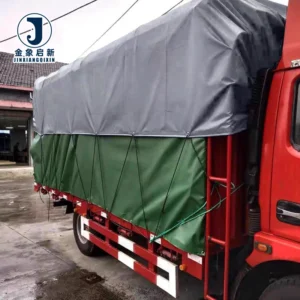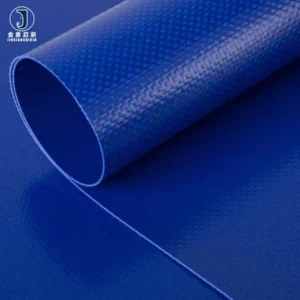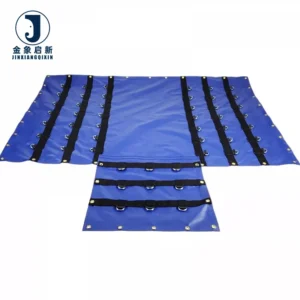
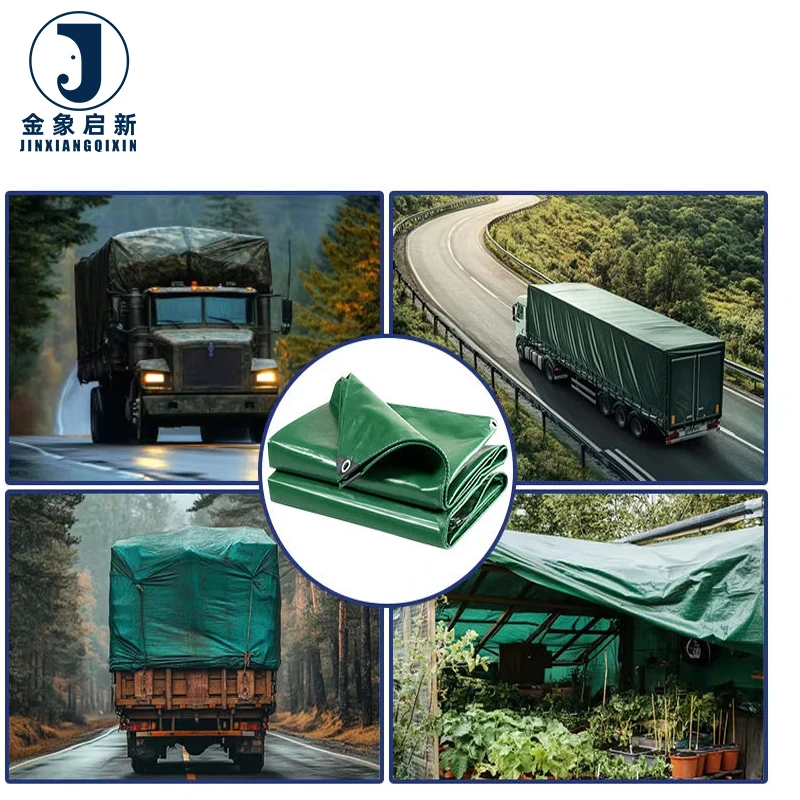
Coating Adhesion Control — deep process control over dip-coating weight and base fabric adhesion ensures consistent performance across every roll of PVC truck cover tarpaulin material shipped.
Technical Specifications
| Parameter | Value |
|---|---|
| Product Type | PVC Coated Tarpaulin |
| Material | Vinyl-coated polyester mesh fabric |
| Coating Process | 100% PES dipping coating |
| Weave Construction | Knitting and plain weave options |
| Weight (GSM) | 50 g/m² ~ 220 g/m² (select grade per application) |
| Thickness | 0.2–0.4 mm / 8 mil–16 mil |
| Roll Width | 6ft, 8ft, 10ft, 12ft / 2m, 4m, 6m |
| Roll Length | 100 yards, 100 meters, or custom |
| Edge Reinforcement | PP rope in hem, all four edges |
| Eyelets | Galvanized, spaced every 3ft or 1 meter |
| Corner Reinforcement | Reinforced plastic corners |
| Waterproof | Yes |
| UV Treatment | Available — test basis not stated, confirm requirement |
| Mildew Resistant | Yes |
| Anti-aging | Yes |
| Tear Resistant | Yes |
| Color Options | Blue, Blue/Orange, Green, Grey, Black, Clear, Grey/Green, Orange, or custom |
| Certification | ISO, CE |
Application Suitability
| Application | Exposure & Requirement |
|---|---|
| Flatbed truck load covering | Continuous UV exposure, wind uplift, road debris impact, tie-down point abrasion |
| Lumber and steel tarps | Heavy concentrated loads, sharp edge contact, repeated folding at stiff angles |
| Coil tarps | High point-load from cylindrical steel coils, lateral tension during transit |
| Side curtain fabric | Constant flex cycling, high-frequency folding, welding seam stress |
| Snow tarps | Prolonged moisture contact, sub-zero temperature embrittlement risk, salt exposure |
Why Quoted GSM Fails to Predict Real-World Tear Performance
GSM alone is a coating weight figure — tear resistance is a function of base fabric denier, weave density, and the bond between yarn and coating.
Technical buyers often receive PVC truck cover material that matches the quoted GSM on a scale yet tears prematurely under load. The reason sits below the surface. Two fabrics reading 180 g/m² can perform completely differently if one uses a denser base weave with lighter coating while the other carries heavier PVC on a loosely woven scrim. For truck and trailer covers where flex points concentrate stress, base fabric architecture matters more than total weight. [NEED_CITE: tensile and tear test methods for coated fabrics per ISO 1421]. Specifying by GSM without requesting base fabric denier and mesh count leaves a critical variable unchecked.
Coating Adhesion and the Dip Process
The 100% PES dipping coating process used for this PVC truck cover tarpaulin material fully encapsulates individual yarns rather than applying a surface film. This penetration creates a mechanical bond between coating and base fabric that resists delamination under repeated flexing — the exact failure mode seen on truck side curtains where folds cycle hundreds of times per trip.
Base Fabric Architecture and Load Behaviour
Knitting and plain weave base constructions serve different mechanical roles. Plain weave provides dimensional stability for flat covers that must hold shape under wind load, while knitted structures allow controlled stretch for applications requiring fabric to conform around irregular loads. The PVC truck cover material properties — coating technology choices made at the base fabric stage determine whether a cover drapes or bridges. [NEED_CITE: relationship between woven structure and tear propagation in coated technical textiles].
Reading GSM, Thickness and Weave Together
Weight in the 50 g/m² to 220 g/m² range combined with 0.2–0.4 mm thickness tells only part of the material story. A lighter grade at 0.2 mm may use a tight, high-denier base fabric that tears more predictably than a thicker 0.4 mm material built on a loose scrim with heavy filler coating. For transport equipment builders welding finished covers, the coating method affects how the material responds to heat at the seam — dip-coated PVC melts into the base yarn for stronger welds, whereas laminated surfaces can separate before the weld reaches full strength. Matching the PVC truck cover tarpaulin grade to the actual stress profile of the load type prevents over-specifying weight while under-specifying base fabric quality.
The Hidden Cost of Specifying Weight Without Weave Data
Material that passes incoming GSM inspection yet fails early in service almost always traces back to an underspecified base fabric. A transport fleet ordering by weight alone may receive rolls that test correctly on arrival but split at eyelet points within months because the scrim denier cannot carry the concentrated tie-down load. For fabricators welding seams, inconsistent base fabric density causes welds to grip unevenly — strong on one section, peeling on the next. [NEED_CITE: premature tarpaulin failure analysis related to base fabric specification gaps]. Colour variation between rolls compounds the problem when batch consistency documentation is absent, forcing rework on installed covers where panels sit side by side.
Why Fabricators and Fleets Source Here
Three full production lines and 36 sets of professional coating equipment give this facility the capacity to hold tight GSM and coating weight tolerances across large-volume truck cover roll orders. A dedicated 10-person R&D team handles material selection and sample development, allowing buyers to request swatches that match exact denier, coating weight and colour before committing to production. Every roll undergoes 100% pre-shipment inspection with documented records rather than spot-check sampling. Nearly 30 years of focused coated fabric production means the process parameters for PVC truck cover tarpaulin — from dip bath temperature to drying tunnel speed — are controlled from experience, not adjusted on the fly. Material specification sheets stating GSM, base fabric and coating type accompany every dispatch for incoming verification.
Documentation & Verification
- Material specification sheet confirming exact GSM, base fabric denier, and coating type per roll
- Test report for UV treatment supplied where applicable — request with quotation
- Pre-shipment inspection record documenting weight verification against quoted specification
- ISO and CE certificate copies available on file with each quotation
- Roll packing list with colour reference for batch-to-batch traceability
Fabrication, Handling & Storage
- Heat-weld dip-coated PVC at manufacturer-recommended temperature to ensure coating penetrates the seam zone rather than surface-melting
- Space galvanized eyelets at 3ft or 1m intervals as supplied; reinforce with plastic corners at high-stress points
- Store rolls horizontally on a flat surface to prevent permanent creasing in the 0.2–0.4 mm coating layer
- Allow cold-stored rolls to reach ambient temperature before unrolling to avoid cracking the vinyl coating
- Use mild detergent only for cleaning; solvents will soften the PVC surface and degrade mildew-resistant treatment
- When cutting from 2m, 4m, or 6m roll widths, nest pattern pieces to minimise waste at panel edges
What to Include in Your Enquiry
Specify the load type and exposure conditions your truck covers will face — flatbed highway transport, heavy machinery storage, or side curtain cycling. State whether you require roll stock for in-house fabrication or finished panels cut to vehicle dimensions, along with target GSM and any UV or mildew treatment requirements for your market. Provide colour references and annual volume so we can confirm batch consistency and lead time for your PVC truck cover tarpaulin specification.
Frequently Asked Questions
Q: How is GSM verified on arrival and what documentation supports the quoted weight?
A: Every shipment includes a material specification sheet stating the exact GSM, base fabric type and coating process for each roll. Our 100% pre-shipment inspection record documents weight checks against your quoted specification. You can verify incoming material against this documentation before the rolls enter your warehouse or production line.
Q: What test reports support UV and mildew-resistance claims?
A: UV treatment is available and test reports are supplied where applicable — confirm the specific test standard your market requires when enquiring. Mildew-resistant treatment is integrated into the coating formulation. Request the relevant test documentation with your quotation to ensure compliance with your local transport or storage regulations.
Q: How do welded seams perform compared to the fabric itself under load flex?
A: The 100% PES dipping coating process encapsulates yarns rather than sitting on the surface, which allows heat welding to bond through the coating into the base fabric. This produces seams that flex with the material rather than peeling away. Actual weld strength depends on the grade selected and the welding parameters used.
Q: Can colour consistency be guaranteed across multiple rolls in one order?
A: Colour reference documentation accompanies each batch. Rolls produced in the same production run maintain consistent pigment dispersion across the full order quantity. For repeat orders, we retain colour reference records to match your original specification on subsequent shipments.
Q: What coating weight options are available for different truck cover duty cycles?
A: The range spans 50 g/m² to 220 g/m² with thickness from 0.2 mm to 0.4 mm. Lighter grades suit temporary load protection while heavier grades serve long-haul fleet covers exposed to continuous weather and abrasion. Base fabric denier and weave construction should be matched to the grade for balanced performance.